

How Shape-Memory Alloys Return to Their Original Form Explainer
Shape-memory alloys can recover a trained form after substantial deformation because their crystal structure changes reversibly between solid phases. Nickel-titanium, often called Nitinol, is the best-known example, though other alloy systems exist. The useful explanation follows energy, matter, and fields while respecting material properties at each boundary. Keeping track of losses explains why practical performance falls short of an ideal limit.
At lower temperature, martensite can rearrange through the motion of internal variants, allowing deformation with less permanent dislocation damage than ordinary metal bending. The deformed object can remain in that temporary shape while cool. Geometry and composition set the available pathways, so small design changes can alter the response. Scale changes the balance among surface effects, bulk behavior, and heat flow.
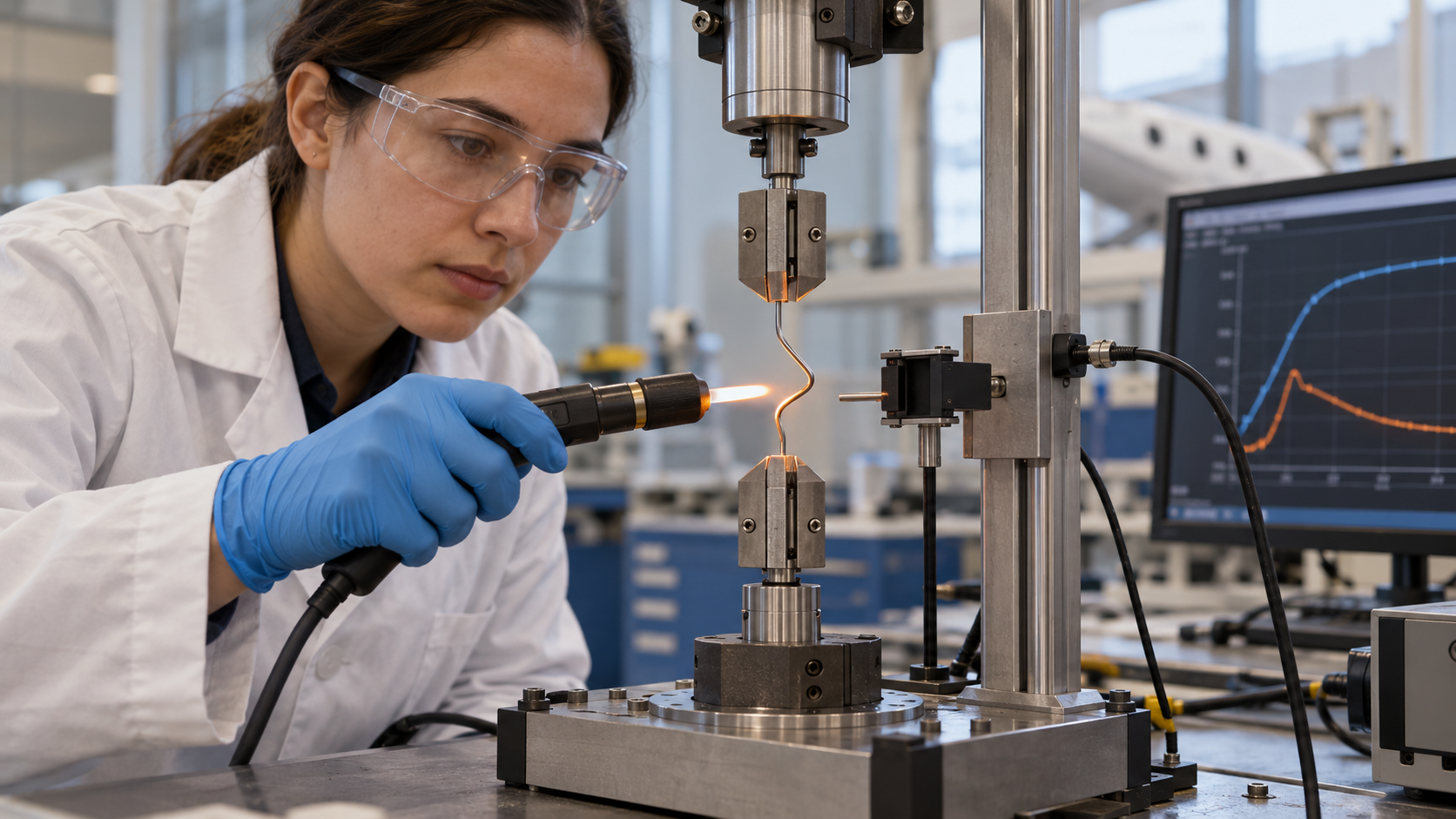
Heating above transformation temperatures converts martensite to the higher-temperature austenite arrangement. The lattice change drives the material toward the geometry established during processing and training, producing useful motion and force. The process continues only while a driving difference overcomes losses, resistance, or competing motion.
Some alloys also show superelasticity when loaded above the transformation range. Stress creates martensite, and unloading reverses the transformation so the material recovers strain without requiring a separate heating step. Real systems add interfaces and imperfections that idealized diagrams usually leave out.
Composition, heat treatment, grain structure, stress, and cycling set transformation temperatures, force, recoverable strain, and hysteresis. Repeated operation can still cause fatigue, drift, incomplete recovery, or loss of usable work. Scientists test the model by changing one condition and measuring the predicted thermal, optical, or electrical signal.
Engineers test phase changes, strain, load, and lifetime before using these materials in actuators, medical devices, couplings, aircraft components, or rover tires. Shape memory is a designed phase response, not literal storage of a geometric image. The core physics is dependable, but efficiency and scale depend on operating conditions and experimental uncertainty.
Processing establishes a preferred high-temperature geometry.
Cooling forms a deformable martensitic phase.
Applied stress rearranges martensite variants.
Heating transforms the lattice toward austenite.
The transformation recovers shape and can produce force.
Composition and cycling determine temperature range and durability.
Explore more "Explainers"
Discover additional explainers across politics, science, business, technology, and other fields. Each explainer breaks down a complex idea into clear, everyday language—helping you better understand how major concepts, systems, and debates shape the world around us.