

Diegetic and Nondiegetic Sound Explainer
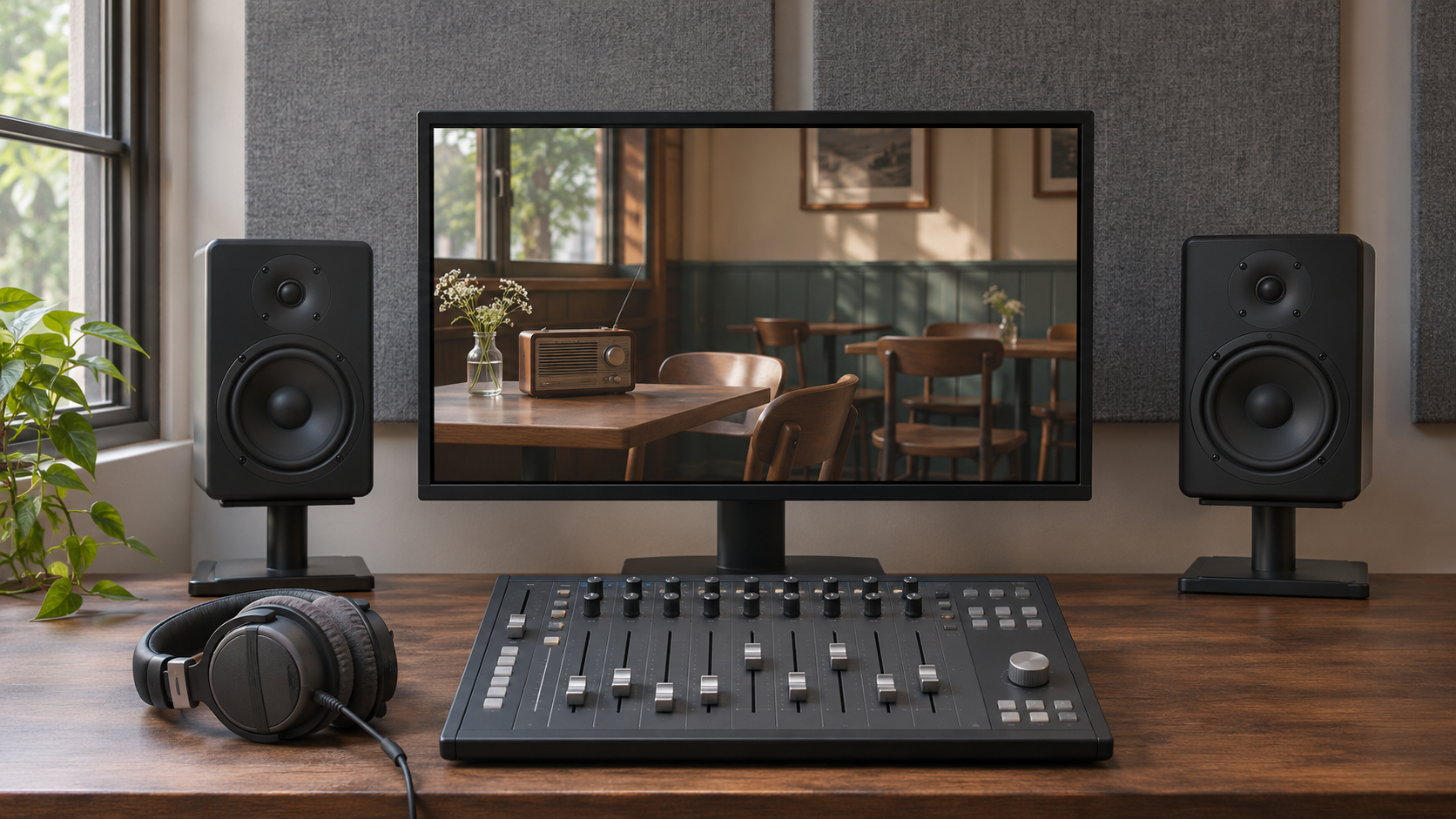
Diegetic sound is audio presented as belonging to a film’s story world. Characters talking, a door closing, traffic outside an apartment, and music playing from a radio can all be diegetic. Nondiegetic sound comes from outside that world: an orchestral score may guide the audience’s feelings even though no orchestra exists in the scene. The distinction concerns the source a film asks us to imagine, rather than whether a sound is realistic, musical, loud, or recorded during filming. A familiar song can belong to either category. It is diegetic when a character plays it through a speaker and nondiegetic when it accompanies the scene without a source in the story. Recognizing the difference helps explain how a soundtrack supplies information, establishes a point of view, and shapes our response to what we see. Both categories are creative tools, and neither automatically makes a film more authentic or effective.
A source does not have to appear in the frame to belong to the story. In an illustrative scene, a character might pause after hearing footsteps in a hallway while the camera stays inside a bedroom. The footsteps remain diegetic because the film places them in the surrounding space. An unseen radio, a voice from another room, or a train approaching before it becomes visible works the same way. Onscreen and offscreen describe a source’s relationship to the frame; diegetic and nondiegetic describe its relationship to the fictional world. Confusing those two distinctions can make an ordinary offscreen noise seem like an added dramatic commentary. Filmmakers can also withhold the source deliberately. The listener may initially be unsure whether a melody belongs to the setting, a character’s private experience, or an external score. A later shot or a character’s reaction can change that interpretation.
Production method is a separate question. Footsteps performed on a Foley stage, dialogue replaced in a recording booth, and environmental effects added during editing can still represent sounds inside the story. Conversely, recording an orchestra with real instruments does not make its background score diegetic. Sound editing and mixing assemble these materials and control their timing, level, texture, and apparent distance. Those choices help a viewer understand a sound’s location, but they do not provide a mechanical classification rule. A distant voice may become muffled behind a door, while music from a radio may become quieter when a character leaves the room. These are possible clues to a physical source, not requirements every production follows. The important distinction is between how the soundtrack was made and the role the finished soundtrack assigns to each sound. One describes the production process; the other describes storytelling.
The boundary becomes more complicated when a film presents thoughts, memories, dreams, or narration. Internal diegetic sound can belong to a character’s mind even when other characters cannot hear it, so the shortcut that all diegetic sound must be audible to everyone is unreliable. Voice-over also needs interpretation: a narrator commenting from outside the action differs from a character’s thoughts presented as part of a subjective experience. Films may change a sound’s status within a sequence. For example, a song could begin as music from a visible radio, then continue over a montage after the story leaves that room. Another scene might reveal that what sounded like background scoring actually comes from a performer nearby. These transitions can create surprise, humor, intimacy, or uncertainty. When analyzing a scene, identify the likely source, note what the film reveals or withholds, and explain how that changes the viewer’s understanding. The terms are most useful when they illuminate a creative choice rather than force an intentionally ambiguous moment into a rigid box.
Diegesis means the world established by a story. It includes locations and events that the audience understands to exist even when the camera does not show them.
The whole soundtrack can contain dialogue, music, and effects. Calling something part of the soundtrack does not by itself identify whether its source belongs to the story.
Look for evidence such as a visible instrument, a character operating a speaker, or a reaction to an unseen noise. Interpret the cues together rather than relying on volume alone.
Track a sound across cuts. Its source may remain in the previous room, move into the next scene, or become deliberately uncertain as the sequence develops.
A sound added after filming can still represent an event within the scene. Post-production and nondiegetic are different categories, not interchangeable descriptions.
A thought or remembered voice may be internal to one character's experience. Explain the perspective and any uncertainty before assuming that every voice-over works in the same way.
Explore more "Explainers"
Discover additional explainers across politics, science, business, technology, and other fields. Each explainer breaks down a complex idea into clear, everyday language—helping you better understand how major concepts, systems, and debates shape the world around us.