

On This Day in Tech: July 12, 1949
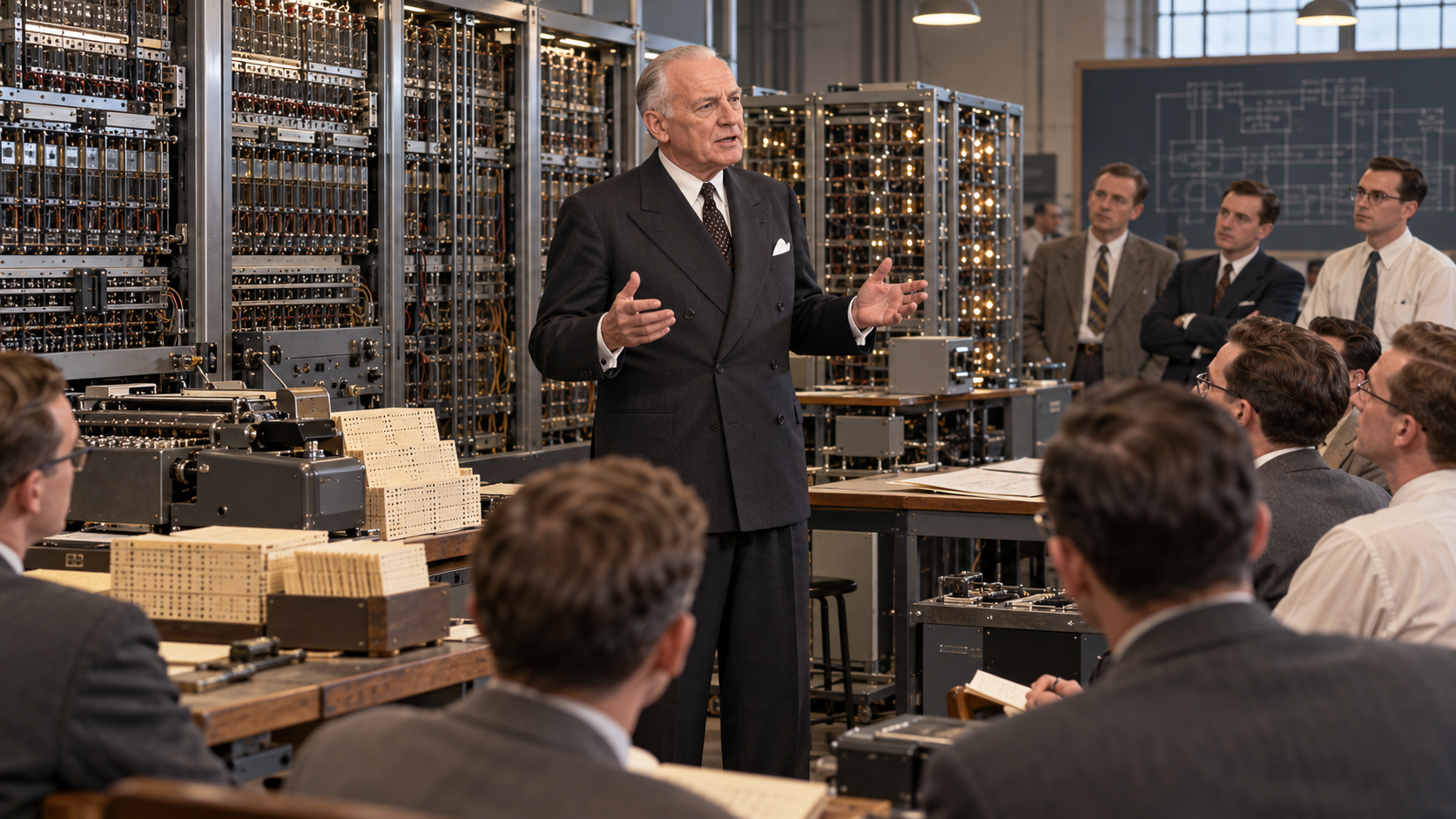
On July 12, 1949, in Endicott, New York, IBM leader Thomas J. Watson Sr. predicted that electronics would replace moving parts in computing equipment. The central participants were Thomas Watson, IBM engineers, punched-card customers, and electronics researchers. The milestone belongs to a larger shift in which computing, electronics, and communications were moving from specialized experiments toward tools used by organizations and individuals. Looking closely at the exact date separates the event itself from improvements, publicity, and consequences that followed later. It also helps distinguish documented facts from the broader history surrounding the anniversary.
The essential background was a practical limitation. IBM’s business depended heavily on electromechanical tabulators while vacuum-tube computers were proving faster. Electronic switching could perform logical and arithmetic operations without the inertia and wear of relays and mechanical counters. The work depended on available materials, manufacturing methods, software, institutional support, and people able to translate an idea into reliable operation. Those conditions explain why the result did not appear fully formed and why choices that seem modest in retrospect carried lasting importance. Cost, reliability, compatibility, training, and access all influenced whether a promising design could move beyond a laboratory, office, or limited demonstration.
On the anniversary, Watson publicly acknowledged the direction of the technology. The statement signaled that a major tabulating-machine company was preparing for electronic computing. The immediate result was meaningful, but it was not the finished form of the technology. Vacuum tubes were costly, hot, and less familiar than proven electromechanical systems. Technical progress rarely follows a single straight line: demonstrations, standards, products, and widespread adoption often occur years apart. The event nevertheless supplied evidence that others could test, improve, challenge, or build upon. Its value lay not only in the immediate outcome but also in the new decisions and experiments it made possible.
The longer legacy extended beyond the original participants and equipment. IBM soon became a dominant supplier of commercial electronic computers. Later systems often looked different, yet they inherited methods, expectations, markets, or standards established around this milestone. The story also shows that technology develops through networks of researchers, manufacturers, institutions, customers, and regulators. Success depends on ingenuity as well as maintenance, standards, financing, distribution, and willingness to adopt unfamiliar tools. Museum records, institutional histories, and contemporary technical accounts help keep that sequence grounded in evidence instead of mythology. They also show how later retellings can simplify complicated collaborative work. Remembering July 12, 1949, preserves both the achievement and its limitations while placing later successes in the correct chronology.
The setting was Endicott, New York, where Thomas Watson, IBM engineers, punched-card customers, and electronics researchers worked within the technical and institutional limits of 1949.
IBM’s business depended heavily on electromechanical tabulators while vacuum-tube computers were proving faster. That need created the conditions for the milestone.
Electronic switching could perform logical and arithmetic operations without the inertia and wear of relays and mechanical counters. On the date itself, Watson publicly acknowledged the direction of the technology.
The statement signaled that a major tabulating-machine company was preparing for electronic computing. However, Vacuum tubes were costly, hot, and less familiar than proven electromechanical systems.
IBM soon became a dominant supplier of commercial electronic computers.
The anniversary distinguishes the documented event of July 12, 1949, from developments that unfolded later.
Explore more of "On This Day ..."
Discover more events from the same date across news, politics, technology, sports, and other fields. Each link highlights significant moments that shaped history on different fronts.