

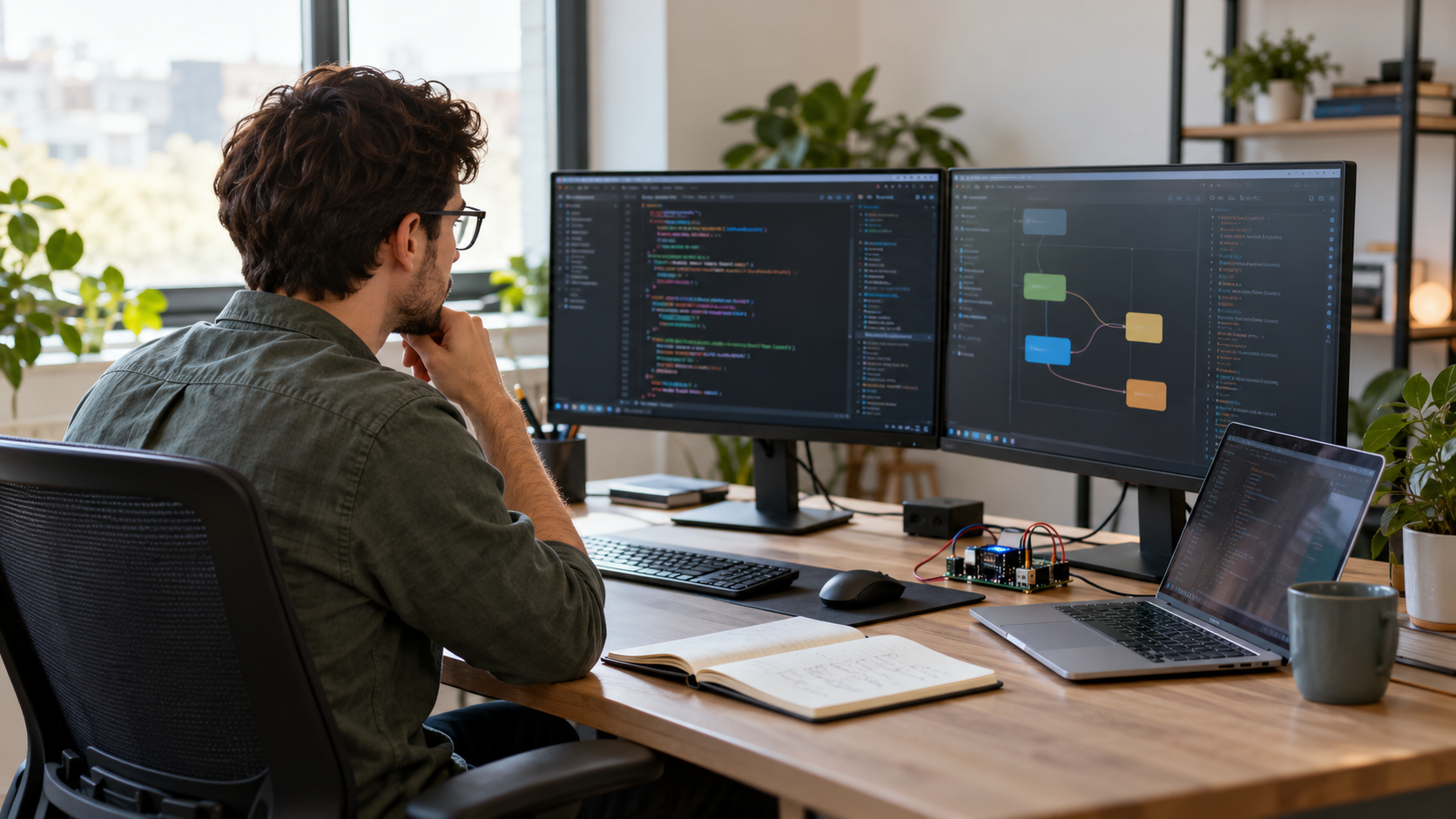
An event loop is a scheduling mechanism that repeatedly chooses runnable work, executes it, and then checks for more events. It lets one execution thread coordinate timers, user input, network completions, and rendering without dedicating a thread to every activity. The useful way to understand the concept is to separate the guarantee it provides from the products that implement it. Compatible systems may expose different controls, but they still need a clear contract about ownership, ordering, and what another component may safely assume. That contract should identify which state is authoritative, when a result becomes visible, and whether a later participant may repeat an operation without creating a second effect. Naming the boundary also prevents the mechanism from being credited with protections or performance gains it was never designed to provide.
Producers place tasks into queues. The runtime takes an eligible task, runs its callback until it returns, performs required microtask checkpoints, and then gives other work a chance to proceed. Browser and server runtimes differ in queue details, but both depend on short, nonblocking callbacks. The implementation also needs explicit rules for timeouts, cancellation, overload, and restart. Those rules determine whether interrupted work can resume, repeat safely, or must be reconciled before the next step begins. Engineers should distinguish the fast path from recovery behavior because a design that looks simple during normal operation can become ambiguous after a lost message, stalled worker, or partial write. Durable state and temporary state should be identified separately so recovery does not rely on an assumption that disappeared with a process or machine.
When a web app starts a network request, the request can progress outside the main callback. Its completion schedules new work, which runs only after the current task and higher-priority checkpoints finish. This example matters because the visible behavior usually depends on several layers cooperating. Logs, counters, traces, and diagnostic tools help operators separate expected waiting from contention, configuration mistakes, or an actual failure. A useful test observes the input, the internal state transition, and the externally visible result so the team can tell where an unexpected delay or value entered the sequence.
The model handles many waiting operations with modest thread overhead and gives the runtime a clear place to coordinate ordering. The tradeoff should be measured against a service goal rather than assumed from a feature name. Teams compare latency, throughput, error rate, capacity, and operating cost under realistic load, including peaks and partial dependency failures. Averages alone are not enough: tail latency, queue depth, retry volume, and behavior during maintenance often reveal costs that a quiet demonstration hides. Measurements should be tied to the user-visible outcome so a local optimization does not merely shift delay or failure into another layer.
A long calculation, an unbounded microtask chain, or synchronous input can monopolize the loop. The result is delayed timers, frozen interfaces, and high tail latency even when average throughput looks acceptable. Compatibility also matters during upgrades because old and new behavior may coexist. A fallback path, broad permission, missing alarm, or scarce dependency can defeat an otherwise careful design. Defense in depth treats the mechanism as one layer, not the entire reliability or security plan. Mixed versions deserve explicit testing because the least capable participant may silently determine the actual protection, ordering rule, or performance limit. Teams also need to know which safeguards fail open, which fail closed, and what each choice means during an outage.
Keep callbacks bounded, move CPU-heavy work to workers, apply backpressure to incoming events, and measure queue delay as well as request duration. Document ownership, expected behavior, failure modes, and the tested recovery route. Introduce major changes gradually, preserve a way to reverse them, and review assumptions after workload, software, hardware, or threat conditions change. Production-like tests should cover data volume, concurrency, latency, and failure—not only the happy path. Capacity plans should include bursts and dependency outages, while runbooks should name the evidence an operator needs before retrying, rolling back, or escalating an incident. Periodic access reviews, configuration history, and simple dashboards make drift easier to notice before it becomes a security incident or service interruption.
The model handles many waiting operations with modest thread overhead and gives the runtime a clear place to coordinate ordering.
A long calculation, an unbounded microtask chain, or synchronous input can monopolize the loop. The result is delayed timers, frozen interfaces, and high tail latency even when average throughput looks acceptable.
Keep callbacks bounded, move CPU-heavy work to workers, apply backpressure to incoming events, and measure queue delay as well as request duration.
Explore more "Explainers"
Discover additional explainers across politics, science, business, technology, and other fields. Each explainer breaks down a complex idea into clear, everyday language—helping you better understand how major concepts, systems, and debates shape the world around us.