

On This Day in Tech: September 30, 1968
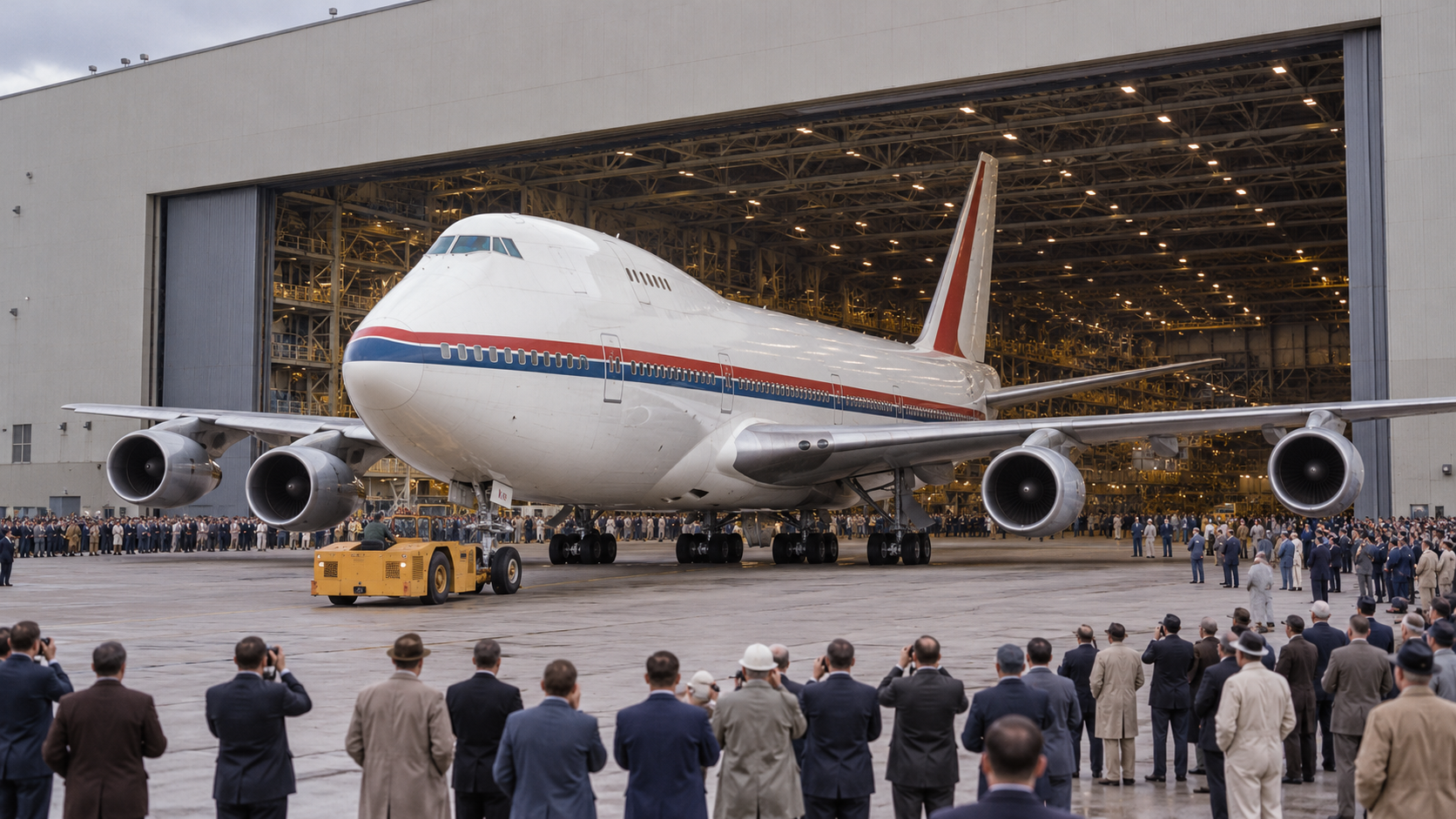
On September 30, 1968, the first Boeing 747 rolled out of its factory in Everett, Washington. The prototype’s enormous fuselage, four engines, and distinctive upper-deck hump made the scale of the project visible for the first time outside the production team. Boeing had constructed the Everett facility beginning in 1966 because no existing company building could accommodate the new wide-body jet. The rollout was not a first flight; it was a public presentation of an aircraft that still faced months of ground and flight testing. Even so, the completed airplane showed that the ambitious design had become physical hardware.
The 747 responded to rapid growth in commercial air travel and the arrival of powerful high-bypass turbofan engines. Its wide main deck could carry far more passengers than the narrow-body jets then serving long routes, while two aisles made loading and cabin movement more practical. The small upper deck created the profile that became the airplane’s signature. The design also considered freight use: placing the flight deck above the main deck left room for a large nose opening on cargo versions. That adaptability would later become crucial as passenger and freight markets changed.
Size created engineering problems throughout the program. Designers had to manage wing loads, landing gear, braking, airport compatibility, cabin evacuation, and the behavior of new engines. Manufacturing demanded new tooling and coordination among thousands of workers and suppliers. The airplane also forced airports to reconsider pavement strength, boarding gates, baggage handling, and passenger flow. After the rollout, the prototype began extensive ground tests before making its first flight on February 9, 1969. Certification followed, and the 747 entered airline service in January 1970 on a New York-to-London route. The airplane’s large capacity allowed carriers to spread operating costs across more seats, helping reshape the economics of long-distance travel.
Across later versions, the 747 served as a passenger airliner, high-volume freighter, airborne command platform, presidential transport, and carrier for the Space Shuttle. Newer twin-engine jets eventually became more economical for many passenger routes, but the 747’s upper deck and cargo capability kept specialized versions useful for decades. Its influence also extended beyond one model: airports built gates and terminals for larger aircraft, manufacturers embraced wide-body cabins, and intercontinental travel expanded in scale. The September 30 rollout marked the moment the first jumbo jet emerged from the factory and gave the public a view of how dramatically commercial aviation was about to change.
Commercial air travel was expanding rapidly in the 1960s, and new high-bypass turbofan engines made a much larger long-range jet practical. Boeing needed an entirely new factory in Everett to build it.
On September 30, 1968, the first 747 prototype emerged from the Everett hangar. The rollout displayed the completed aircraft but preceded its first flight and certification testing.
The 747 combined a wide two-aisle main deck, four engines, swept wings, and a short upper deck. Its scale required new solutions for structures, landing gear, braking, evacuation, and airport operations.
Ground and flight testing continued after the ceremony. The prototype first flew in February 1969, and the 747 entered passenger service in January 1970.
The airplane's capacity changed the economics of long-distance travel, while the raised flight deck and large fuselage supported highly capable freighter versions. Airports also adapted gates and terminals for wide-body jets.
Later 747s served as airliners, freighters, government transports, and Space Shuttle carriers. The design became a durable symbol of large-scale intercontinental aviation.
Explore more of "On This Day ..."
Discover more events from the same date across news, politics, technology, sports, and other fields. Each link highlights significant moments that shaped history on different fronts.