

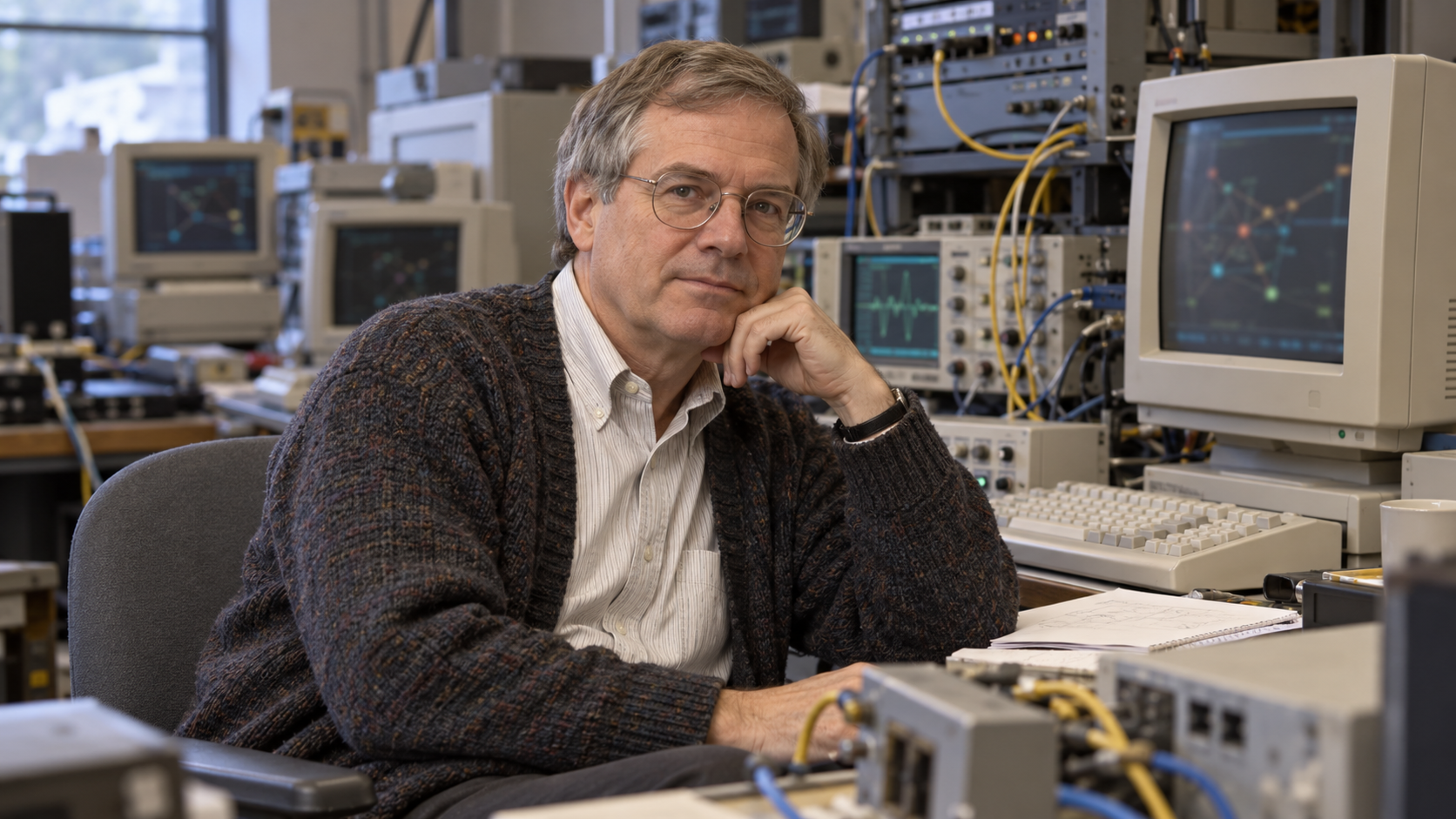
“A new packet isn’t put into the network until an old packet leaves.”
Van Jacobson’s sentence sounds almost too simple for a problem that once threatened the early internet. In 1986, data throughput between Lawrence Berkeley Laboratory and the University of California, Berkeley—sites only hundreds of yards apart—collapsed from 32 kilobits per second to about 40 bits per second. More traffic was not producing more useful communication; it was producing congestion, dropped packets, and repeated retransmissions that made the network even busier. In his landmark 1988 paper “Congestion Avoidance and Control,” Jacobson used a physical analogy to describe the needed discipline: stable packet flow should behave like a conserved system.
The quoted line gives that principle an intuitive form. When a TCP connection has a full window of data in transit, acknowledgments show that packets have successfully left the network path. Those acknowledgments can act like a clock, allowing the sender to introduce new packets at a pace the path has demonstrated it can sustain. Without that feedback, a fast sender can overwhelm a slow or crowded link with a burst of traffic. Jacobson and Michael Karels connected this insight to mechanisms including slow start, improved round-trip-time estimation, retransmission backoff, and dynamic window sizing. Together, those mechanisms taught computers to probe capacity rather than assume it.
Packet conservation did not eliminate congestion, and modern TCP has evolved far beyond one 1988 design. Its deeper contribution was to frame network stability as a feedback problem. A sender must pay attention to evidence from the path, reduce pressure when the evidence signals loss, and expand cautiously when delivery succeeds. That pattern is now familiar in many systems: rate limits protect services, queues absorb short bursts, and adaptive controllers respond to changing conditions. The lesson is not that every resource must be managed exactly like a packet window. It is that a shared system cannot remain reliable if every participant behaves as though capacity were infinite.
Jacobson’s line also offers a useful counterpoint to the culture of instant scale. Networks feel invisible when they work, which makes their limits easy to ignore. But every request travels through finite links, buffers, processors, and power budgets. Good engineering respects those constraints and uses feedback to coordinate demand. The internet grew because its endpoints learned to cooperate without requiring one central traffic controller to schedule every packet. That is the enduring elegance of the quote: stability emerged not from perfect knowledge of the whole network, but from many senders following a disciplined rule about when to add more.
For a stable TCP connection with data already in flight, the sender should introduce a new packet only after an earlier packet has left the path. An acknowledgment provides evidence that this has happened.
This self-clocking behavior prevents the sender from continually adding traffic faster than the network can carry it. The result is a flow that adapts to the demonstrated capacity of the route.
The early internet experienced episodes in which heavy traffic caused throughput to fall dramatically. Lost packets triggered retransmissions, and those retransmissions added still more load to already congested links.
Jacobson’s work showed that the problem was not simply insufficient hardware. Transport implementations needed better feedback, timing, and growth rules so that endpoints would respond constructively when the network was under stress.
Slow start and congestion avoidance became foundational ideas in TCP, while later algorithms refined how senders measure and react to network conditions. Modern implementations differ, but they still depend on feedback and controlled adaptation.
The broader lesson applies to any shared technical resource. Systems remain dependable when participants observe real capacity, limit bursts, and respond to overload instead of assuming that someone else will absorb the cost.
Explore more "Quotes of The Day"
Discover more notable quotes from influential voices across politics, science, business, technology, sports, and culture. Each quote offers insight into how ideas, beliefs, and decisions shape the world around us.