

On This Day in Health: July 6, 1953
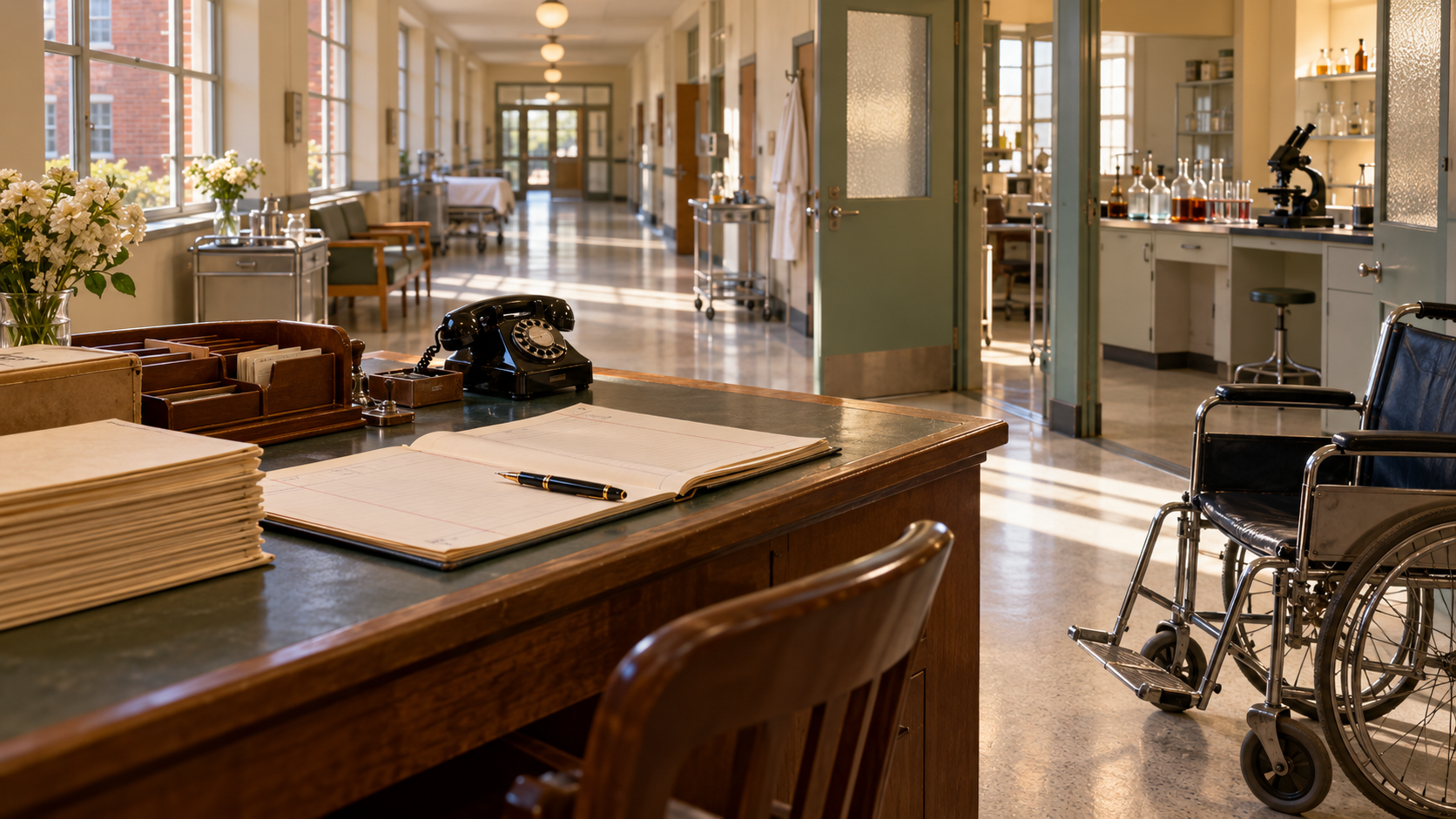
On July 6, 1953, the National Institutes of Health Clinical Center in Bethesda, Maryland, admitted its first patients. Dr. Roy Hertz admitted Charles Meredith, a Maryland farmer being treated for prostate cancer, at 9 a.m.; sixteen more inpatients and one outpatient followed that day. The hospital had been dedicated four days earlier by Health, Education, and Welfare Secretary Oveta Culp Hobby. Its opening placed patient rooms, specialized clinical services, and research laboratories inside one large federal building. The purpose was unusually direct for its era: volunteers with serious illnesses could receive intensive care while physicians and laboratory scientists studied disease together under formal research protocols.
Congress had authorized NIH to conduct clinical research through the 1944 Public Health Service Act. On July 8, 1947, lawmakers provided planning funds for a research hospital and related buildings, and President Harry Truman laid the cornerstone in 1951. Building 10 eventually rose fourteen stories on the NIH campus. Early plans called for hundreds of research beds, although units opened gradually as staff and programs became ready. The first group included people with cancer, heart disease, hypertension, rheumatoid arthritis, and diabetes. Investigators hoped proximity would shorten the distance between observations at the bedside and experiments in the laboratory, while allowing difficult or rare conditions to be followed closely.
The model carried important responsibilities. Clinical investigation in the aftermath of abusive wartime human experiments required stronger attention to voluntary participation, independent review, and the welfare of patients. NIH established a medical board to examine protocols, and the Clinical Center developed systems for scientific and ethical review that changed over time. Admission did not promise a cure. Participants entered studies designed to answer uncertain questions, and some early treatments failed. The hospital also differed from an ordinary community facility: its beds were tied to research programs rather than general local demand. That focus made careful consent and an honest explanation of risks especially important.
Over subsequent decades, the Clinical Center supported work in cancer, infectious disease, genetics, immunology, and rare disorders. Research there contributed to the first cure of a solid tumor with chemotherapy and to early antiretroviral development, among many later advances. Those achievements were not present on opening day; they grew from sustained partnerships among participants, nurses, physicians, technicians, and laboratory teams. July 6 marks the practical beginning of a distinctive institution rather than the dedication ceremony or the passage of its authorizing law. When Charles Meredith entered Building 10, a national plan for hospital-based clinical research became an operating program centered on patients who volunteered to help answer medical questions.
The Clinical Center was designed to place hospital wards beside research laboratories. That arrangement supported continuous exchange between bedside observations and laboratory investigation.
Charles Meredith was the first patient admitted on July 6, 1953. Seventeen inpatients and one outpatient entered during the first day of operations.
Admission was connected to a research protocol, not ordinary community hospital access. Participation could offer specialized care but did not guarantee that an experimental approach would work.
Postwar concern about research ethics shaped oversight. Protocol review and voluntary participation became essential parts of conducting studies with patients.
The institution later supported major advances in cancer, infectious disease, immunology, and rare disorders. Those results accumulated through decades of research after the opening.
Its central legacy is a patient-scientist partnership. Volunteers made it possible to study disease mechanisms and treatments under closely monitored conditions.
Explore more of "On This Day ..."
Discover more events from the same date across news, politics, technology, sports, and other fields. Each link highlights significant moments that shaped history on different fronts.