

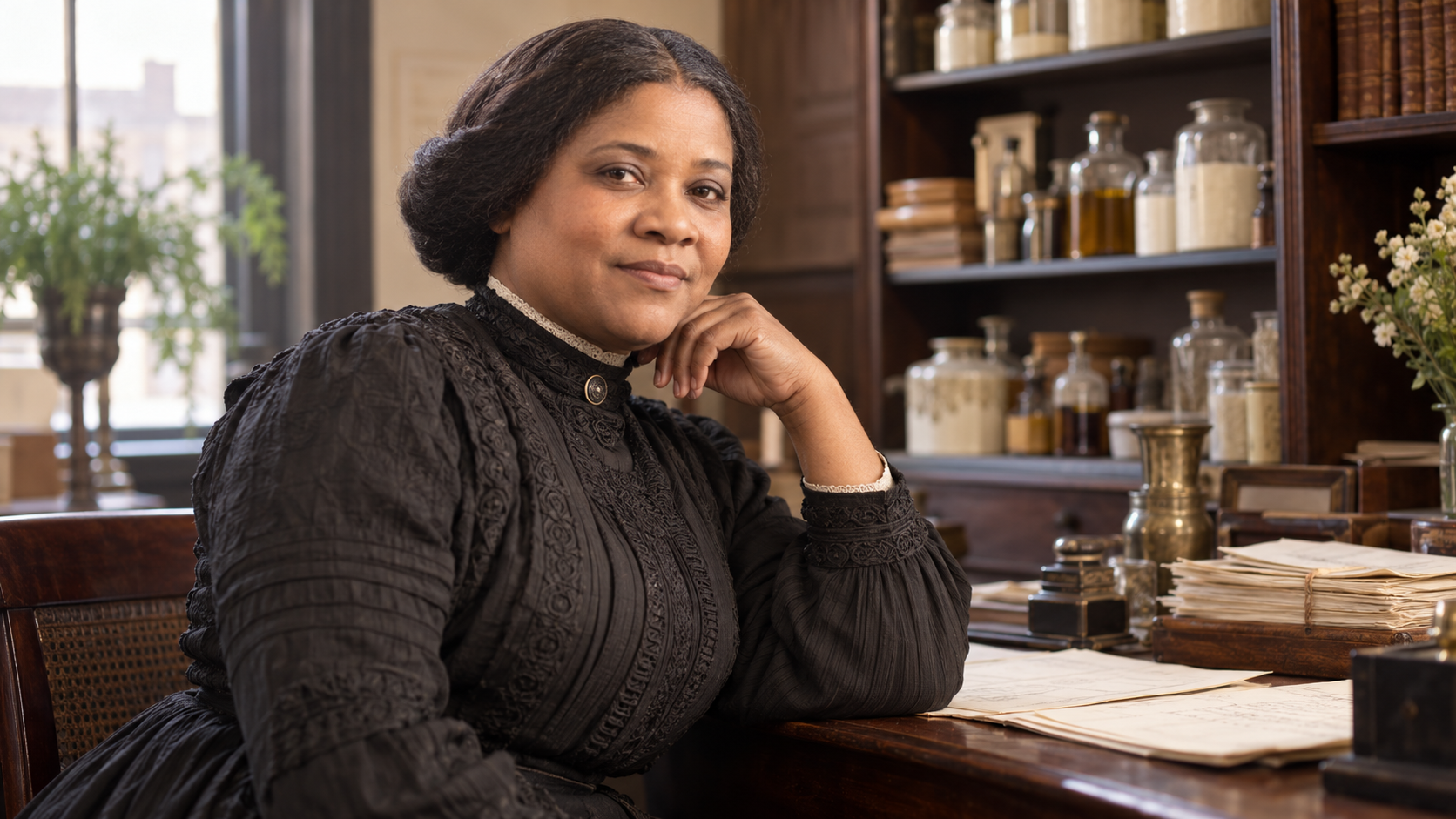
“I promoted myself into the business of manufacturing hair goods and preparations.”
Madam C. J. Walker used these words in July 1912 when she addressed the National Negro Business League in Chicago. Born Sarah Breedlove in Louisiana in 1867, she had worked as a farm laborer, laundress, and sales agent before developing and marketing products for Black women’s hair care. Her statement was neither a fairy-tale claim of effortless success nor a boast detached from experience. “Promoted myself” compressed years of selling, demonstrating, testing, organizing, and learning into a phrase that asserted her authority to build a company when conventional institutions offered Black women few paths to capital or executive leadership.
Walker recognized a market that established businesses did not adequately serve. Hair and scalp care were practical concerns, but her enterprise addressed more than a product gap. It treated Black women as customers worthy of specialized attention and as professionals capable of earning income. The Walker system combined preparations with instruction and a network of trained sales agents. That distribution model expanded the reach of the brand while giving women a way to develop commercial skills, serve their communities, and gain a measure of financial independence. Customer need and workforce opportunity were built into the same business.
The word “promoted” carries another important meaning. Walker did not wait for an employer, lender, or trade association to certify her ambition. She created evidence of competence through action: a product, a sales method, a recognizable identity, and an organization. Yet self-promotion alone was not the achievement. Her credibility depended on delivery. Customers had to find value in what she sold, agents needed useful training and incentives, and the company had to maintain quality as it grew. Her rise therefore illustrates a demanding version of entrepreneurship—one in which confidence opens the door, but systems and relationships keep the enterprise standing.
For modern founders, Walker’s sentence still speaks to markets overlooked because decision-makers do not share the customer’s experience. People close to a problem may see demand before institutions recognize it. Turning that insight into a durable business requires more than visibility: it takes patient customer education, dependable operations, and channels that let value travel. Walker also shows that growth can broaden opportunity rather than merely enlarge a balance sheet. A company’s commercial model can develop talent and agency among the people who carry it to market. Her self-promotion became powerful because it created room for others to advance as well.
Walker delivered the line at the National Negro Business League convention in Chicago in 1912. She described a journey from poorly paid labor and sales work to the manufacturing and marketing of her own hair-care products.
The speech placed her achievement within a wider argument for Black enterprise and economic opportunity. She presented herself as both proof of possibility and a businesswoman prepared to claim a place in a male-dominated forum.
“Promoted myself” expresses agency, but it should not be reduced to personal branding. Walker’s advancement rested on understanding customers, developing products, training agents, and constructing a distribution network.
Her company’s significance was also collective. It sold to an underserved market while enabling thousands of women to build skills and earn income as representatives of the Walker system.
Many valuable businesses still begin with a need that incumbents overlook. Founders with direct experience of that need can possess insight unavailable in traditional market reports.
Walker’s example also challenges leaders to ask who gains capability as a company grows. Distribution, training, and employment can become part of the value a business creates, not merely costs attached to expansion.
Explore more "Quotes of The Day"
Discover more notable quotes from influential voices across politics, science, business, technology, sports, and culture. Each quote offers insight into how ideas, beliefs, and decisions shape the world around us.