

On This Day in Health: July 24, 1969
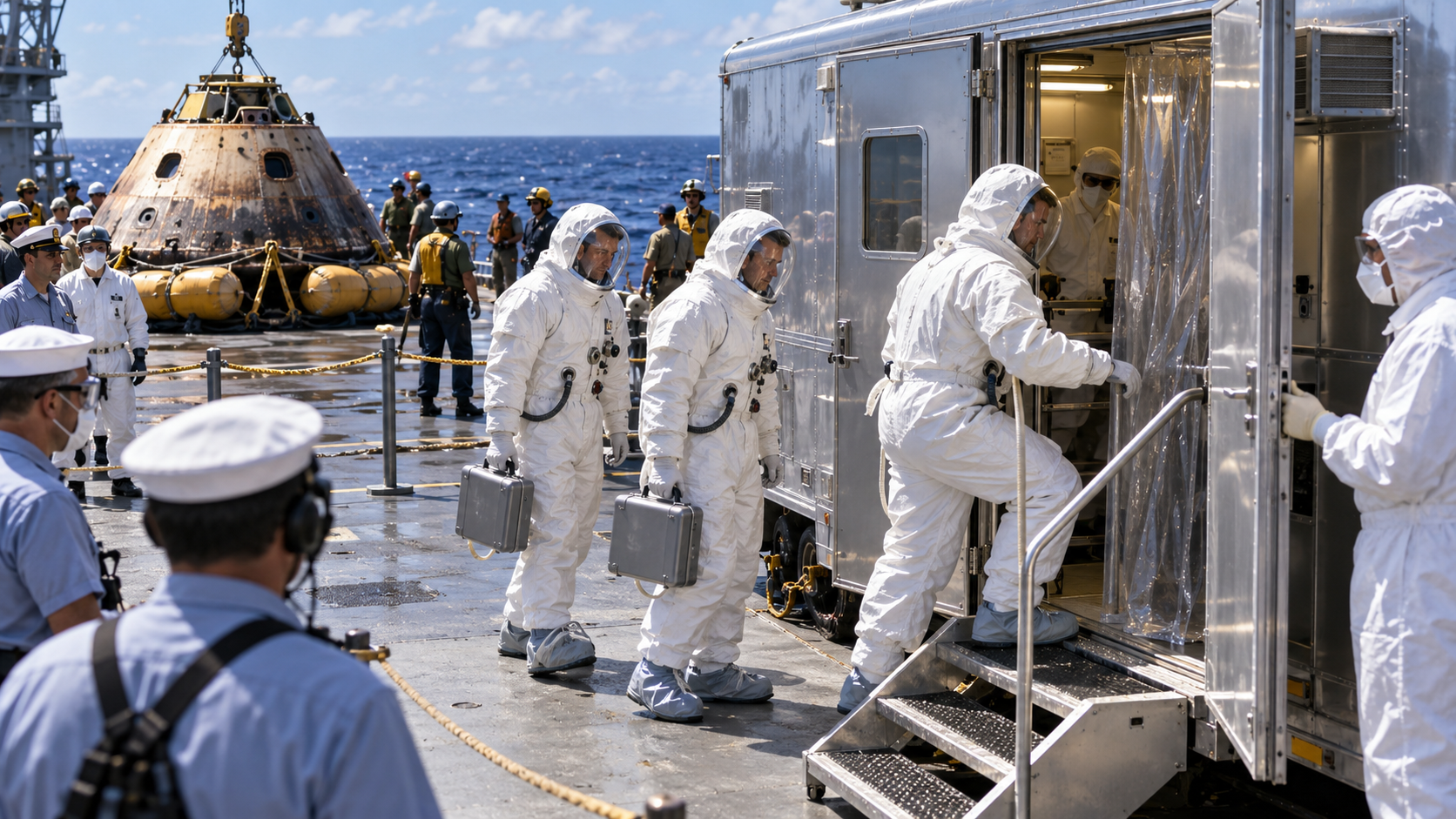
On July 24, 1969, Apollo 11 splashed down in the Pacific Ocean after the first crewed lunar landing. Recovery teams treated Neil Armstrong, Buzz Aldrin, Michael Collins, their spacecraft, and the lunar samples as possible carriers of unknown organisms. The astronauts put on biological isolation garments before leaving their life raft and entered a mobile quarantine facility aboard the USS Hornet. President Richard Nixon greeted them through a window. The precaution was designed to protect Earth from the remote possibility that life from the Moon could cause disease or disrupt the environment.
NASA's quarantine system began before splashdown. The command module was disinfected during recovery, equipment was handled under containment procedures, and the sealed mobile facility transported the crew to the Lunar Receiving Laboratory in Houston. There, scientists examined the astronauts and tested lunar rocks, soil, spacecraft material, and exposed plants and animals for biological hazards. The quarantine period was calculated as twenty-one days from the crew's first exposure to lunar material, so the astronauts were released in August after monitoring showed no evidence of lunar infection.
The procedures were imperfect. Opening the hatch at sea, handling the spacecraft in ocean water, and moving people into the mobile unit created potential pathways that would have undermined strict containment if a dangerous organism had been present. Scientists also lacked direct evidence that lunar microbes existed or that the chosen tests could detect every unfamiliar form of life. The program therefore mixed engineering, medicine, microbiology, and precaution under deep uncertainty. It protected against a hazard considered unlikely but potentially serious while allowing scientists to study material that had never been available on Earth.
No lunar organisms were found, and NASA ended astronaut quarantine after Apollo 14 as evidence accumulated that the Moon was lifeless. Modern planetary-protection programs still address contamination in both directions: spacecraft should not carry terrestrial organisms that confuse exploration, and samples from some worlds may require containment on return. July 24 is consequently a health-history date as well as a spaceflight anniversary. It shows public-health reasoning applied to a novel environment, where officials had to define a plausible hazard, build safeguards before evidence was complete, monitor outcomes, and revise the policy when repeated findings changed the risk assessment. It became an early example of planning for biological risk in advance, including medical isolation, environmental protection, laboratory testing, and transparent criteria for release when the hazard itself remained deeply uncertain.
Apollo 11 splashed down on July 24, 1969. The crew moved from the ocean recovery operation into a sealed mobile quarantine facility.
NASA feared a remote possibility that lunar material could contain organisms harmful to people or Earth's environment, even though none had been observed.
Containment was not airtight by modern standards. Hatch opening, seawater exposure, and transfers during recovery created possible breaks in the barrier.
Available tests could not prove the absence of every unfamiliar life form, so decisions relied on precaution, monitoring, and the best evidence available.
The astronauts and lunar material were examined in Houston, and the crew was released after monitoring showed no evidence of lunar infection.
NASA ended astronaut quarantine after Apollo 14, while planetary-protection policies continued for missions that could contaminate other worlds or return samples.
Explore more of "On This Day ..."
Discover more events from the same date across news, politics, technology, sports, and other fields. Each link highlights significant moments that shaped history on different fronts.