

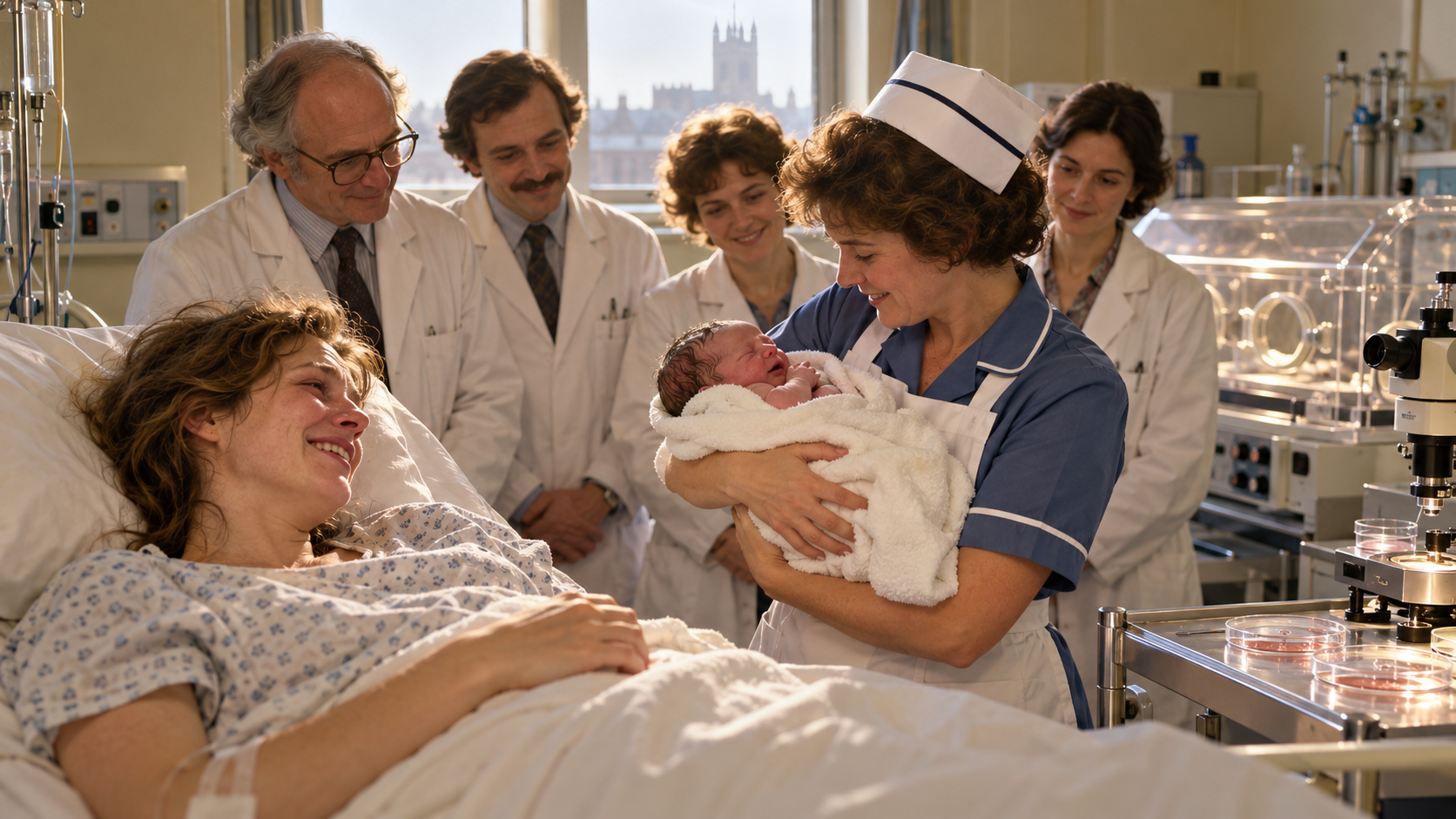
On This Day in Health: July 25, 1978
Louise Joy Brown was born by cesarean section in Oldham, England, at 11:47 p.m. on July 25, 1978. She was the first person known to be born after conception through in vitro fertilization. Her parents, Lesley and John Brown, had experienced years of infertility caused by blocked fallopian tubes. The medical and laboratory team included physiologist Robert Edwards, gynecologist Patrick Steptoe, embryologist and nurse Jean Purdy, and hospital staff. Louise's healthy birth showed that an egg fertilized outside the body could develop after transfer to the uterus and result in a live birth.
The achievement followed roughly a decade of collaboration and repeated failure. Steptoe used laparoscopy to retrieve eggs, while Edwards studied human fertilization and early embryo development. Purdy managed essential laboratory and clinical work and was the first to observe the cell divisions that led to Louise, though her contribution was often minimized in early public accounts. The successful cycle used a naturally timed ovulation rather than strong hormone stimulation. Fertilization occurred in a laboratory dish, not a test tube, and the early embryo was transferred to Lesley Brown's uterus.
One birth did not make IVF immediately safe, efficient, or widely available. Early success rates were low, treatment was physically and emotionally demanding, and public debate raised questions about embryos, family relationships, disability, commercialization, and control of reproduction. Later practice introduced ovarian stimulation, ultrasound-guided egg retrieval, embryo freezing, intracytoplasmic sperm injection, genetic testing, and stronger laboratory standards. Those developments expanded treatment but also created risks such as multiple pregnancy and ovarian hyperstimulation, prompting changes in monitoring and the number of embryos transferred.
IVF has since helped millions of people have children and has supported fertility preservation for patients facing cancer treatment and other threats to reproduction. Access remains unequal because treatment can be expensive, insurance coverage varies, clinics and laws differ, and social barriers affect single people, same-sex couples, and others seeking care. The field also requires ongoing attention to consent, long-term outcomes, donor information, embryo storage, and fair presentation of success rates. July 25 marks a live birth that changed what medicine could offer for infertility, while also beginning decades of scientific, ethical, and policy work that remain active today. The anniversary also recognizes patients whose willingness to undergo experimental procedures produced knowledge, often under intense publicity and before today's detailed oversight frameworks had fully developed. Their experiences remain central to the history of reproductive medicine worldwide.
Louise Brown was born on July 25, 1978, after an egg was fertilized outside the body and the resulting early embryo was transferred to her mother's uterus.
The achievement came from the combined clinical and laboratory work of Robert Edwards, Patrick Steptoe, Jean Purdy, hospital staff, and the participation of Lesley Brown.
The first success followed years of unsuccessful procedures and did not make IVF immediately efficient, affordable, or routine.
Later techniques improved outcomes but introduced continuing questions about multiple pregnancy, embryo storage, donor information, consent, and commercialization.
IVF transformed infertility treatment and contributed to fertility preservation, embryo research, genetic testing, and new understanding of early human development.
Millions have benefited, but cost, insurance, geography, legal restrictions, and social barriers still create unequal access to reproductive care.
Explore more of "On This Day ..."
Discover more events from the same date across news, politics, technology, sports, and other fields. Each link highlights significant moments that shaped history on different fronts.