

On This Day in Business: January 14, 1954
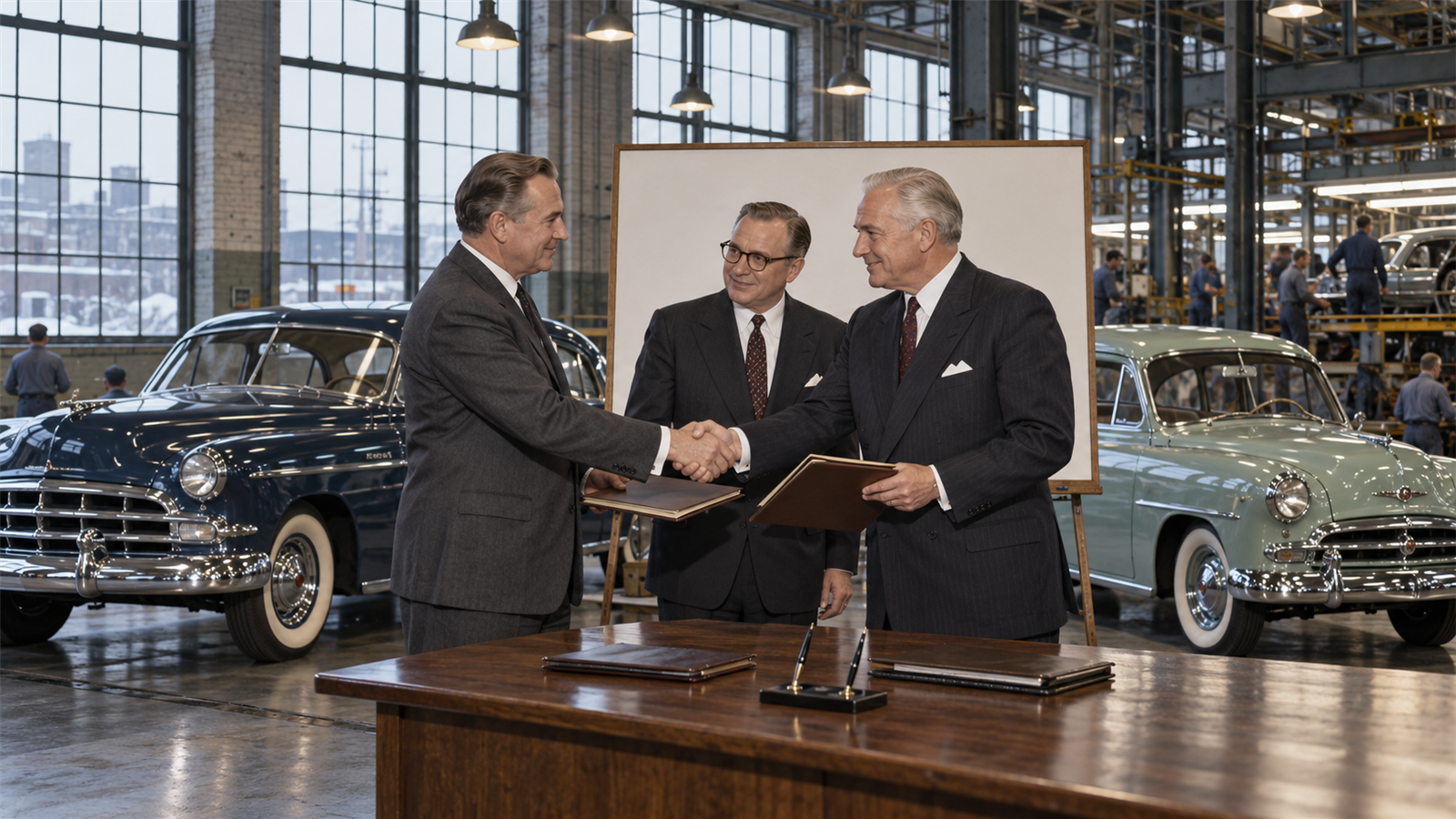
On January 14, 1954, executives from Nash-Kelvinator Corporation and Hudson Motor Car Company announced an agreement to combine their businesses under a new name: American Motors Corporation. Nash president George W. Mason, Hudson president A. E. Barit and Nash executive George Romney presented the plan as a way for two independent manufacturers to survive an industry increasingly dominated by General Motors, Ford and Chrysler. Contemporary reports placed the combined assets at roughly $355 million, making the transaction the largest corporate merger in American history at that time. Shareholders still had to approve the deal, and the legal consolidation would take effect later in the spring, but the announcement defined the new strategy.
Both companies carried valuable brands, factories and dealer networks, yet neither had the scale of the Big Three. Tooling an automobile line required enormous capital, while purchasing, advertising and distribution costs rewarded high production volumes. Hudson had won acclaim for its low-slung Step-Down cars and racing success, but sales weakened sharply after 1951 and the company reported a major 1953 loss. Nash had stronger finances and experience in compact cars and appliances through Kelvinator. Combining purchasing, engineering and administration promised savings, while keeping separate automobile identities initially reduced the disruption for dealers and customers.
The boards agreed to a stock exchange rather than a cash acquisition. Three Hudson shares would convert into two shares of the new company, while each Nash-Kelvinator share would become one American Motors share. The companies reported combined 1953 sales of about $680 million and production that included automobiles as well as hundreds of thousands of appliances. Shareholders approved the plan in March, and the merger became effective May 1. Mason became president and chairman, with Romney in a senior role. After Mason died in October, Romney took the top job and pushed a more focused strategy centered on smaller, economical cars.
American Motors never matched the Big Three in total scale, but it demonstrated that an independent automaker could compete by choosing different products instead of imitating every segment. The Rambler became central to a so-called dinosaur-fighter strategy built around compact size and fuel economy. Nash and Hudson nameplates disappeared after 1957, and AMC later produced models ranging from the Jeep line to performance cars before Chrysler acquired the company in 1987. January 14 matters because it captures the decision point before those later outcomes: two pressured manufacturers pooled capital, production and distribution to create a fourth major U.S. automaker. The deal remains a case study in consolidation as both a defensive response and an opportunity to reposition a business.
By the early 1950s, independent automakers faced high tooling costs and intense price, marketing and distribution pressure from General Motors, Ford and Chrysler.
Hudson brought respected engineering and a dealer network but weakening sales, while Nash-Kelvinator contributed stronger finances, compact-car experience and appliances.
On January 14, 1954, George Mason, A. E. Barit and George Romney announced the agreement and the planned American Motors Corporation name.
The proposal required shareholder approval and did not become legally effective until May 1, so the January date marks the public agreement rather than final closing.
Combining purchasing, engineering and administration promised scale, but the company still had to rationalize factories, dealers and overlapping vehicle brands.
AMC later emphasized compact Ramblers and acquired Jeep, showing how a smaller manufacturer could compete through focus even without Big Three production volume.
Explore more of "On This Day ..."
Discover more events from the same date across news, politics, technology, sports, and other fields. Each link highlights significant moments that shaped history on different fronts.