

On This Day in Tech: December 13, 1962
On December 13, 1962, NASA launched Relay 1 from Cape Canaveral, Florida, aboard a Thor-Delta rocket. Built by RCA, the experimental satellite was designed to receive communications signals from one ground station and transmit them toward another, testing links across large distances on Earth. It also carried experiments examining the space radiation environment and its effects on electronic components. The launch placed an important test platform in orbit, but it did not immediately establish a continuous global television service. A power problem affected the spacecraft at first, and its useful communications experiments developed after operators brought a backup transponder into service.
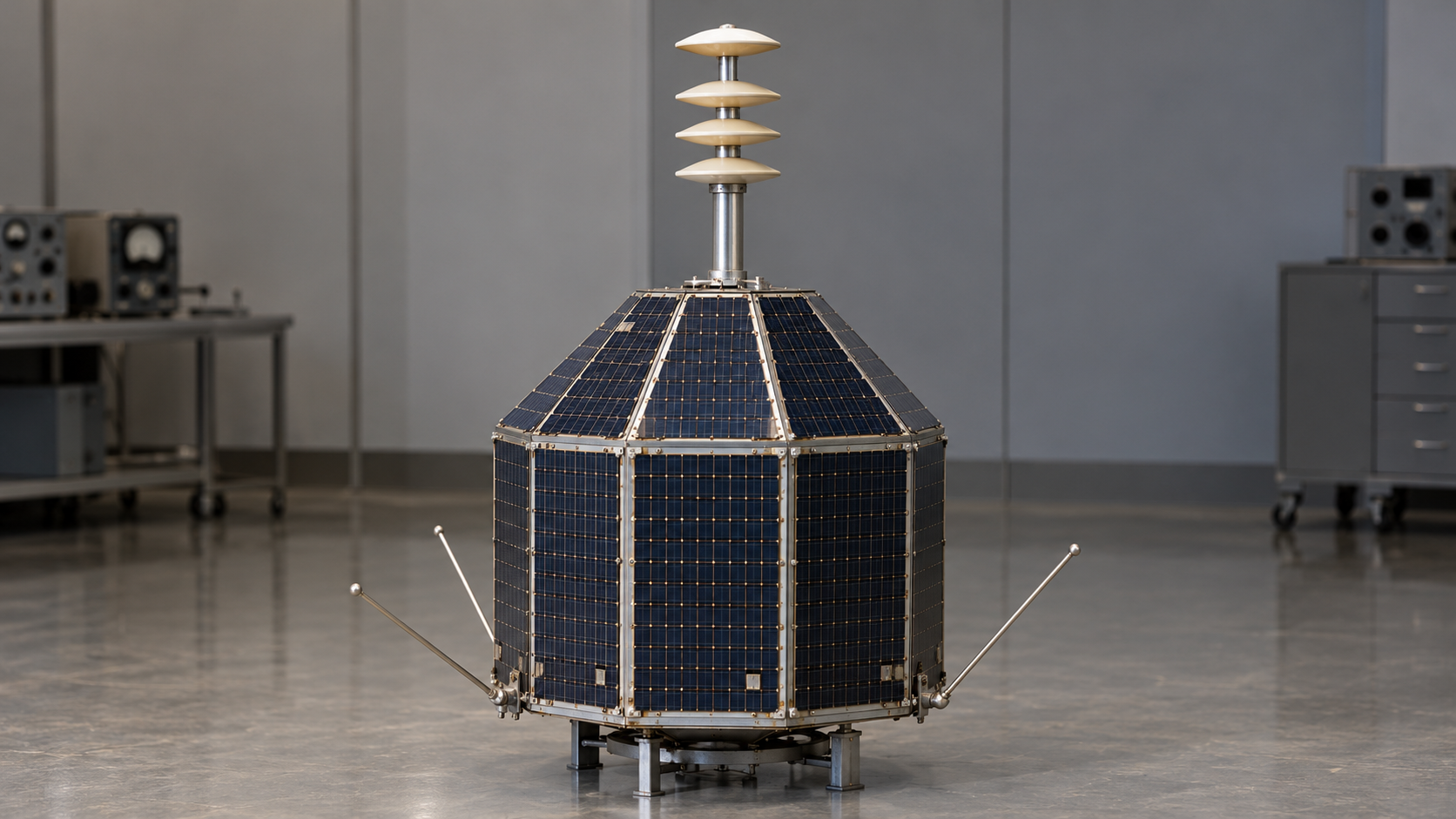
Relay belonged to a period of competing approaches to satellite communications. Some earlier experiments used a large passive object to reflect radio waves, while an active satellite carried equipment that received and retransmitted a signal. Relay took the active approach, combining a radio repeater, solar cells, storage batteries, command equipment, and tracking systems. Its many-sided body narrowed toward an antenna mast, and spin stabilization helped maintain the required orientation. The orbit was elliptical rather than the near-equatorial, day-long orbit associated with later geostationary communications systems. Ground stations had to track the moving spacecraft and use the periods when the geometry permitted a link.
An abnormal drain on the batteries initially limited operations. Engineers traced the difficulty to a voltage-regulation problem associated with one transponder, and an alternate transponder enabled the test program to proceed in January 1963. This distinction matters: successful launch and successful communications service were related but separate achievements. Experiments subsequently connected stations in North America, Europe, and South America, while radiation measurements tested the durability of components in orbit. The ground network was as important as the spacecraft. Large antennas, sensitive receivers, timing, coordination, and clear operating arrangements were necessary to turn a moving satellite into a useful communications path.
Relay 1 later contributed to international television demonstrations, including a transpacific link in 1963. Other experimental spacecraft, including Telstar and Syncom, helped establish different parts of the technical foundation for commercial systems. Relay should therefore not be credited with inventing every form of satellite communications or with providing uninterrupted worldwide coverage on its launch day. Its value was the practical experience gained from operating an active repeater, coordinating distant stations, and measuring how space affected its electronics. December 13 marks a step toward the integration of spacecraft and terrestrial networks, showing that reliable communication requires more than a transmitter in the sky: it requires a complete system that can be controlled, powered, tracked, and tested.
An active repeater receives and retransmits a signal, rather than merely reflecting an incoming radio wave. That distinction shaped the spacecraft's power and electronics requirements.
RCA built Relay under NASA's experimental communications program. The effort ran alongside other designs, so its history belongs within a wider search for workable satellite systems.
Relay's early battery drain was traced to equipment associated with one transponder. The alternate unit allowed the program to continue rather than ending with the initial fault.
The spacecraft moved through an elliptical orbit. It was not a fixed point above the equator, and the ground-station network had to account for changing visibility.
Measurements of radiation and component damage accompanied the communications trials. Engineers needed to learn how long electronics and solar cells would remain useful in orbit.
Later commercial networks drew on experience from several experiments. Relay's legacy lies in demonstrated operations and technical learning, not a claim to have created a complete global service alone.
Explore more of "On This Day ..."
Discover more events from the same date across news, politics, technology, sports, and other fields. Each link highlights significant moments that shaped history on different fronts.