

SSD Controller Explainer
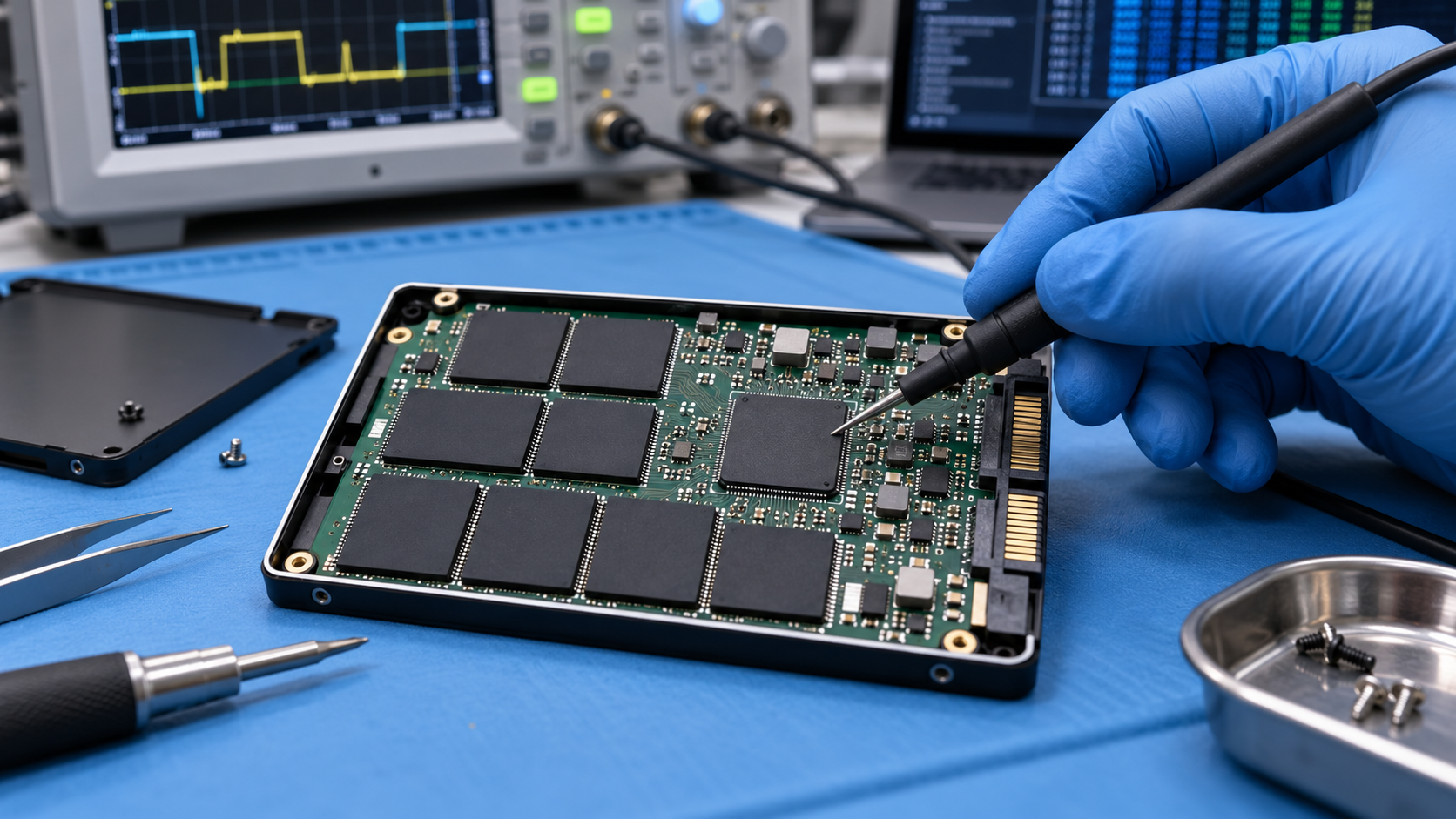
An SSD controller is the specialized processor that turns raw NAND flash into storage a computer can use like a disk. The host sends commands naming logical block addresses, but NAND is arranged as pages that can be programmed and larger blocks that must be erased before reuse. The controller maintains a flash translation layer that maps each logical address to the current physical page. When data changes, it usually writes the new version elsewhere and updates the mapping rather than overwriting the old page in place.
Out-of-place writing leaves invalid pages behind. Garbage collection selects a block containing a mixture of valid and stale data, copies the valid pages to another location, erases the entire block, and returns it to the free pool. The work may happen while the drive is idle or alongside host requests. If free space becomes scarce, the controller has fewer choices and must move more data, increasing write amplification and latency. Overprovisioned capacity provides hidden working room for this maintenance.
Wear leveling prevents a small set of blocks from reaching its program-and-erase limit while other blocks remain lightly used. Dynamic wear leveling spreads new writes across available blocks. Static techniques may also move long-lived data so rarely changed blocks do not monopolize the least-worn flash. The controller records erase counts and health information in protected metadata. It also retires blocks that fail verification or exceed error limits, replacing them with reserved capacity.
NAND reads naturally contain some bit errors, especially as cells age and store more voltage levels. The controller appends error-correcting information to each page and uses it to recover corrupted bits. It may retry a read with adjusted reference voltages, combine soft information from repeated measurements, or refresh data whose error rate is rising. A sudden loss of power can interrupt mapping or metadata updates, so enterprise drives often include capacitors and journaled structures that let the controller finish critical writes.
Performance comes from parallelism as well as raw flash speed. The controller distributes work across channels, packages, dies, planes, and queues, interleaving operations so one unit can program while another reads. A DRAM cache may hold mapping tables and pending metadata, while some designs use host memory or internal SRAM. A portion of multi-bit NAND can operate temporarily in a faster single-bit mode, absorbing bursts before data is reorganized. Sustained speed falls when caches fill or thermal limits reduce activity.
The operating system can send a discard or TRIM notice when logical blocks no longer contain useful data. That information lets the controller mark pages invalid without first reading their contents during future cleanup. TRIM does not necessarily erase the cells immediately, nor is it a guaranteed secure-deletion method. Encryption, sanitize commands, and physical media behavior affect data removal. Similarly, the drive’s reported spare area and health estimates are abstractions over many internal decisions.
An SSD controller is therefore a real-time storage manager. It maps addresses, schedules parallel operations, corrects errors, moves valid data, erases blocks, balances wear, manages heat and power, and protects its own metadata. These activities explain why two drives using similar NAND can differ greatly in speed, consistency, endurance, and failure behavior. The host sees a tidy sequence of logical blocks only because the controller continuously reorganizes an imperfect, erase-before-write medium underneath.
Explore more "Explainers"
Discover additional explainers across politics, science, business, technology, and other fields. Each explainer breaks down a complex idea into clear, everyday language—helping you better understand how major concepts, systems, and debates shape the world around us.