

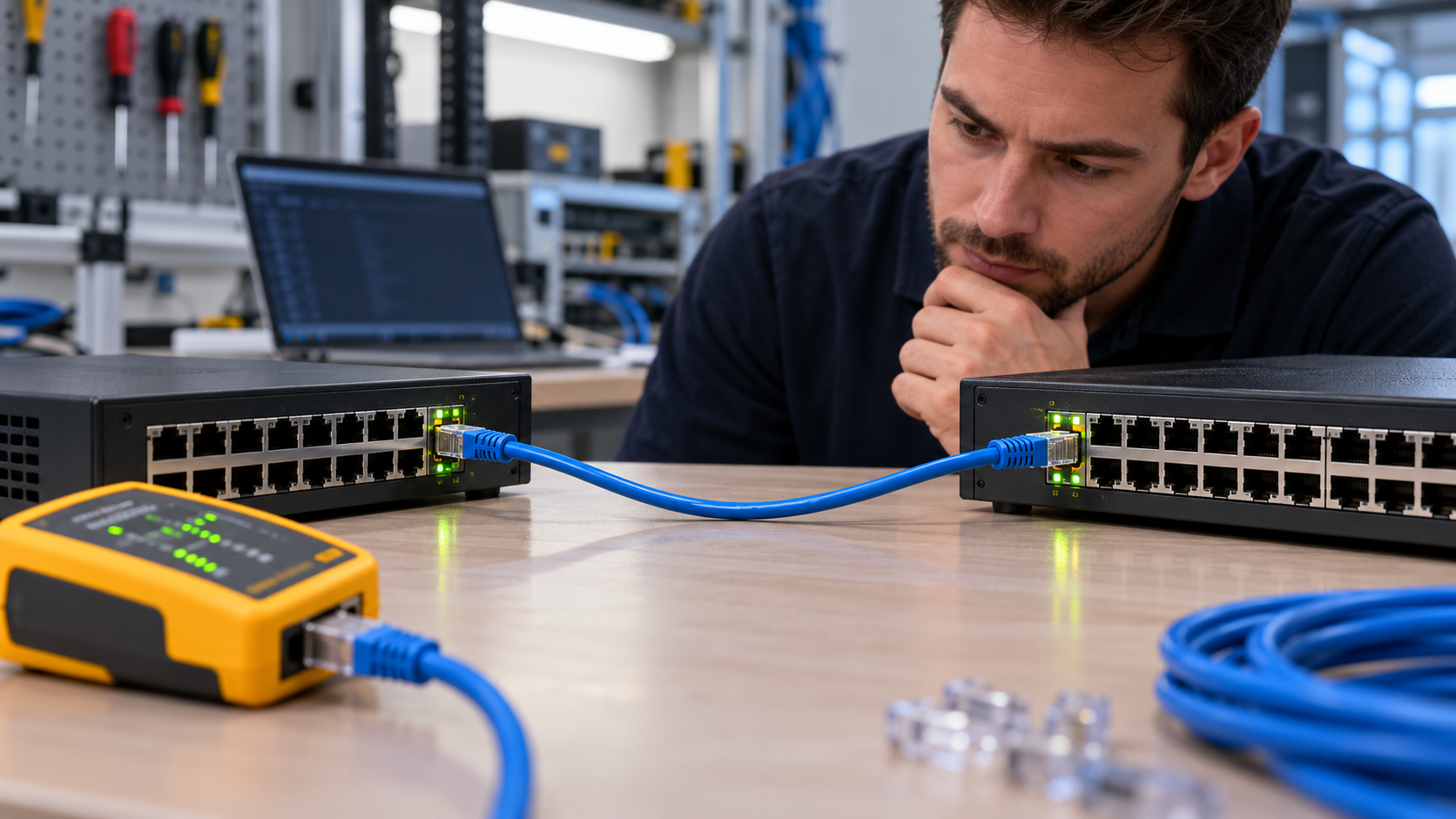
Ethernet Autonegotiation Explainer
Ethernet autonegotiation is the startup conversation that lets two connected ports choose compatible link settings. Each side advertises capabilities such as supported speeds and duplex modes. Both ports apply the same priority rules to the two advertisements and select the best common result. This avoids requiring an administrator to configure every cable end manually and helps new equipment interoperate with older standards. On familiar twisted-pair links, the exchange occurs before normal Ethernet frames can travel.
For early 10- and 100-megabit twisted-pair Ethernet, ports exchange bursts of link pulses. The timing positions inside a burst encode capability bits while remaining recognizable to older link-detection hardware. An autonegotiating port can detect some legacy devices that send only ordinary link pulses, though it cannot learn every setting from them. Gigabit and faster copper standards depend more deeply on negotiation to coordinate link parameters and often require it for correct operation.
The chosen mode is the highest-priority ability both partners advertise, not an arbitrary guess and not simply the fastest capability of one side. Full duplex allows simultaneous transmission and reception over the link design, while obsolete half-duplex operation uses collision handling and cannot send both ways at once. At higher speeds, negotiation may also coordinate which end supplies timing roles, forward error correction, or other physical-layer features. The exact pages and fields expand as standards add abilities.
A classic problem occurs when one side is forced to a speed and full-duplex mode while the other remains on autonegotiation. The automatic side may detect speed from the electrical signal but fail to learn duplex, leading it to a fallback assumption. One end then operates full duplex while the other behaves as half duplex. The link light can be on, yet performance is poor because one side reports collisions and the other reports frame errors. Configuring both sides consistently avoids the mismatch.
Modern switches may support energy-efficient behavior, pause capabilities, or multigigabit rates that add negotiation details. A completed negotiation does not prove the cable can sustain clean traffic indefinitely. Pair faults, excessive length, damaged connectors, electromagnetic noise, or poor termination can cause errors after link-up. Some physical layers retrain or drop to a lower mode, while others repeatedly cycle the link. Cable diagnostics and error counters distinguish capability agreement from signal integrity.
The process restarts when a cable is inserted, a port resets, or certain failures occur. Link establishment can take noticeable time because physical receivers must synchronize and training may follow capability exchange. Rapid spanning-tree behavior and application timeouts are separate layers. A delay before the first network packet may involve autonegotiation, physical training, switch authorization, address assignment, or all of them. Status LEDs simplify this sequence into one visible signal.
Autonegotiation’s value is deterministic compatibility. Each port announces what it can do, the intersection is ranked, and both sides independently arrive at the same choice. The protocol prevents a powerful port from imposing a mode its partner cannot use. When administrators override it, both ends must be treated as one configuration. A working Ethernet connection begins with this quiet exchange long before the first web request, file transfer, or control packet appears.
VLAN tagging marks Ethernet traffic so one physical network can carry separate logical networks. It helps switches keep groups of devices apart without needing a different cable for every group.
A compatible switch adds an identifier to a frame when traffic travels over a trunk connection. Other switches read that identifier and forward the frame only within the matching virtual network.
A wrong tag, trunk setting, or allowed-VLAN list can send traffic to the wrong place or block it entirely. VLANs organize traffic, but routing and security policies are still needed between separate networks.
Explore more "Explainers"
Discover additional explainers across politics, science, business, technology, and other fields. Each explainer breaks down a complex idea into clear, everyday language—helping you better understand how major concepts, systems, and debates shape the world around us.