

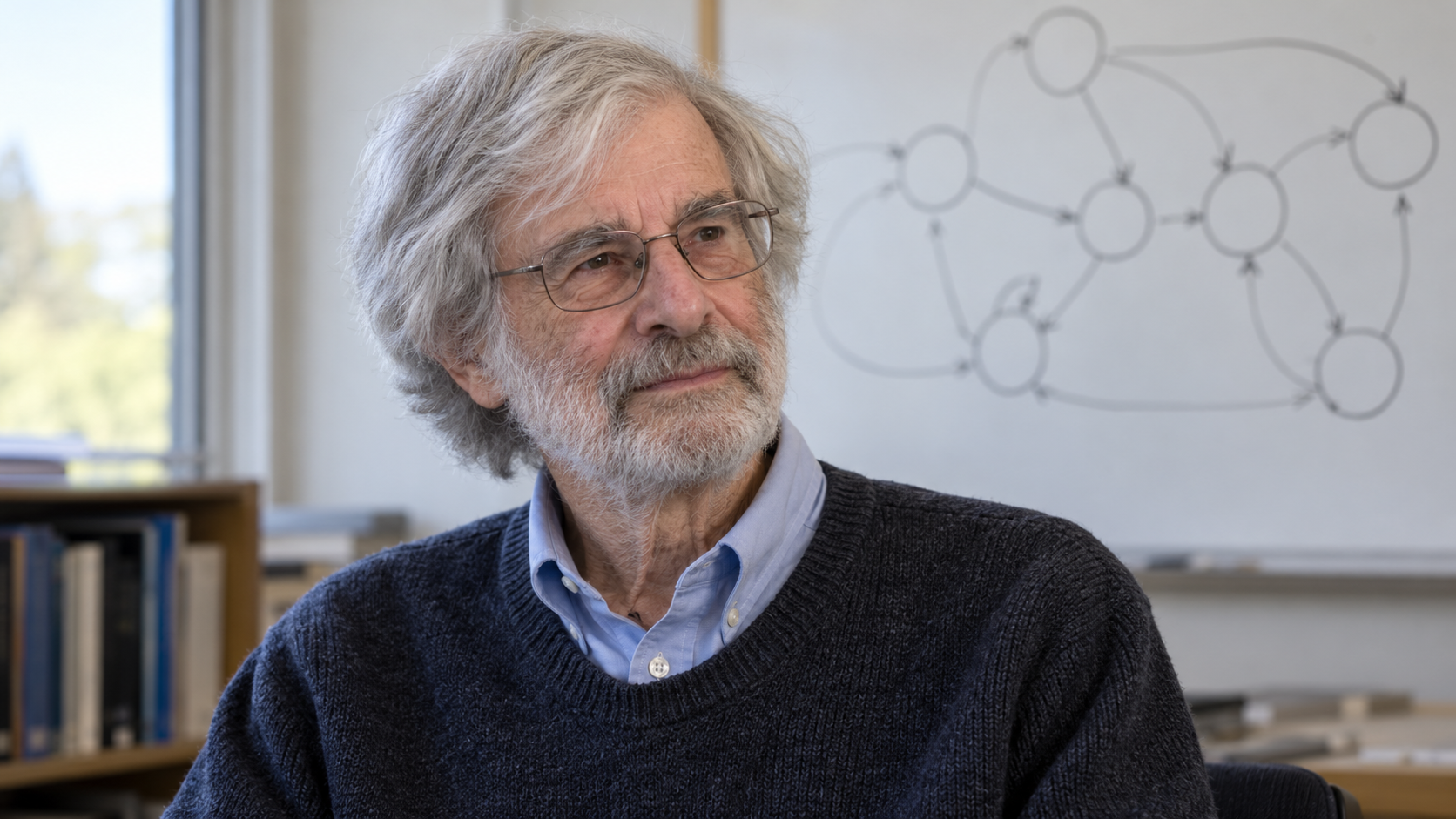
“What it’s supposed to do can be described as a state machine.”
Leslie Lamport offered this line in his ACM Turing Award interview about distributed systems. Lamport was explaining the general insight behind work that grew from distributed mutual exclusion and logical time. Instead of treating a system as a pile of implementation events, he described its permitted states and the steps that move it from one state to another. Keeping the original occasion in view protects the quote from being stretched beyond its evidence.
A state-machine description creates a precise bridge between intention and behavior. It lets designers say which transitions are legal, reason about concurrent events, and distinguish the specification from one particular implementation. The sentence becomes concrete when it is connected to interfaces, incentives, and observable results. In practice, that means asking what changed, who gained new capability, which assumption carries the most risk, and how the result would be checked by someone who did not share the builder’s expectations. It also means comparing the claimed benefit with the maintenance, access, and recovery work required to keep it real over time. The quotation earns its place by sharpening those questions instead of closing them.
A correct abstract model does not guarantee an efficient or failure-tolerant implementation. Lamport noted that early algorithms could solve a problem in principle without being the best practical solution, and real systems still require assumptions about faults and environments. The quotation remains useful only when its memorable wording does not erase evidence that points in another direction. Strong technology reporting must preserve this boundary, because the same words can support very different choices after the original constraints disappear. Readers should be able to see both the useful principle and the evidence that would require a different judgment. A responsible reading separates the speaker’s documented claim from broader promises that admirers may attach to it later.
Distributed services, workflows, and agentic software often fail because intended behavior remains informal. Lamport’s framing encourages teams to write the states, invariants, and transitions first, making races and impossible combinations visible before production traffic discovers them. That makes the quotation a tool for present decisions while respecting the limits of the original claim. Teams can make that test concrete through review, accessible documentation, independent feedback, and measures that include failures as well as successes. The same discipline should follow the system after launch, when real users reveal consequences no prototype fully predicted in advance. Those habits turn a memorable insight into work that readers, builders, and institutions can examine and improve.
Leslie Lamport offered this line in his ACM Turing Award interview about distributed systems. Lamport was explaining the general insight behind work that grew from distributed mutual exclusion and logical time. Instead of treating a system as a pile of implementation events, he described its permitted states and the steps that move it from one state to another. Keeping the original occasion in view protects the quote from being stretched beyond its evidence.
The source record connects the wording to his ACM Turing Award interview about distributed systems, which is the context used for this post.
A state-machine description creates a precise bridge between intention and behavior. It lets designers say which transitions are legal, reason about concurrent events, and distinguish the specification from one particular implementation. The sentence becomes concrete when it is connected to interfaces, incentives, and observable results. In practice, that means asking what changed, who gained new capability, which assumption carries the most risk, and how the result would be checked by someone who did not share the builder’s expectations. It also means comparing the claimed benefit with the maintenance, access, and recovery work required to keep it real over time. The quotation earns its place by sharpening those questions instead of closing them.
The interpretation focuses on a decision or design principle that readers can test against actual systems.
A correct abstract model does not guarantee an efficient or failure-tolerant implementation. Lamport noted that early algorithms could solve a problem in principle without being the best practical solution, and real systems still require assumptions about faults and environments. The quotation remains useful only when its memorable wording does not erase evidence that points in another direction. Strong technology reporting must preserve this boundary, because the same words can support very different choices after the original constraints disappear. Readers should be able to see both the useful principle and the evidence that would require a different judgment. A responsible reading separates the speaker’s documented claim from broader promises that admirers may attach to it later.
Distributed services, workflows, and agentic software often fail because intended behavior remains informal. Lamport’s framing encourages teams to write the states, invariants, and transitions first, making races and impossible combinations visible before production traffic discovers them. That makes the quotation a tool for present decisions while respecting the limits of the original claim. Teams can make that test concrete through review, accessible documentation, independent feedback, and measures that include failures as well as successes. The same discipline should follow the system after launch, when real users reveal consequences no prototype fully predicted in advance. Those habits turn a memorable insight into work that readers, builders, and institutions can examine and improve.
Explore more "Quotes of The Day"
Discover more notable quotes from influential voices across politics, science, business, technology, sports, and culture. Each quote offers insight into how ideas, beliefs, and decisions shape the world around us.