

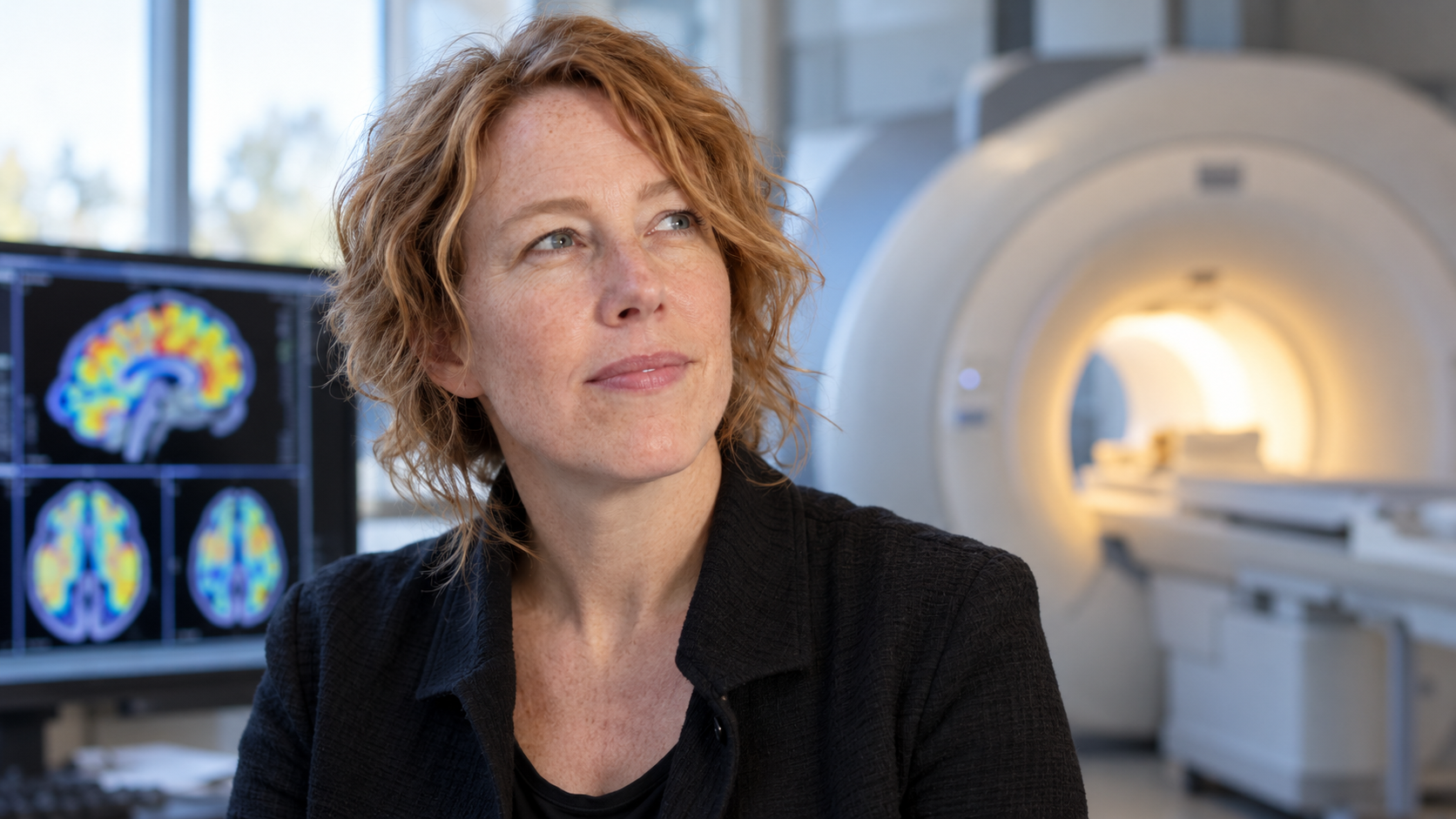
“We’re going to be able to dump our ideas directly to digital media.”
Mary Lou Jepsen offered this line in her TED2013 talk on higher-resolution brain imaging. Jepsen connected her experience as a visual thinker and brain-surgery patient with research reconstructing viewed or imagined images from neural activity. She proposed that improved scanning and computational techniques might eventually make a personal thought-to-image interface possible. That history gives the sentence more weight than a generic claim about innovation.
The sentence imagines removing the manual bottleneck between mental imagery and a screen. If perception can be measured with sufficient resolution and decoded with suitable models, communication could include representations that are difficult to draw or describe. Its practical value appears when teams use it to choose between competing designs and priorities. In practice, that means asking what changed, who gained new capability, which assumption carries the most risk, and how the result would be checked by someone who did not share the builder’s expectations. It also means comparing the claimed benefit with the maintenance, access, and recovery work required to keep it real over time. The quotation earns its place by sharpening those questions instead of closing them.
The talk presented a forward-looking research vision, not a demonstrated consumer product or literal reading of unrestricted thoughts. Individual calibration, biological complexity, consent, and limited current resolution sharply constrain what can be inferred. The strongest reading preserves both the insight and the cases in which it should not control the decision. Strong technology reporting must preserve this boundary, because the same words can support very different choices after the original constraints disappear. Readers should be able to see both the useful principle and the evidence that would require a different judgment. A responsible reading separates the speaker’s documented claim from broader promises that admirers may attach to it later.
Brain-computer interfaces are advancing, which makes privacy and control inseparable from performance. Jepsen’s vision is compelling only if people decide what is captured, understand uncertainty, and can keep intimate neural data from becoming another extractive platform. The result is a standard that can be checked in a design review, an incident report, and the lived experience of users. Teams can make that test concrete through review, accessible documentation, independent feedback, and measures that include failures as well as successes. The same discipline should follow the system after launch, when real users reveal consequences no prototype fully predicted in advance. Those habits turn a memorable insight into work that readers, builders, and institutions can examine and improve.
Mary Lou Jepsen offered this line in her TED2013 talk on higher-resolution brain imaging. Jepsen connected her experience as a visual thinker and brain-surgery patient with research reconstructing viewed or imagined images from neural activity. She proposed that improved scanning and computational techniques might eventually make a personal thought-to-image interface possible. That history gives the sentence more weight than a generic claim about innovation.
The source record connects the wording to her TED2013 talk on higher-resolution brain imaging, which is the context used for this post.
The sentence imagines removing the manual bottleneck between mental imagery and a screen. If perception can be measured with sufficient resolution and decoded with suitable models, communication could include representations that are difficult to draw or describe. Its practical value appears when teams use it to choose between competing designs and priorities. In practice, that means asking what changed, who gained new capability, which assumption carries the most risk, and how the result would be checked by someone who did not share the builder’s expectations. It also means comparing the claimed benefit with the maintenance, access, and recovery work required to keep it real over time. The quotation earns its place by sharpening those questions instead of closing them.
The interpretation focuses on a decision or design principle that readers can test against actual systems.
The talk presented a forward-looking research vision, not a demonstrated consumer product or literal reading of unrestricted thoughts. Individual calibration, biological complexity, consent, and limited current resolution sharply constrain what can be inferred. The strongest reading preserves both the insight and the cases in which it should not control the decision. Strong technology reporting must preserve this boundary, because the same words can support very different choices after the original constraints disappear. Readers should be able to see both the useful principle and the evidence that would require a different judgment. A responsible reading separates the speaker’s documented claim from broader promises that admirers may attach to it later.
Brain-computer interfaces are advancing, which makes privacy and control inseparable from performance. Jepsen’s vision is compelling only if people decide what is captured, understand uncertainty, and can keep intimate neural data from becoming another extractive platform. The result is a standard that can be checked in a design review, an incident report, and the lived experience of users. Teams can make that test concrete through review, accessible documentation, independent feedback, and measures that include failures as well as successes. The same discipline should follow the system after launch, when real users reveal consequences no prototype fully predicted in advance. Those habits turn a memorable insight into work that readers, builders, and institutions can examine and improve.
Explore more "Quotes of The Day"
Discover more notable quotes from influential voices across politics, science, business, technology, sports, and culture. Each quote offers insight into how ideas, beliefs, and decisions shape the world around us.