

“Who does science determines what science gets done.”
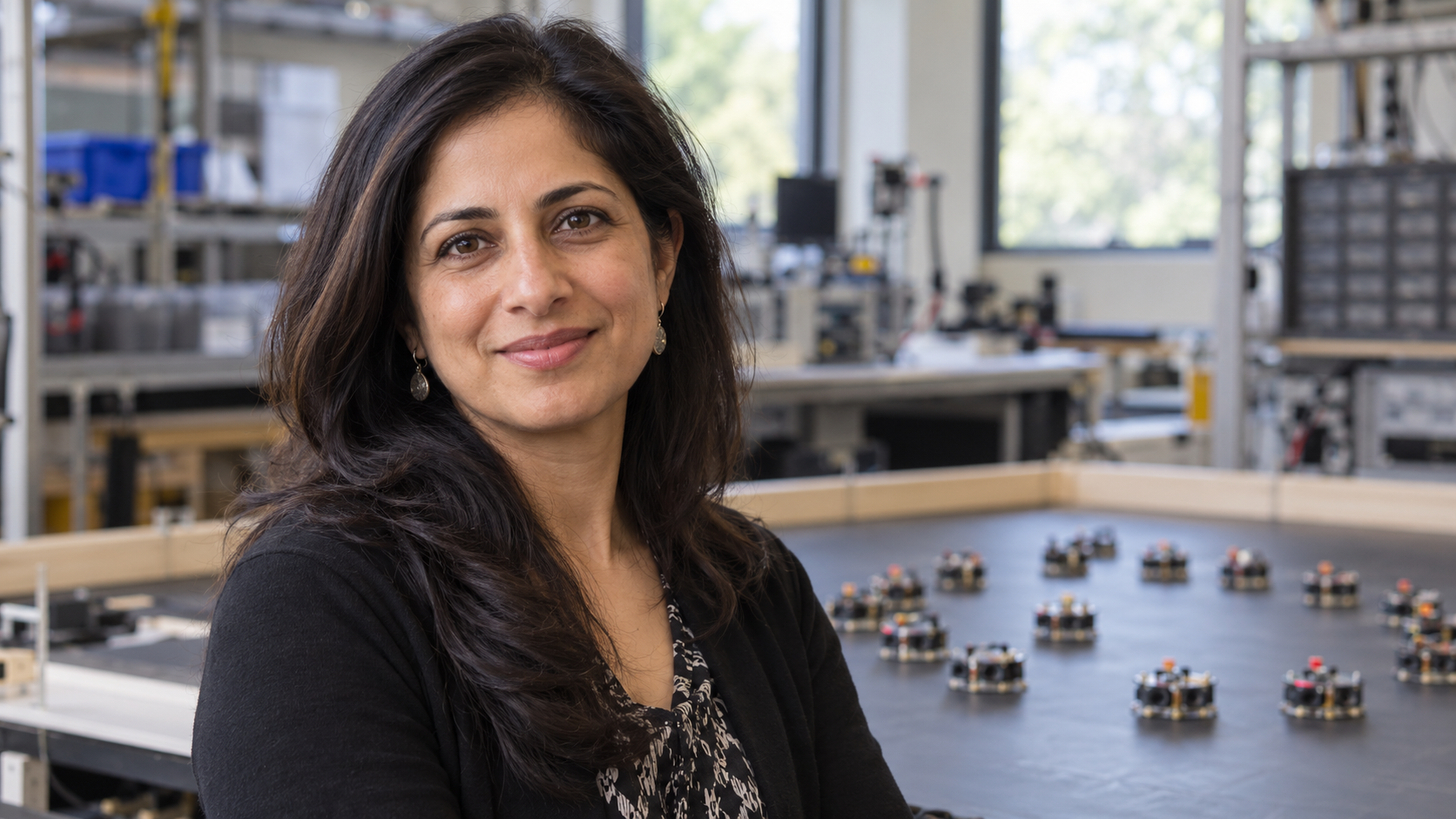
Radhika Nagpal offered this line in her TED2017 talk on collective intelligence and robot swarms. Nagpal moved from schools of fish to colonies of simple robots that coordinate through local rules without a central leader. She then widened the idea of collective intelligence to scientific communities and asked who is able to participate in setting research directions. Its force comes from consequences the speaker had already seen in working systems and institutions.
Questions are selected before experiments begin. The backgrounds, experiences, and priorities present in a field influence which problems appear urgent, which applications are imagined, and which harms are recognized early. The insight is therefore less about admiration than about where to direct engineering attention. In practice, that means asking what changed, who gained new capability, which assumption carries the most risk, and how the result would be checked by someone who did not share the builder’s expectations. It also means comparing the claimed benefit with the maintenance, access, and recovery work required to keep it real over time. The quotation earns its place by sharpening those questions instead of closing them.
Representation alone does not guarantee good science, and demographic identity does not determine one fixed viewpoint. Institutions also control funding, hiring, publication, and access to equipment. Inclusion must include actual authority and resources. Nuance matters because slogans can scale faster than the safeguards and assumptions that once surrounded them. Strong technology reporting must preserve this boundary, because the same words can support very different choices after the original constraints disappear. Readers should be able to see both the useful principle and the evidence that would require a different judgment. A responsible reading separates the speaker’s documented claim from broader promises that admirers may attach to it later.
Robotics and AI are becoming public infrastructure. Nagpal’s sentence asks labs and companies to treat participation as part of research quality, because a wider scientific collective can notice needs and failure modes that a narrow one never formulates. Its modern value lies in making accountability part of technical quality instead of an afterthought. Teams can make that test concrete through review, accessible documentation, independent feedback, and measures that include failures as well as successes. The same discipline should follow the system after launch, when real users reveal consequences no prototype fully predicted in advance. Those habits turn a memorable insight into work that readers, builders, and institutions can examine and improve.
Radhika Nagpal offered this line in her TED2017 talk on collective intelligence and robot swarms. Nagpal moved from schools of fish to colonies of simple robots that coordinate through local rules without a central leader. She then widened the idea of collective intelligence to scientific communities and asked who is able to participate in setting research directions. Its force comes from consequences the speaker had already seen in working systems and institutions.
The source record connects the wording to her TED2017 talk on collective intelligence and robot swarms, which is the context used for this post.
Questions are selected before experiments begin. The backgrounds, experiences, and priorities present in a field influence which problems appear urgent, which applications are imagined, and which harms are recognized early. The insight is therefore less about admiration than about where to direct engineering attention. In practice, that means asking what changed, who gained new capability, which assumption carries the most risk, and how the result would be checked by someone who did not share the builder’s expectations. It also means comparing the claimed benefit with the maintenance, access, and recovery work required to keep it real over time. The quotation earns its place by sharpening those questions instead of closing them.
The interpretation focuses on a decision or design principle that readers can test against actual systems.
Representation alone does not guarantee good science, and demographic identity does not determine one fixed viewpoint. Institutions also control funding, hiring, publication, and access to equipment. Inclusion must include actual authority and resources. Nuance matters because slogans can scale faster than the safeguards and assumptions that once surrounded them. Strong technology reporting must preserve this boundary, because the same words can support very different choices after the original constraints disappear. Readers should be able to see both the useful principle and the evidence that would require a different judgment. A responsible reading separates the speaker’s documented claim from broader promises that admirers may attach to it later.
Robotics and AI are becoming public infrastructure. Nagpal’s sentence asks labs and companies to treat participation as part of research quality, because a wider scientific collective can notice needs and failure modes that a narrow one never formulates. Its modern value lies in making accountability part of technical quality instead of an afterthought. Teams can make that test concrete through review, accessible documentation, independent feedback, and measures that include failures as well as successes. The same discipline should follow the system after launch, when real users reveal consequences no prototype fully predicted in advance. Those habits turn a memorable insight into work that readers, builders, and institutions can examine and improve.
Explore more "Quotes of The Day"
Discover more notable quotes from influential voices across politics, science, business, technology, sports, and culture. Each quote offers insight into how ideas, beliefs, and decisions shape the world around us.