

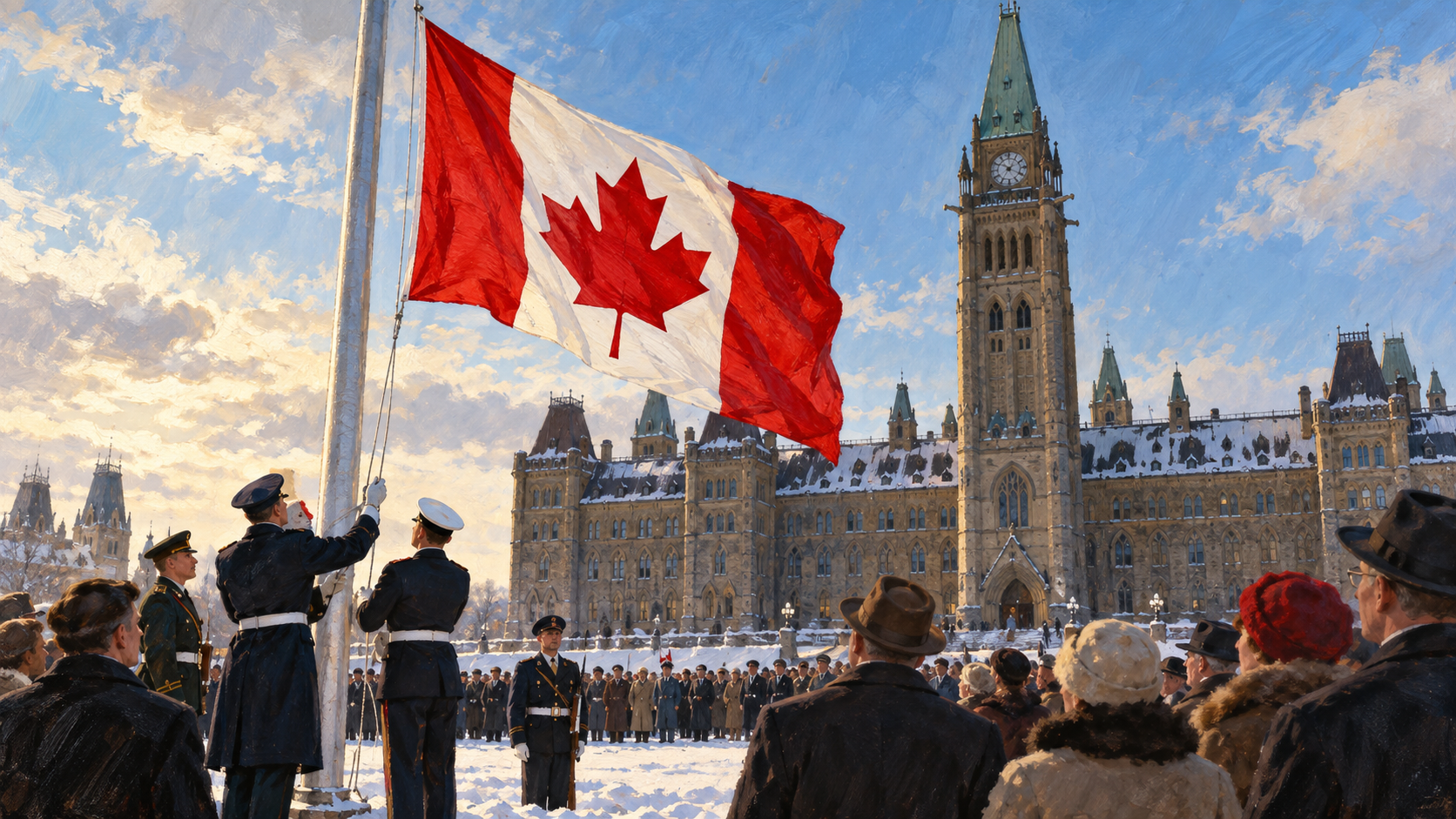
On This Day in Politics: February 15, 1965
On February 15, 1965, Canada’s red-and-white maple leaf flag was inaugurated at a public ceremony on Parliament Hill in Ottawa. At noon, the Canadian Red Ensign came down and the new national flag rose before a gathered crowd. The ceremony made visible a decision reached through a long and sometimes bitter political debate. Canadians were considering not only a design but also how their country should represent itself. A distinctive flag offered a shared national emblem at a time when questions of language, identity, and Canada’s relationship with Britain were shaping public life.
Prime Minister Lester B. Pearson had made resolving the flag question a political priority. The Red Ensign, with its Union Jack and Canadian shield, had strong associations with military service and British heritage. Many Canadians valued those connections, while others wanted a symbol that could represent the country without giving one inherited allegiance such a prominent place. Pearson’s initial proposal featured three maple leaves and blue side bars. Opposition and disagreement led to a parliamentary committee with members from several parties. Its work turned the controversy into a process of comparing alternatives, negotiating support, and finding a design that Parliament could adopt.
The committee ultimately selected a single-leaf concept associated with historian George F. G. Stanley. Design specialists refined it into the familiar red maple leaf on a white centre with red bands at the sides. The Commons endorsed the design in December 1964, and the Senate followed. Queen Elizabeth II signed the proclamation in January 1965, establishing the basis for the February inauguration. The sequence matters: the flag was not simply chosen by the crowd attending its first raising. It emerged from parliamentary decisions, design work, and formal authorization, all brought together in a public event that gave the new symbol its national debut.
The maple leaf itself was already deeply familiar through military insignia and other Canadian uses. The innovation lay in making it the central feature of a distinct national flag. That helped the design carry meaning across regions and communities even though the debate had demonstrated how differently Canadians understood their history. No flag could resolve those differences on its own, and adoption did not require every citizen to feel the same attachment immediately. Over time, the emblem became widely recognizable at home and abroad. February 15 recalls the political work behind that familiarity: an argument over belonging was translated into a durable public symbol, through institutions capable of reaching a decision amid disagreement.
The flag debate asked how Canada should represent a population with different histories and attachments. The choice of emblem was therefore a political question.
The Red Ensign carried longstanding British and military associations. Support for a new design did not erase the importance those memories held for many Canadians.
An all-party committee examined alternatives before Parliament approved the single-leaf design. The final image grew out of both political and graphic design work.
The proclamation preceded the inauguration. February 15 commemorates the public raising and entry into use of the new flag.
The maple leaf connected the new design with an established Canadian symbol, helping make a significant change recognizable.
The anniversary illustrates how a contested public decision can gradually become part of everyday national life without eliminating the differences that shaped it.
Explore more of "On This Day ..."
Discover more events from the same date across news, politics, technology, sports, and other fields. Each link highlights significant moments that shaped history on different fronts.