

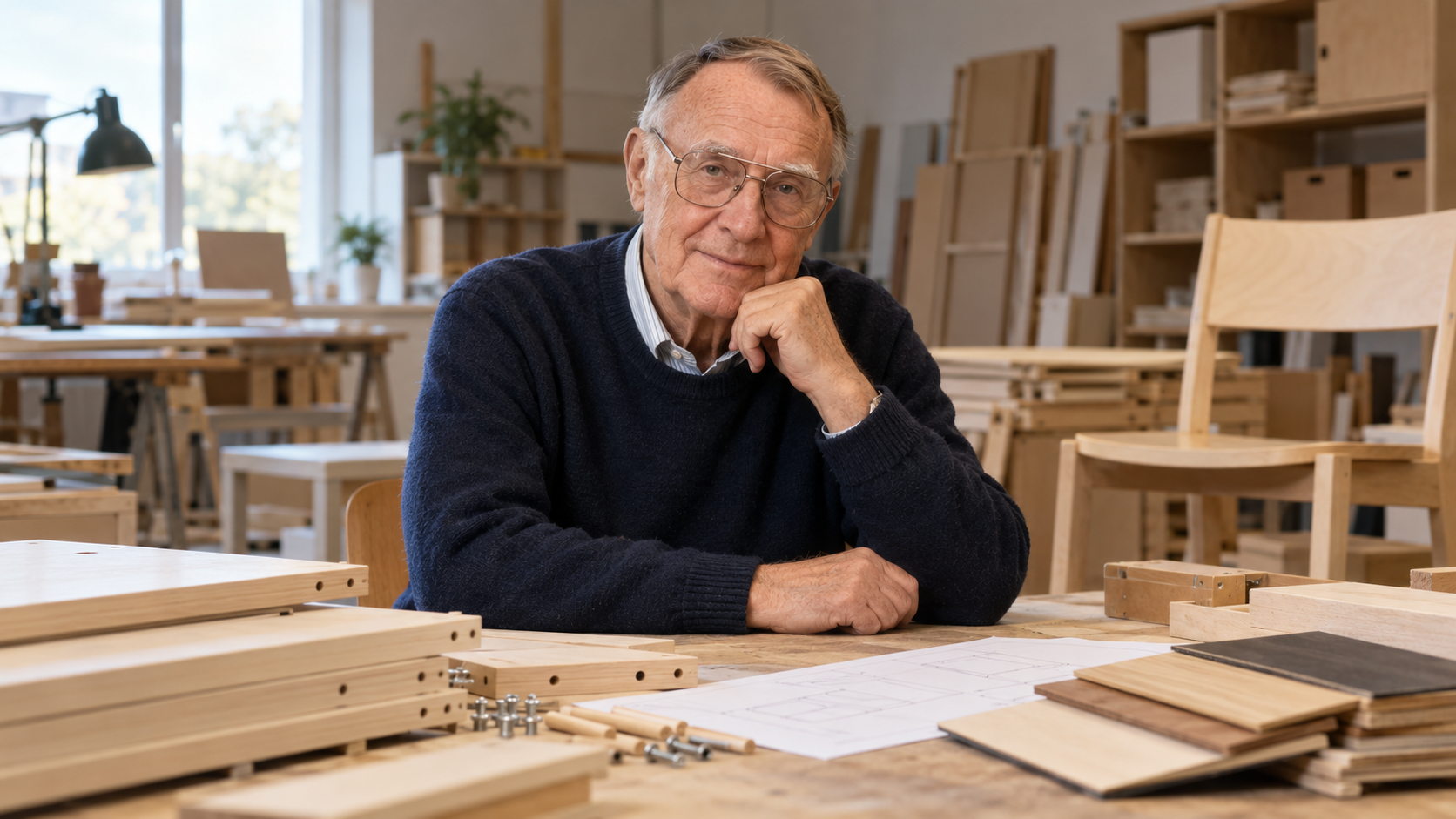
“Most things still remain to be done. A glorious future!”
Ingvar Kamprad ended A Furniture Dealer’s Testament with this forward-looking declaration, and IKEA continues to feature it as part of its founder’s legacy. The line combines dissatisfaction and optimism. Even after progress, most useful work remains unfinished; precisely for that reason, the future contains possibility. Kamprad linked the outlook to IKEA’s purpose of improving everyday life for many people through functional design and affordability rather than treating growth as an endpoint in itself.
The statement encourages institutional humility. Success can make a company defend the methods that produced it, while changing homes, materials, technology, and customer expectations require new answers. “Still remain to be done” keeps attention on unmet need: products that cost too much, waste that can be designed out, experiences that exclude people, and operations that can become safer or simpler. Optimism becomes credible when it directs resources toward specific unfinished work.
Restlessness also needs limits. A permanent sense that nothing is complete can exhaust employees, devalue maintenance, and turn novelty into a goal. Some achievements deserve consolidation, repair, and gratitude before the next initiative begins. “Glorious” should not hide the environmental or labor costs of expansion. The future is better only if improvement includes durability, circular materials, fair work, and honest responsibility for the full life of products.
For established companies, the quote offers an antidote to both complacency and despair. A mature enterprise can honor its history without assuming that its current form is final. Leaders can identify which parts of the mission remain underserved, which capabilities must change, and which past strengths should be preserved. The best use of Kamprad’s optimism is practical: acknowledge the distance still to travel, choose the next valuable problem, and invite many people to help build a future worthy of the adjective. The phrase can shape innovation portfolios by balancing three horizons: maintain what customers rely on, improve the current offer, and explore needs the business does not yet serve. Funding only exploration creates instability; funding only maintenance turns heritage into inertia. Leaders can make the balance explicit and review whether each initiative advances the founding purpose under present conditions. Kamprad’s optimism then becomes a management discipline. The future is neither guaranteed nor empty. It is built through a continuing selection of practical problems that are worth solving and can be solved without abandoning responsibility. Progress then honors the past by extending its purpose into new conditions with disciplined optimism.
Kamprad used the declaration in A Furniture Dealer’s Testament, the 1976 statement of IKEA’s purpose and values.
IKEA still presents the line alongside its vision of creating a better everyday life for many people.
The sentence joins humility about unfinished work with confidence that practical improvement remains possible.
Continuous change must leave room for maintenance, rest, durability, fair work, and environmental responsibility.
Long-lived companies need a way to respect heritage without treating the current business model as final.
Naming specific unmet needs turns optimism into a portfolio of useful work rather than a slogan about growth.
Explore more "Quotes of The Day"
Discover more notable quotes from influential voices across politics, science, business, technology, sports, and culture. Each quote offers insight into how ideas, beliefs, and decisions shape the world around us.