

On This Day in Business: March 2, 1901
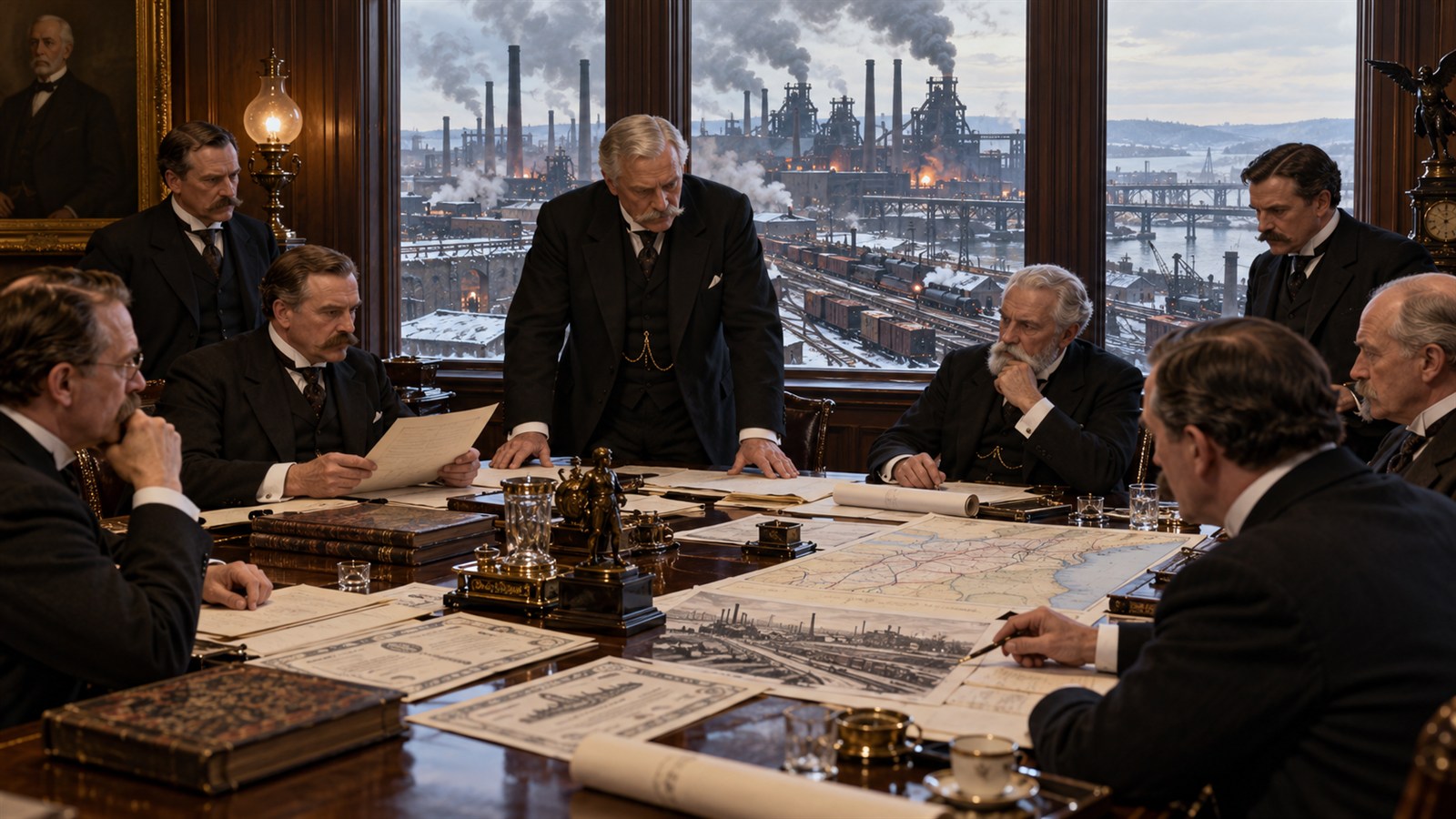
On March 2, 1901, the financing behind United States Steel came together, bringing Andrew Carnegie's steel interests and several other major producers into a corporation of unprecedented scale. Banker J. P. Morgan organized the combination after negotiations involving Carnegie, Charles M. Schwab, and the owners of mills, ore properties, railroads, and finishing businesses. Chartered in New Jersey, U.S. Steel soon controlled a broad chain from raw materials to finished products. Its capitalization exceeded $1 billion, making the new company a symbol of both American industrial power and the era's enthusiasm for giant corporate combinations.
The merger addressed a strategic problem created by intense competition. Steelmaking required enormous fixed investment, yet rival producers could cut prices when capacity outran demand. Combining companies promised steadier production, coordinated investment, and savings from shared supplies and transportation. Carnegie received securities worth hundreds of millions of dollars, converting a privately controlled industrial empire into liquid financial wealth. Morgan gained a corporation large enough to appeal to public investors, while Schwab became its first president and managed the difficult task of integrating businesses with different equipment, cultures, and cost structures.
Scale did not automatically produce efficiency. U.S. Steel inherited aging plants as well as strong assets, and its managers had to balance dividends, modernization, labor relations, and market share. The company never possessed an uncontested monopoly, but its size shaped prices, investment decisions, and public debate. Critics saw the merger as evidence that financiers could concentrate economic power beyond effective competition. Supporters argued that integrated production and professional management could stabilize a volatile industry and supply the rails, bridges, buildings, ships, and machinery of a rapidly growing economy.
The formation of U.S. Steel changed expectations about what a corporation could be. It demonstrated that capital markets could assemble enterprises on a national scale and distribute ownership through stocks and bonds. It also made governance more complex: distant shareholders depended on executives and boards to coordinate vast operations and report reliable results. The company's birth therefore belongs to more than steel history. It marked the arrival of the billion-dollar corporation and forced investors, workers, regulators, and citizens to confront the opportunities and risks created when finance and industry combined at a scale few had previously imagined. U.S. Steel also tested whether size itself could be managed. Purchasing power, captive transport, and access to ore promised savings, but layers of administration could slow decisions and protect inefficient plants. The company had to develop reports and controls capable of turning scattered operations into comparable numbers. Its experience helped shape the twentieth-century managerial corporation, in which strategy depended on information moving upward and coordinated investment moving back through a complex hierarchy.
By 1901, Carnegie Steel and several rivals controlled mills, mines, transportation links, and finishing operations essential to the expanding steel economy.
J. P. Morgan organized a combination that would reduce destructive competition and create a vertically integrated national producer.
The transaction converted Carnegie's private company into securities and brought multiple businesses under the new United States Steel Corporation.
Its capitalization exceeded $1 billion, a scale that astonished the public and made integration, modernization, and governance immediate challenges.
U.S. Steel helped normalize widely held industrial corporations financed through public capital markets and administered by professional managers.
The company also intensified arguments over monopoly power, labor, disclosure, and the proper public limits on corporate consolidation.
Explore more of "On This Day ..."
Discover more events from the same date across news, politics, technology, sports, and other fields. Each link highlights significant moments that shaped history on different fronts.