

On This Day in Business: March 16, 1926
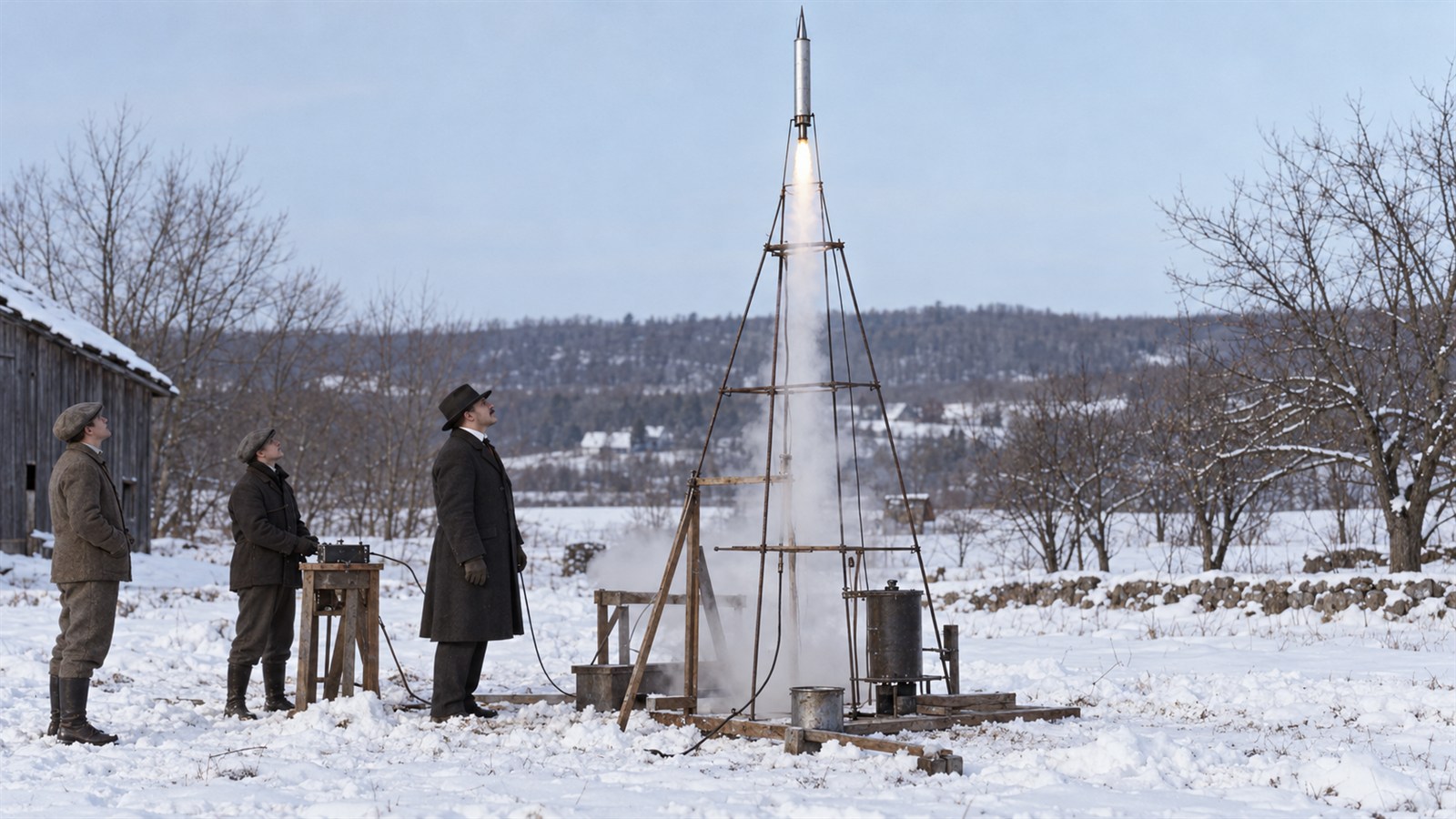
On March 16, 1926, Robert H. Goddard launched the world's first liquid-fueled rocket from a farm in Auburn, Massachusetts. The slender apparatus burned gasoline and liquid oxygen, rose for only a few seconds, and landed roughly 184 feet away. Its altitude was modest, but the principle was profound. Liquid propellants could be pumped or fed into a combustion chamber and controlled more effectively than the solid powders used in earlier rockets. Goddard's test converted years of equations, patents, and laboratory work into physical evidence that the system could fly.
The experiment was an entrepreneurial project as well as a scientific one. Goddard worked with limited resources, sought institutional support, protected inventions through patents, and built much of his equipment for a field without an established supply chain. The Smithsonian Institution and later private patrons provided funding, but public understanding was weak and newspaper ridicule sometimes followed his claims. He therefore managed secrecy, reputation, and scarce capital while solving problems in ignition, cooling, guidance, tanks, and lightweight structures.
Commercial value was distant in 1926. No customer could yet buy satellite launches, global communications, or orbital services. Progress depended on patient experimentation whose payoff was uncertain and measured in knowledge rather than revenue. Liquid propulsion later became fundamental to military missiles and space launch vehicles, while Goddard's patents and methods gained wider recognition. His work illustrated how enabling technology may mature long before the markets it ultimately supports, requiring funders to value options and technical learning rather than near-term sales.
The Auburn launch remains a lesson in proof of concept. A small demonstration can reduce one decisive uncertainty even when most engineering challenges remain. Goddard did not reach space that day; he showed that a controllable liquid-fueled rocket could leave the ground under its own power. That result helped define a development path for propulsion, testing, and vehicle design. Modern launch businesses operate at scales he could not finance, yet they follow the same sequence: theory, protected knowledge, prototype, measured flight, repeated improvement, and eventually a service customers are willing to purchase. Goddard's experience also warns that breakthrough research is difficult to evaluate with ordinary short-term metrics. Failed tests may be productive when they reveal a design limit, while a tiny flight may carry enormous informational value. Funding systems that demand immediate revenue can miss such asymmetric possibilities. At the same time, inventors must design experiments that isolate uncertainty and document results. The 1926 launch succeeded as a milestone because it answered a precise question and created a credible basis for the next test.
Robert Goddard combined theoretical research, patents, and practical experiments while seeking support for a field many observers considered unrealistic.
Liquid fuel promised greater control and performance than traditional solid propellants but required difficult tanks, plumbing, ignition, and combustion systems.
On March 16, 1926, his gasoline-and-liquid-oxygen rocket flew briefly from a Massachusetts farm, proving the basic concept.
The test covered only a short distance, and decades of guidance, materials, reliability, and financing challenges remained before practical spaceflight.
Liquid propulsion became central to later missiles and launch vehicles, and Goddard's experimental methods influenced the developing rocket industry.
The launch demonstrates how a focused prototype can unlock investment and learning even when a commercial market is still far away.
Explore more of "On This Day ..."
Discover more events from the same date across news, politics, technology, sports, and other fields. Each link highlights significant moments that shaped history on different fronts.