

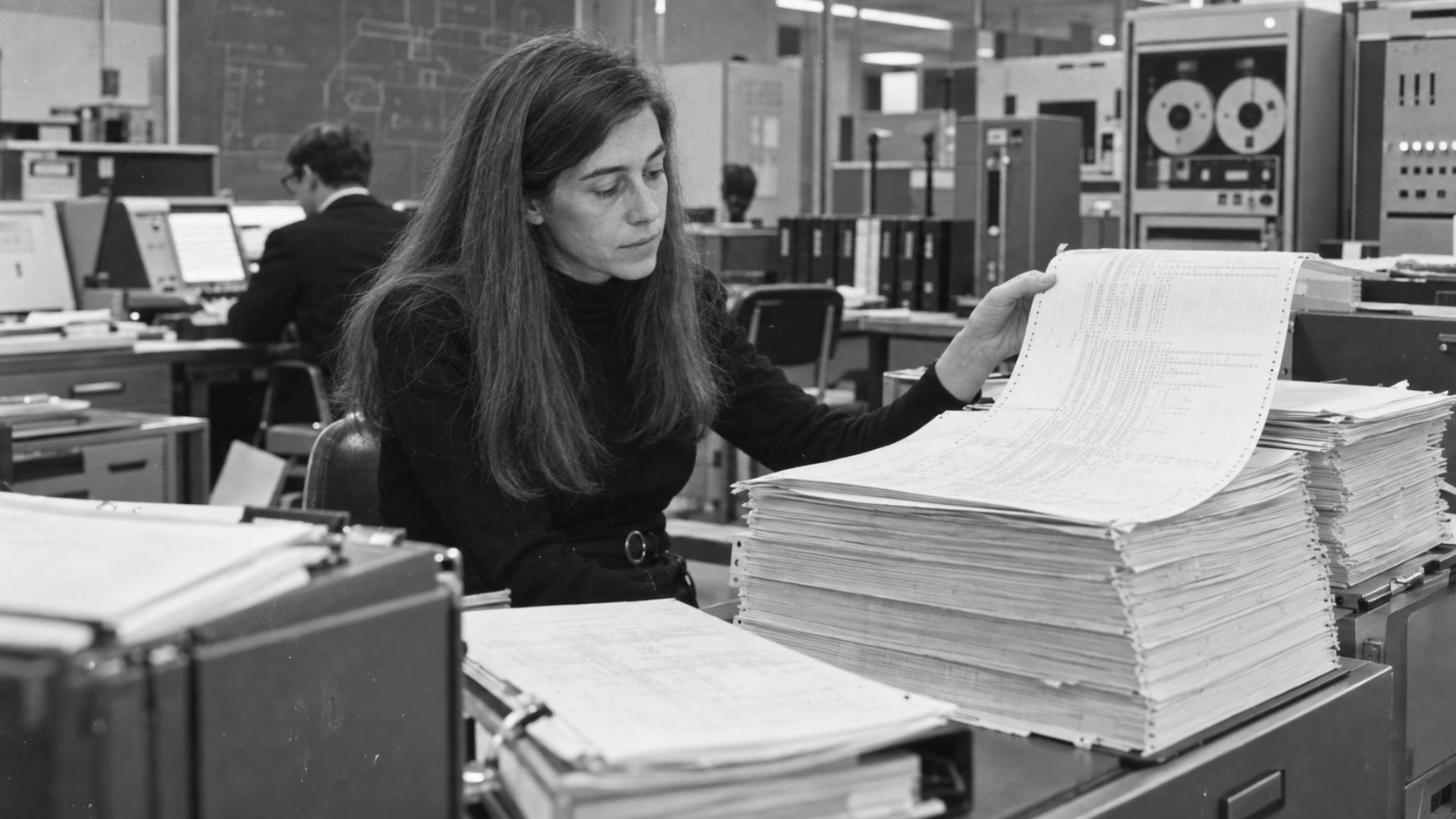
“There was no choice but to be pioneers.”
Margaret Hamilton used this phrase while recalling the software work that carried Apollo astronauts to the Moon. At MIT’s Instrumentation Laboratory, she led the team responsible for the onboard flight software used by the Apollo command and lunar modules. The assignment arrived before software engineering had a settled professional identity. There were few standard methods for organizing such a large real-time system, and failure could endanger both a mission and its crew. Hamilton’s team therefore had to invent techniques while delivering code that could be trusted far from Earth.
The most famous demonstration came during Apollo 11’s descent, when the guidance computer raised program alarms while the lunar module approached the surface. The software did not simply stop. Its priority system shed lower-priority work and preserved the calculations needed for landing. That behavior reflected deliberate engineering: anticipate overload, rank essential functions, test abnormal conditions, and give operators enough information to make sound decisions. The moment was dramatic, but the reliability behind it was built through patient review, simulation, documentation, and countless ordinary choices.
Hamilton’s wording is sometimes heard as a celebration of one brilliant programmer. Her own account points in the opposite direction. Pioneering meant a group confronting questions for which no textbook supplied ready answers. Leadership mattered, but so did communication among programmers, hardware specialists, mission planners, astronauts, and controllers. The achievement depended on interfaces that people could understand and procedures they could repeat. Novelty increased the need for discipline; it did not excuse shortcuts.
That lesson travels well beyond spaceflight. Modern systems coordinate hospitals, transportation, finance, communications, and public infrastructure. Their code may be easier to write and deploy than Apollo software, yet their failures can still spread quickly. Hamilton’s quote reminds technology teams that genuine innovation includes the safeguards that make invention dependable. Requirements must be explicit, assumptions examined, edge cases tested, and warnings designed for the humans who will respond. Pioneers do not merely reach new territory. They leave behind practices that allow others to work there safely. The phrase also restores responsibility to the center of software work. When tools are powerful and deadlines are intense, engineering judgment is not an obstacle to progress; it is what turns a demonstration into a system worthy of trust.
Hamilton made the remark while discussing the Apollo guidance software developed at MIT. The team worked before many of today’s software practices had names or established standards.
The Apollo computer had severe limits in memory and processing power, so every feature required careful prioritization and extensive simulation.
“Pioneers” describes both invention and responsibility. The team created methods, interfaces, and recovery behavior because there was no mature playbook to follow.
The quote should not be mistaken for lone-genius mythology. Apollo software was a collective achievement that joined many disciplines and depended on rigorous collaboration.
Safety-critical software still requires teams to plan for overload, ambiguity, hardware faults, and human decision-making under pressure.
Hamilton’s example shows that speed and reliability are not opposites. Durable innovation combines bold goals with testing, documentation, and accountable judgment.
Explore more "Quotes of The Day"
Discover more notable quotes from influential voices across politics, science, business, technology, sports, and culture. Each quote offers insight into how ideas, beliefs, and decisions shape the world around us.