

On This Day in Lifestyles: March 10, 1876
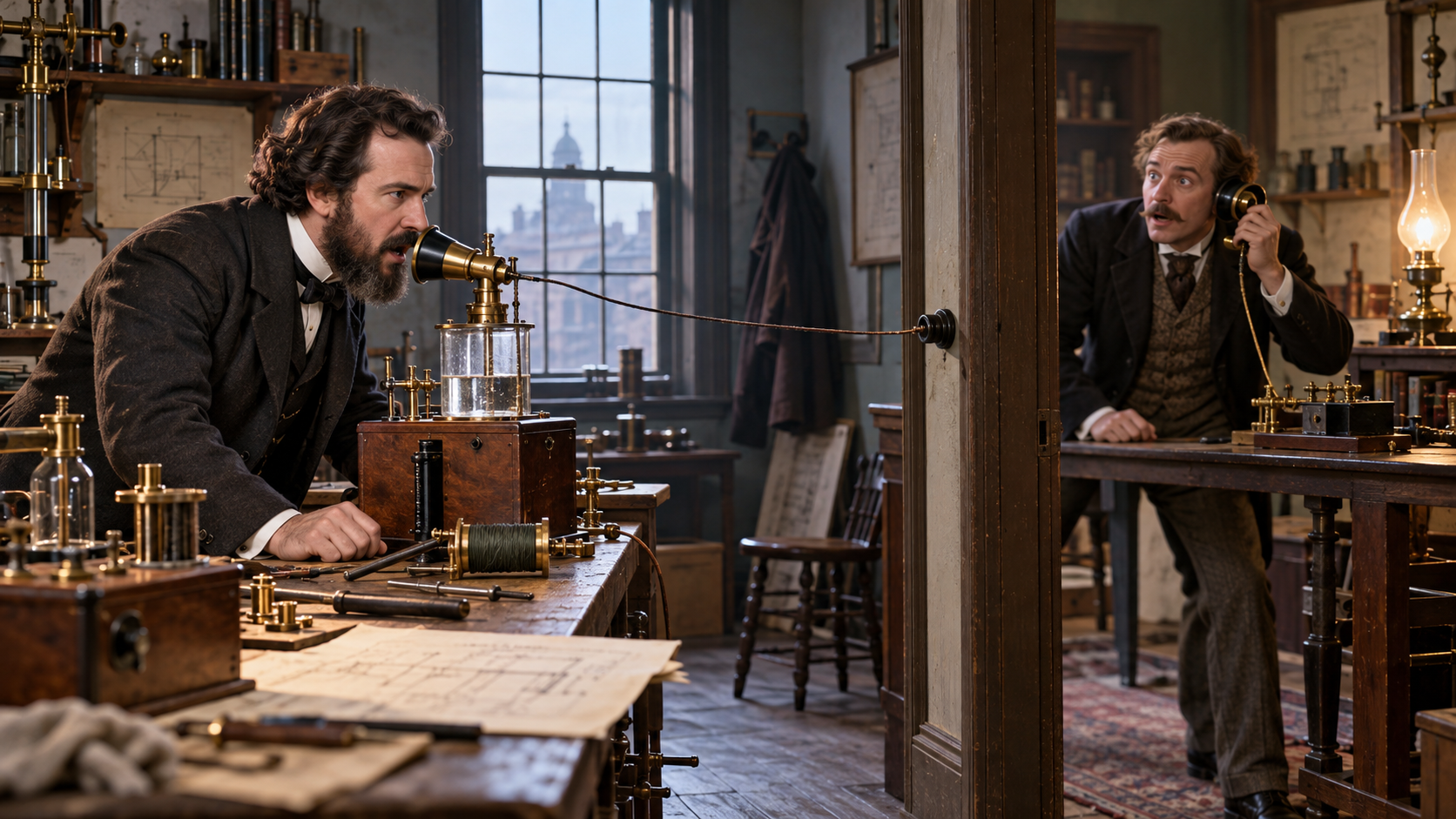
On March 10, 1876, Three days after receiving his patent, Alexander Graham Bell made the first successful intelligible telephone call in his Boston laboratory. Speaking into an experimental liquid transmitter, he summoned assistant Thomas Watson, who heard the sentence clearly in the adjoining room. The date matters in lifestyle history because a human voice successfully crossed electrical distance in real time. Rather than remaining an isolated announcement or demonstration, the moment gave people a new way to think about speaking, listening, arranging, reassuring, and responding without traveling. Its importance became visible through familiar places, objects, and routines, where a broad historical change could be felt at human scale.
The apparatus was fragile and the distance short, but the result demonstrated more than coded pulses: the variations of a human voice could travel along a wire and be understood. Bell recorded the experiment in his notebook, creating a precise contemporary trace of the milestone. The setting shaped how contemporaries understood the event. Bell, Watson, later inventors, operators, line crews, subscribers, businesses, and families encountered it through experimental wires, demonstrations, local exchanges, switchboards, long-distance lines, and eventually wireless networks. Those details show that social change usually travels through ordinary systems such as workplaces, schools, shops, homes, streets, or public institutions. What seems inevitable in hindsight depended on people testing, organizing, purchasing, teaching, maintaining, or protecting the idea in real time.
At first the telephone seemed useful mainly for specialized business. Exchanges, operators, improved transmitters, and expanding wire networks soon made conversation across town practical, reshaping errands, appointments, news, friendship, courtship, and emergency communication. In daily life, people shortened some messages, scheduled calls, learned telephone manners, and began to treat distance as an inconvenience technology could overcome. The episode also exposed questions about network control, privacy, access, interruption, surveillance, and the social demand for immediate response. Access and influence were never perfectly even, and later generations adapted the original development to different communities, values, and technologies. Still, the event changed expectations by making direct conversation when people could not share a room easier to imagine, recognize, or demand.
The famous laboratory moment led into a vast social and technical system built by many inventors and workers. Each later form, from household receiver to smartphone, preserved the central expectation that a distant person could answer now. Today, echoes remain in phone calls, voice messages, video chats, help lines, and the assumption of instant contact. Looking back helps separate the documented milestone from the myths that often accumulate around famous anniversaries. It also reminds us that lifestyle history is built from choices about design, health, work, leisure, communication, memory, and public space. On this day, the first clear sentence made the telephone’s promise audible before its enormous network existed.
Three days after receiving his patent, Alexander Graham Bell made the first successful intelligible telephone call in his Boston laboratory. Speaking into an experimental liquid transmitter, he summoned assistant Thomas Watson, who heard the sentence clearly in the adjoining room.
The apparatus was fragile and the distance short, but the result demonstrated more than coded pulses: the variations of a human voice could travel along a wire and be understood. Bell recorded the experiment in his notebook, creating a precise contemporary trace of the milestone.
At first the telephone seemed useful mainly for specialized business. Exchanges, operators, improved transmitters, and expanding wire networks soon made conversation across town practical, reshaping errands, appointments, news, friendship, courtship, and emergency communication.
The larger theme was that a human voice successfully crossed electrical distance in real time.
The famous laboratory moment led into a vast social and technical system built by many inventors and workers. Each later form, from household receiver to smartphone, preserved the central expectation that a distant person could answer now.
Today the story remains visible in phone calls, voice messages, video chats, help lines, and the assumption of instant contact.
Explore more of “This Day in Lifestyles”
Discover more moments in everyday life, design, education, travel, food, fashion, and culture. Each story connects a calendar date with an event that changed how people lived.