

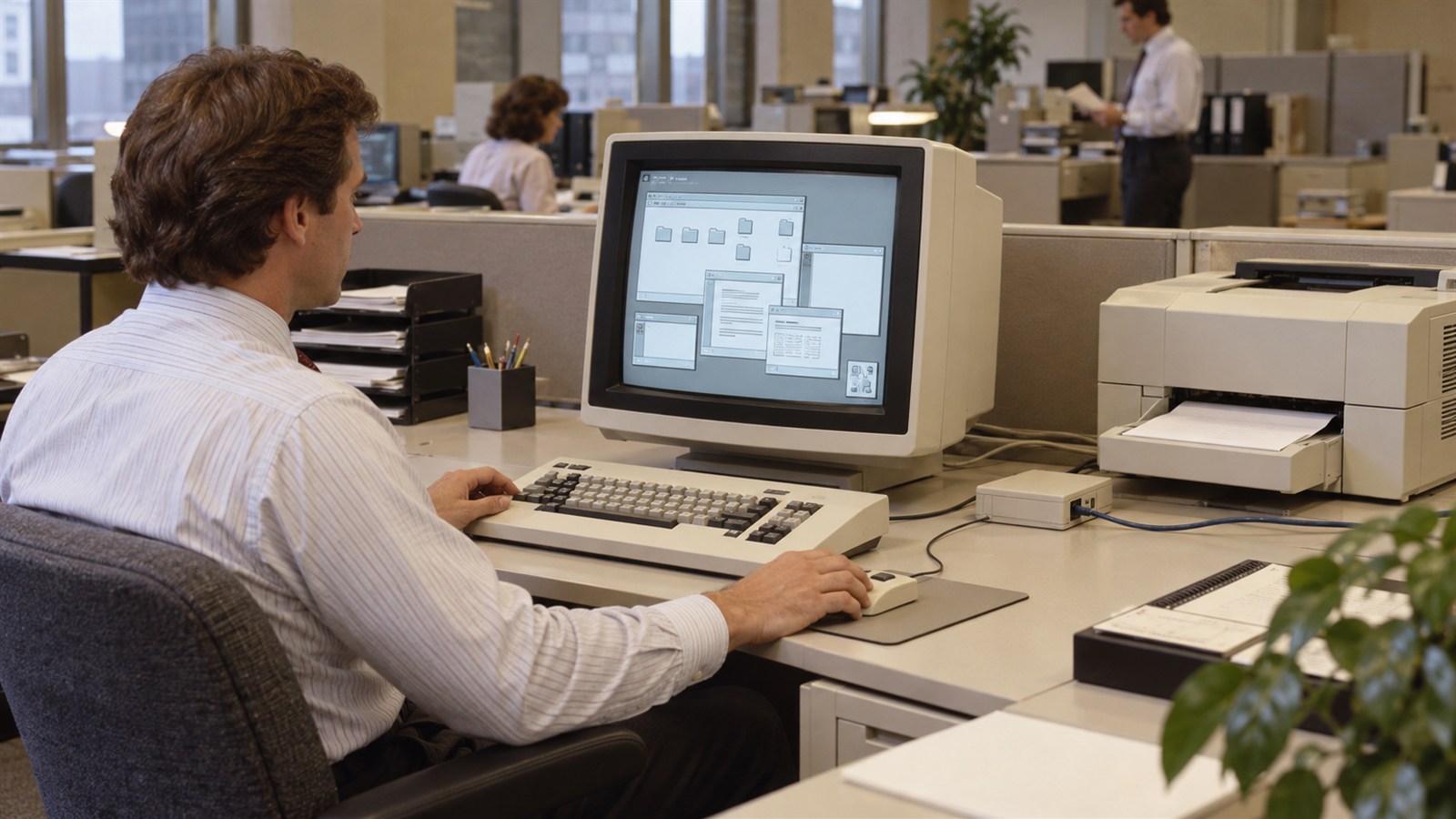
On This Day in Business: April 27, 1981
On April 27, 1981, Xerox introduced the 8010 Star Information System, commonly called the Xerox Star. The workstation brought research ideas from Xerox PARC into a commercial office product. Users worked with a bitmapped display, windows, icons, folders, documents, and a mouse rather than relying only on typed commands. Systems could connect through Ethernet to file servers and laser printers, creating an integrated electronic office. Many of those concepts later became familiar across personal computing, but Star presented them together as a carefully designed environment aimed at professional organizations.
Xerox treated the system as office infrastructure rather than a low-cost individual computer. A complete installation could include several workstations, servers, networking, and printing, making the purchase expensive and requiring organizational commitment. Designers emphasized consistency and direct manipulation, testing how people performed everyday document tasks. The system's strength was integration: visual software, hardware, networking, and printing shared a coherent model. Yet that same completeness limited flexibility and increased cost. Customers also needed applications and support beyond an elegant interface, and the market was beginning to embrace cheaper personal computers.
Star did not achieve the mass commercial success its influence might suggest. Sales were modest compared with later systems from Apple and Microsoft, which adopted and popularized related graphical ideas in different markets. Xerox faced the classic problem of commercializing internal research while protecting established copier businesses and sales practices. Its enterprise-oriented channels and pricing did not create a broad developer ecosystem. The product nevertheless shaped designers and competitors, demonstrating workable conventions for electronic documents, networked offices, and graphical interaction.
The launch separates invention from market capture. Xerox assembled many foundational interface concepts in a real product, but technical leadership did not guarantee scale. Timing, price, distribution, application availability, and strategic focus determined whether customers could justify adoption. The Star also shows the value of system design: familiar desktop metaphors became powerful because they were consistent across tasks, not because any single icon was revolutionary. April 27 marks a landmark commercial demonstration of the graphical office and a reminder that an influential product can teach an industry even when its creator earns less than later followers. Xerox also faced a channel conflict between selling integrated office systems and protecting a profitable copier organization. Radical products may require customers, pricing, support, and incentives that an established sales force is not built to provide. If the new offer is evaluated by old margins or routines, it can remain strategically homeless. Star's influence reminds incumbents to design a commercialization system as deliberately as the technology when research points beyond the current business model.
Xerox PARC researchers had developed graphical displays, mice, Ethernet, laser printing, and document-oriented software during the 1970s.
Star combined those ideas into a coherent commercial workstation and network designed for professional office tasks.
Xerox introduced the 8010 system on April 27, 1981, offering icons, windows, folders, documents, and mouse-driven interaction.
High system cost, enterprise sales methods, limited applications, and cheaper personal computers constrained adoption.
Apple, Microsoft, and other companies later brought related interface concepts to much larger audiences and developer markets.
Star remains a defining example of how pioneering product design can influence competitors without guaranteeing its inventor commercial dominance.
Explore more of "On This Day ..."
Discover more events from the same date across news, politics, technology, sports, and other fields. Each link highlights significant moments that shaped history on different fronts.