

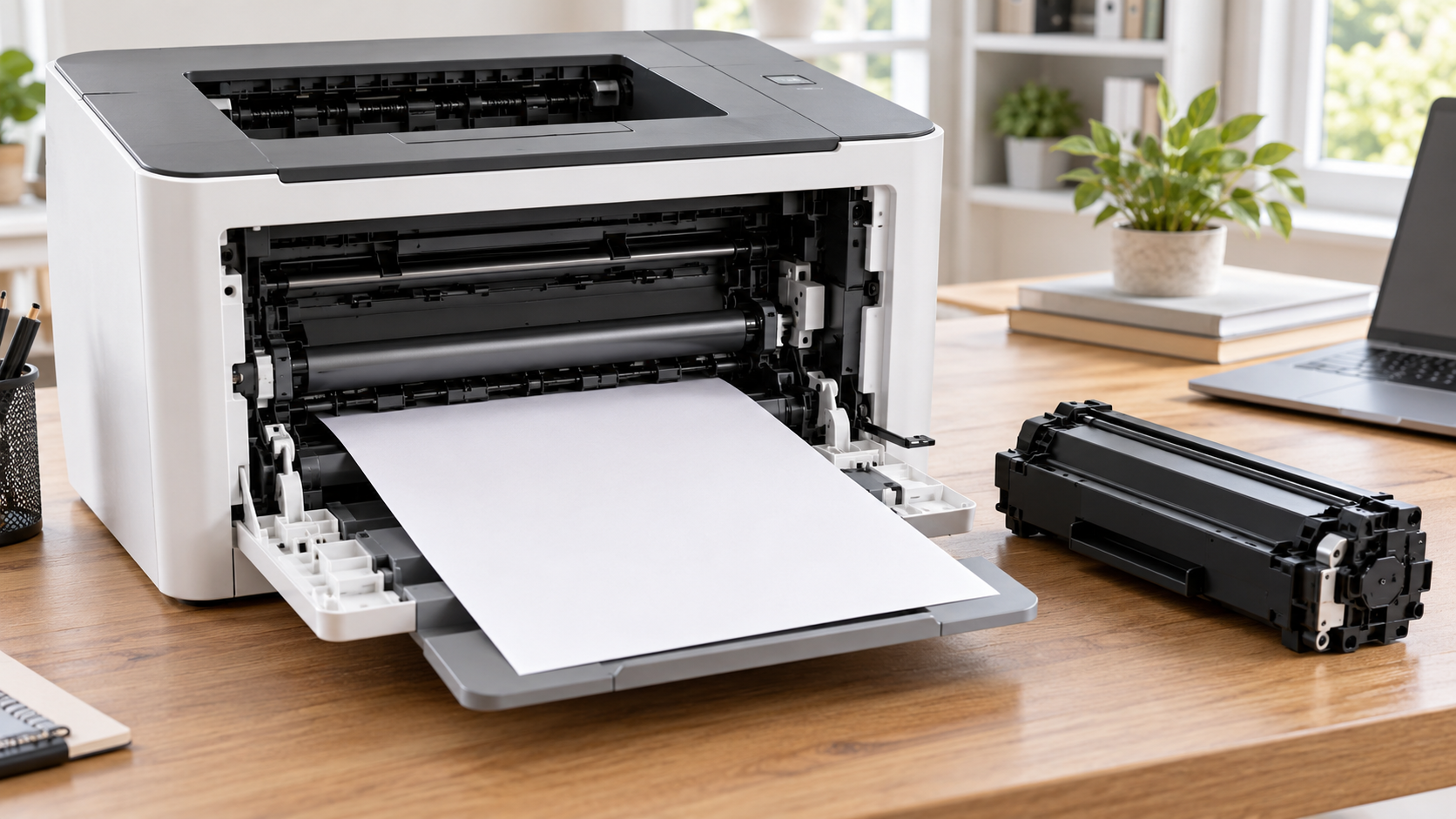
Laser Printer Electrophotography Explainer
A laser printer uses electrophotography, a process that turns an electrical charge pattern into a powdered image. A rotating photosensitive drum first receives a uniform electrostatic charge. A laser beam, steered rapidly across the drum by optics, selectively exposes points corresponding to the page. Light changes the electrical behavior of the photoconductor, reducing charge in the exposed areas and leaving an invisible voltage pattern called a latent image.
The drum then passes the developer unit. Toner consists of very small colored resin particles containing pigment and charge-control materials. Agitation and contact give the particles a predictable electrical charge. Because opposite charges attract and like charges repel, toner adheres to the intended parts of the drum’s latent image while avoiding the background. In a color printer, separate cyan, magenta, yellow, and black images are aligned through multiple drums or repeated cycles.
Paper receives its own controlled charge as it approaches the drum or an intermediate transfer belt. That electric field pulls the toner image from the imaging surface onto the sheet. At this stage the powder rests loosely on the fibers and can still smear. The paper immediately enters a fuser, where a heated roller and pressure roller soften the toner resin and press it into the surface. Cooling solidifies the fused image so it survives normal handling.
After transfer, a cleaning blade or brush removes residual toner from the drum, and an erase or conditioning step prepares its charge for the next page. The drum repeats the cycle once or more per sheet. Paper sensors coordinate pickup rollers, registration, image timing, fusing, and exit so the leading edge meets the drum at the correct moment. A jam occurs when a sheet fails to reach an expected sensor within the allowed interval.
Toner is different from liquid ink. It remains a dry powder until fusing, which supports fast, sharp text and pages that emerge dry. The fuser becomes hot and should be allowed to cool before clearing nearby jams. Loose toner should not be blown with compressed air or handled with an ordinary vacuum not designed for fine particles. Cartridges, drums, transfer parts, and waste containers are model-specific consumables with different service lives.
The laser does not burn the picture onto paper. It writes only an electrical pattern on the photoconductor; charged toner makes that pattern visible, electric fields move it, and the fuser supplies the permanent heat-and-pressure bond. This separation lets the printer reproduce an entire page quickly with no impact mechanism. Print quality depends on clean optics, stable charges, correct toner, sound drum surfaces, precise paper timing, and uniform fuser temperature.
A charged photosensitive drum is selectively exposed by a laser, attracts toner in the latent image, transfers it to paper, and sends the sheet through a hot pressure fuser. Key terms include photoconductor, charge, latent image, toner, developer, transfer, fuser, and cleaning blade.
No. It changes charge on the photosensitive drum. Toner later moves to the paper and is bonded by the fuser’s heat and pressure.
The colorant is powdered resin rather than liquid ink. Fusing melts it into the paper surface, and it solidifies as the page exits.
Explore more "Explainers"
Discover additional explainers across politics, science, business, technology, and other fields. Each explainer breaks down a complex idea into clear, everyday language—helping you better understand how major concepts, systems, and debates shape the world around us.