

On This Day in Politics: March 3, 1913
On March 3, 1913, thousands of women marched along Pennsylvania Avenue in Washington, D.C., demanding a constitutional amendment protecting women’s voting rights. Alice Paul and Lucy Burns organized the procession through the congressional committee of the National American Woman Suffrage Association. They chose the day before Woodrow Wilson’s presidential inauguration, placing the campaign in the capital when national attention was already concentrated there. The march used the ceremonial landscape of American government to make a political argument: women contributed to public life while remaining excluded from voting on the same terms as men across much of the country at that time.
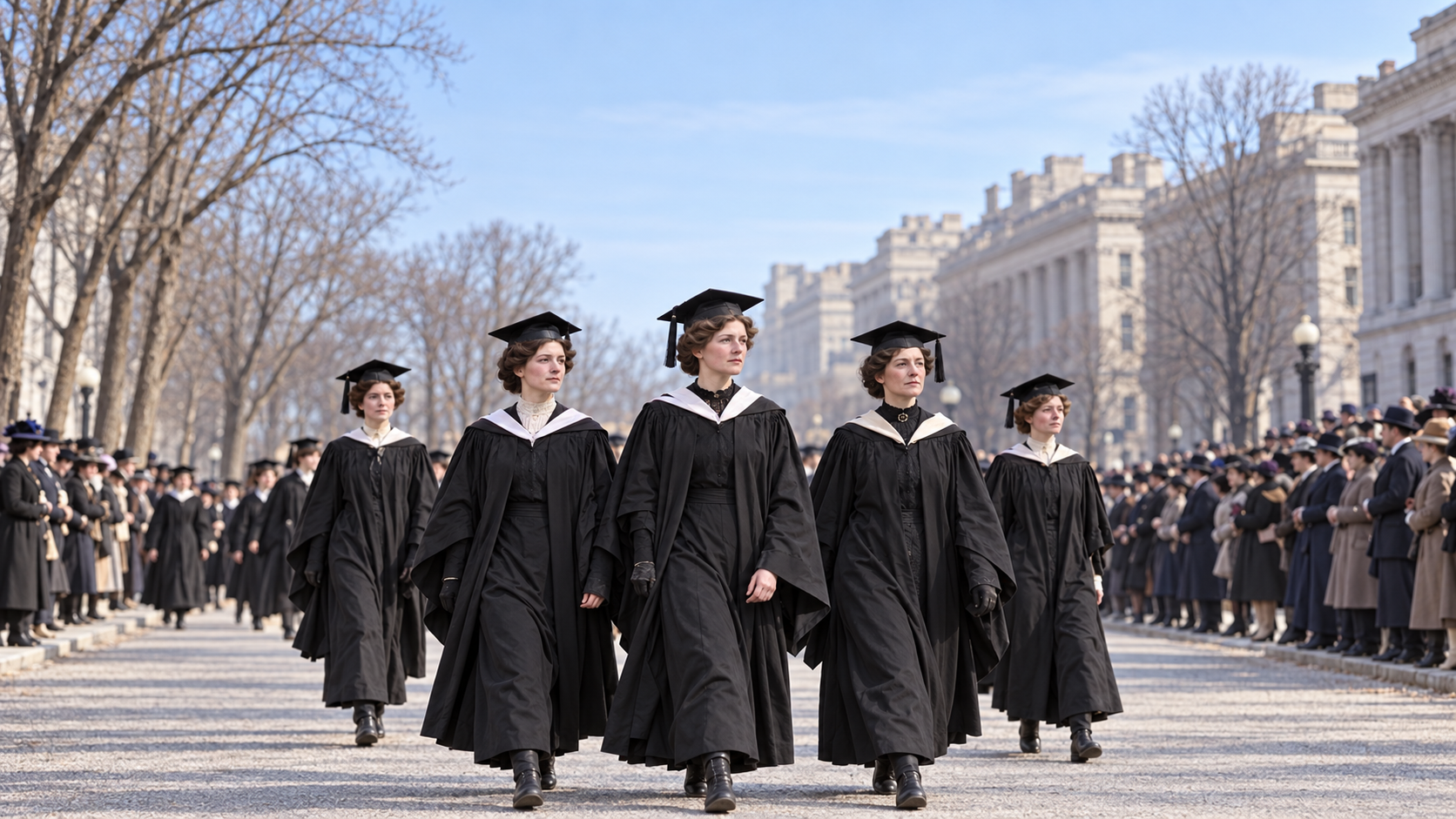
The procession was carefully arranged to make those contributions visible. Lawyer and activist Inez Milholland rode a white horse near its head, wearing a white dress and cape. Delegations followed by state, occupation, organization, and educational background, with college women appearing in academic dress. Bands and floats added spectacle, and a tableau at the Treasury Building formed part of the day’s presentation. The organizers were pressing for a federal amendment after decades of campaigning through multiple routes, including state contests. Their strategy brought a constitutional demand directly to Congress’s doorstep and used a public demonstration to turn an issue often postponed by national politicians into an immediate question.
The planned display encountered serious obstruction. Crowds pushed into the route, and marchers faced insults, intimidation, and physical harassment. Police protection proved inadequate, and the procession struggled to advance until troops helped clear the street. The violence brought additional publicity and prompted a congressional investigation of crowd control. Exclusion also came from inside the movement. Black women faced pressure to accept segregation or remain apart from white delegations. Ida B. Wells-Barnett refused to accept that treatment and joined the Illinois contingent as it passed. Other Black participants marched with professional or state groups and in academic dress, challenging the idea that their citizenship could be treated as secondary within a campaign for equality.
The march did not win a constitutional amendment that day. Its immediate importance lay in the attention it attracted, the pressure it placed on public officials, and the organizing energy it helped build. The Nineteenth Amendment was ratified in 1920, after years of further work by many organizations and individuals. Even that constitutional change did not remove racial discrimination or every other barrier to voting. Remembering the procession therefore requires more than celebrating a single dramatic scene. It shows how political movements use public space to demand recognition, how authorities can fail to protect lawful participation, and how a campaign’s own exclusions can undermine its claims. March 3 made those tensions visible in the streets of the national capital.
The date put the suffrage campaign beside Wilson's inauguration in the national news. The procession followed the route intended for the inaugural parade.
Academic gowns and professional delegations helped show that women already contributed to institutions that denied them equal political influence.
Crowd interference and inadequate policing became subjects of congressional scrutiny, extending attention beyond the march itself.
Black participants challenged discriminatory treatment within the suffrage coalition as well as exclusion from electoral politics.
The Nineteenth Amendment followed in 1920. The procession was one contribution to a much longer and broader campaign.
Constitutional protection against sex-based voting restrictions did not eliminate the racial barriers that continued to obstruct many citizens.
Explore more of "On This Day ..."
Discover more events from the same date across news, politics, technology, sports, and other fields. Each link highlights significant moments that shaped history on different fronts.