

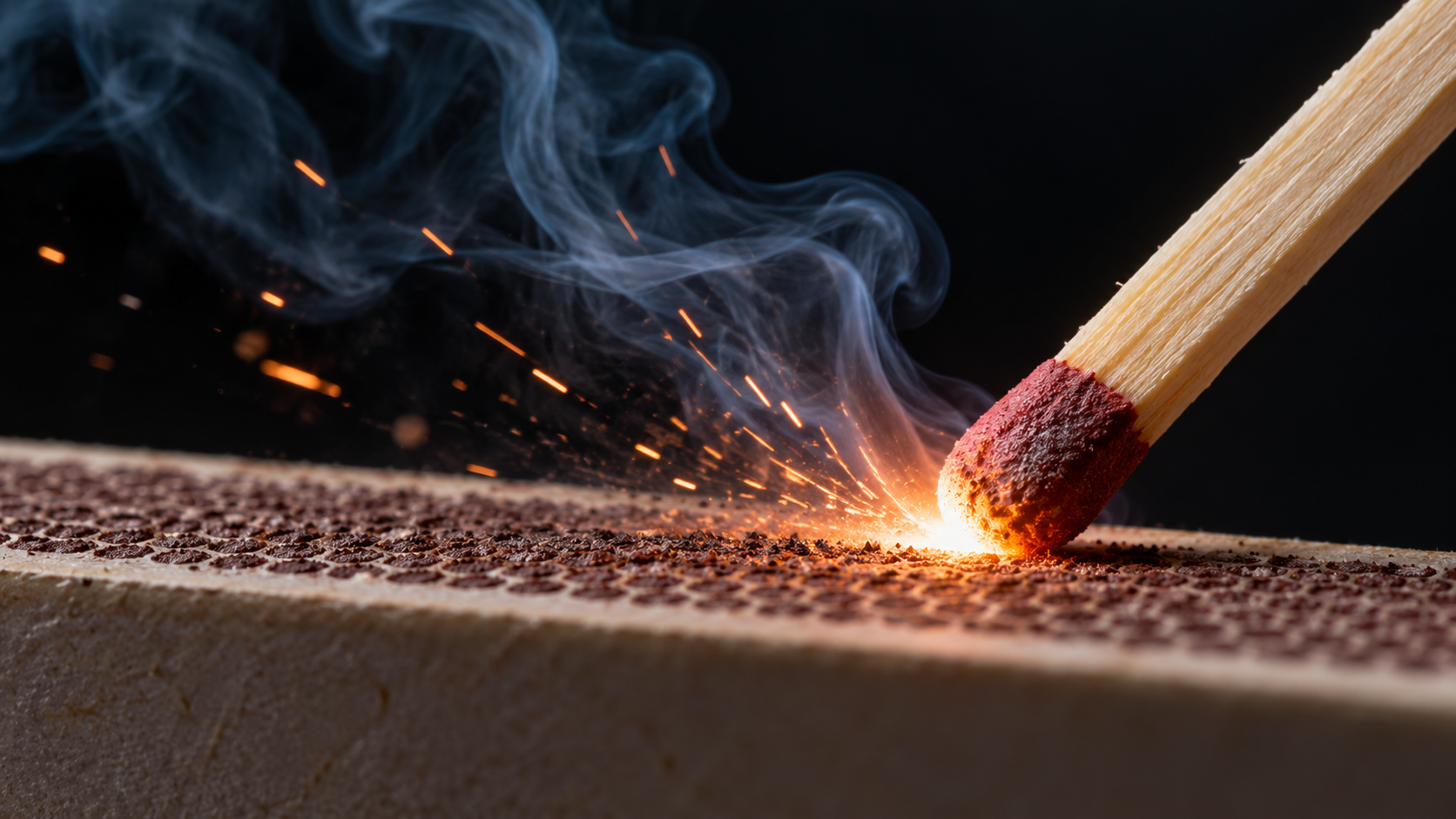
Safety Match Ignition Explainer
A safety match is designed so its head and the box striker complete the ignition system only when brought together. The match head contains an oxidizer, combustible material, binders, and fillers. The special striking surface contains red phosphorus mixed with abrasive and binder. Dragging the head across that rough strip creates local heat and mechanical action. A tiny amount of phosphorus becomes highly reactive and ignites, starting a sequence that lights the head mixture and then the wooden splint.
Separating key chemicals reduces accidental ignition compared with a match that can light on many rough surfaces. The oxidizer in the head supplies oxygen rapidly to the fuel once the starter reaction is hot enough. Glassy abrasive particles increase friction and scrape fresh material into contact. Binders keep the compositions attached during storage and striking, while fillers control sensitivity and burn behavior. The head coating is engineered to catch reliably without exploding or dropping large burning fragments.
Once the head ignites, heat raises the wood above its ignition temperature. The flame then moves from the coated tip to the splint, where pyrolysis releases flammable gases that burn above the surface. A treatment may control afterglow so the charred stick does not continue smoldering excessively. The visible flame is sustained mostly by gases from heated material, not by solid wood burning directly in the air. Airflow and match orientation influence how quickly heat reaches the stem.
Moisture interferes with ignition because it absorbs heat, weakens compositions, and can keep the head below the reaction threshold. A worn or contaminated striker may not create enough friction or provide sufficient phosphorus. Pressing harder is not always helpful; a smooth controlled stroke along the intended strip is safer than crushing the head. Safety matches are not “safe” around children or combustibles—the name describes their separated ignition chemistry, not an absence of fire risk.
Matches should be stored dry, away from heat and flame, and kept out of children’s reach. A lit match is held away from the body and used only where sparks and flame are appropriate. The stick must be fully extinguished and cool before disposal. Large quantities and damaged packages follow local fire-safety rules. Unusual chemicals, homemade match mixtures, and attempts to harvest striker material are hazardous and are not part of ordinary safe use.
The brief flare depends on a carefully staged chemical handoff. Friction activates the phosphorus system at the striker, that reaction ignites the head’s fuel-and-oxidizer mixture, and the head transfers enough heat to release combustible gases from the wood. Keeping the initiating material and main oxidizer separate makes unintended ignition less likely. A commonplace match is therefore a compact example of activation energy, oxidation, heat transfer, and controlled combustion arranged in sequence.
Friction on the special striker activates red phosphorus, which ignites the fuel-and-oxidizer mixture in the head and then the wood. Key terms include red phosphorus, oxidizer, fuel, abrasive, activation energy, pyrolysis, splint, and afterglow.
Its ignition system is divided: red phosphorus is on the special striker, while oxidizer and fuel are in the head. Both surfaces are intended to work together.
Water absorbs heat and disrupts the head and striker compositions, making it difficult to reach the temperature needed for the initiating reaction.
Explore more "Explainers"
Discover additional explainers across politics, science, business, technology, and other fields. Each explainer breaks down a complex idea into clear, everyday language—helping you better understand how major concepts, systems, and debates shape the world around us.