

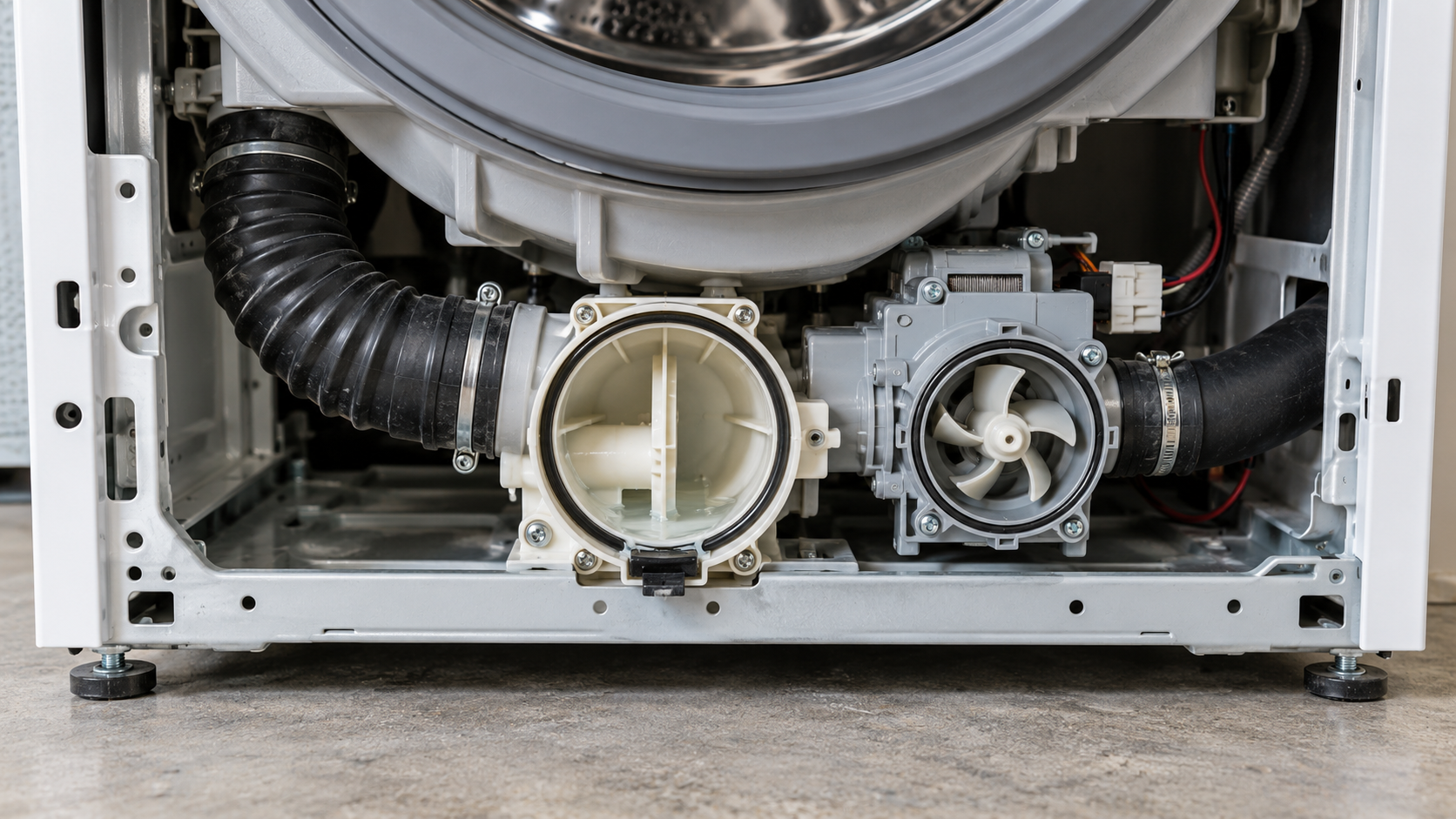
Washing Machine Drain Pump Explainer
When a washing machine needs to empty, its controller powers a small electric drain pump near the bottom of the outer tub. Water reaches the pump by gravity through a sump hose and often passes a coin trap or filter first. Inside the pump chamber, a motor spins an impeller with short vanes. The rotating impeller transfers energy to the water and directs it toward the outlet hose.
Water enters near the center of the impeller and is accelerated outward by the moving vanes. The surrounding volute-shaped chamber collects that faster flow and guides it into the discharge connection. This creates lower pressure at the inlet, so more water from the tub follows. The pump does not lift every drop directly with a blade; it maintains a continuous flow through pressure and velocity changes.
The motor may use a permanent-magnet rotor separated from electrical windings by a watertight housing. Some designs allow a small initial free rotation before the impeller engages, helping the motor start against debris. Check valves or hose routing limit backward flow after shutdown. The drain hose’s maximum height and length matter because the pump must overcome elevation and friction while still moving water quickly enough.
Lint, coins, buttons, and threads are common obstacles. A filter protects the impeller, but an overfilled filter reduces flow and can leave the load wet. String can wrap around a shaft, while a rigid object may stop or break a vane. A humming sound with no drainage suggests the motor is energized but the impeller or path is blocked, although hose kinks and plumbing clogs can produce similar symptoms.
Service begins by disconnecting power and controlling the water that will escape when a filter or hose opens. Machines differ, so access and emergency-drain procedures must follow the manual. The impeller may feel slightly notchy because of its magnetic motor and should not be forced. Leaks, damaged wiring, repeated breaker trips, or a cracked pump housing require qualified repair rather than continued operation.
The drain pump is a compact centrifugal flow system adapted for dirty household water. Gravity supplies the inlet, the motor turns the impeller, the chamber converts swirling motion into directed discharge, and the hose carries water to the standpipe. Good drainage depends on an open filter, an undamaged impeller, airtight inlet connections, and a hose installation that stays within the pump’s designed lift.
A motor spins an impeller that accelerates water outward in a pump chamber, drawing more from the tub and sending it through the drain hose. Key terms include sump, filter, impeller, volute, inlet, discharge, lift, and check valve.
The motor may be energized while a coin, thread, blocked filter, kinked hose, or jammed impeller prevents water movement.
The pump must supply pressure to lift water to the hose crest. Excessive height or length increases resistance and can leave water in the machine.
Explore more "Explainers"
Discover additional explainers across politics, science, business, technology, and other fields. Each explainer breaks down a complex idea into clear, everyday language—helping you better understand how major concepts, systems, and debates shape the world around us.