

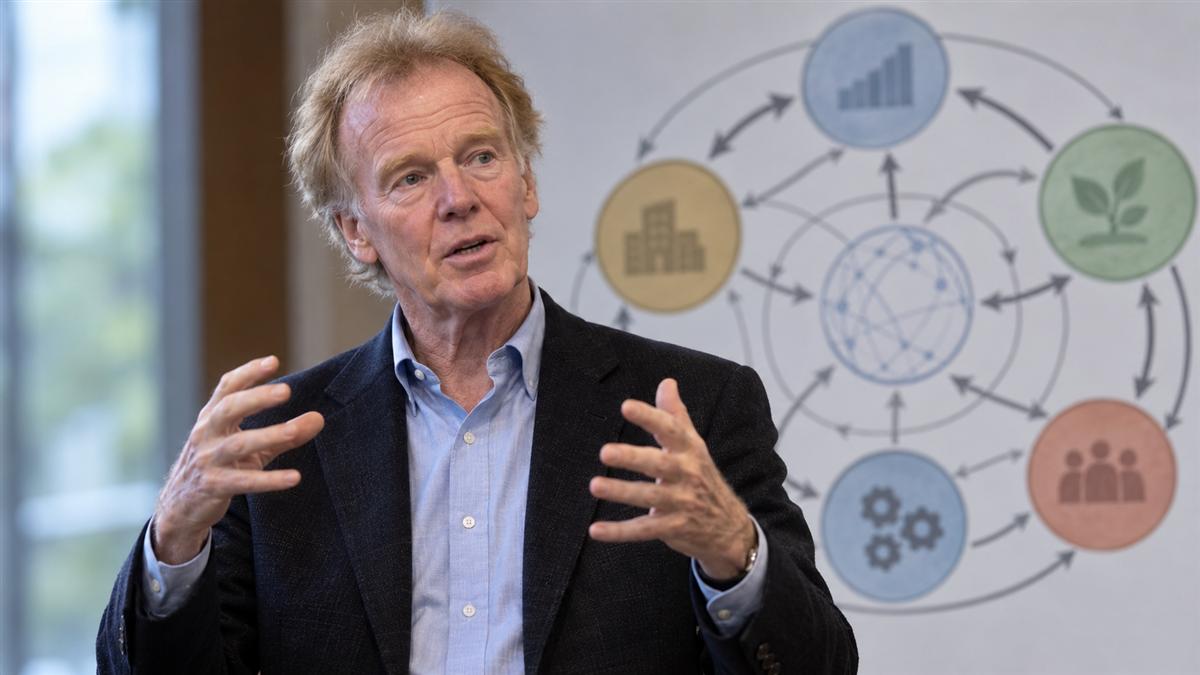
“These challenges cannot be met by isolated heroic leaders.”
Peter M. Senge wrote this warning in “Leading Learning Organizations,” a 1995 MIT Center for Organizational Learning monograph. He was addressing complex, systemic problems that cross functions and institutions, where a powerful individual cannot see every consequence or compel lasting adaptation from the top. Senge replaces the mythology of the solitary rescuer with leadership distributed among executives, internal networkers, and people who build learning communities. Their different positions let them connect formal authority, local knowledge, relationships, and experimentation into a capacity no single office can possess. Read closely, the line is not a promise of easy certainty. It asks decision makers to examine the assumptions and conditions behind ordinary results, especially when familiar routines conceal what customers, employees, or the wider system actually experience.
Leaders can map who understands the system, who has authority, who is trusted across boundaries, and who can run a useful experiment. A coalition should share a purpose and evidence while giving local actors enough discretion to adapt the work to conditions they know best. Managers can make the principle observable by naming the decision it should change, the evidence they will review, and the person accountable for follow-through. That discipline keeps an admired quotation from becoming wall decoration and turns it into a repeatable way of working.
Distributed leadership is not an excuse for executives to disappear or leave risk with people who lack resources. Someone must clarify boundaries, fund the work, resolve conflicts, and remain accountable for outcomes. Collaboration becomes theater when responsibility is everywhere in language and nowhere in practice. The useful interpretation keeps ambition and restraint together. Leaders should ask who benefits, who bears the risk, what would disconfirm the current belief, and whether people have a fair way to challenge the decision before a local success is mistaken for a durable one.
Climate transition, supply-chain resilience, cybersecurity, and responsible AI all move through networks of specialists and affected communities. Organizations that depend on one charismatic sponsor are fragile; those that build many capable leaders can continue learning when roles, technologies, or external conditions change. A leadership map should reveal missing voices and the decisions that must move closer to expertise before the next crisis arrives. A practical review can compare the stated promise with customer outcomes, employee experience, operating evidence, and unintended effects. It should record what changed, what remains uncertain, and when the decision will be examined again with documented evidence. The final test is not whether the line sounds inspiring, but whether it helps the organization learn sooner, act more responsibly, and create value that can survive scrutiny over time.
Peter M. Senge wrote this warning in “Leading Learning Organizations,” a 1995 MIT Center for Organizational Learning monograph. He was addressing complex, systemic problems that cross functions and institutions, where a powerful individual cannot see every consequence or compel lasting adaptation from the top.
Senge replaces the mythology of the solitary rescuer with leadership distributed among executives, internal networkers, and people who build learning communities. Their different positions let them connect formal authority, local knowledge, relationships, and experimentation into a capacity no single office can possess.
Leaders can map who understands the system, who has authority, who is trusted across boundaries, and who can run a useful experiment. A coalition should share a purpose and evidence while giving local actors enough discretion to adapt the work to conditions they know best.
Distributed leadership is not an excuse for executives to disappear or leave risk with people who lack resources. Someone must clarify boundaries, fund the work, resolve conflicts, and remain accountable for outcomes. Collaboration becomes theater when responsibility is everywhere in language and nowhere in practice.
Climate transition, supply-chain resilience, cybersecurity, and responsible AI all move through networks of specialists and affected communities. Organizations that depend on one charismatic sponsor are fragile; those that build many capable leaders can continue learning when roles, technologies, or external conditions change.
A leadership map should reveal missing voices and the decisions that must move closer to expertise before the next crisis arrives.
Explore more "Quotes of The Day"
Discover more notable quotes from influential voices across politics, science, business, technology, sports, and culture. Each quote offers insight into how ideas, beliefs, and decisions shape the world around us.