

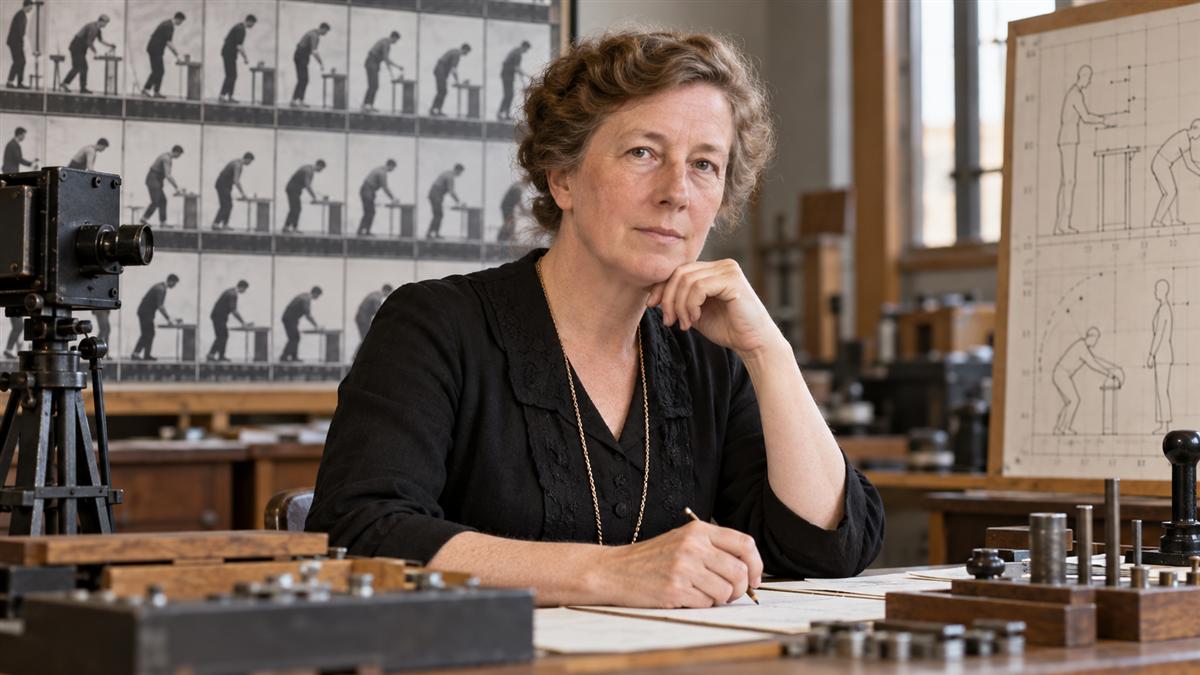
“The emphasis in successful management lies on the man, not on the work.”
Lillian Moller Gilbreth stated this principle in The Psychology of Management in 1914. Working at the intersection of psychology, engineering, and motion study, she argued that efficiency should adapt equipment, materials, methods, and teaching to human capability rather than treat the worker as an afterthought. Her human-centered emphasis complicates the stereotype of scientific management as a stopwatch alone. Work can be simplified while also reducing fatigue, enabling learning, and recognizing individual differences. Better performance and better human experience need not be separate engineering problems. Read closely, the line is not a promise of easy certainty. It asks decision makers to examine the assumptions and conditions behind ordinary results, especially when familiar routines conceal what customers, employees, or the wider system actually experience.
Teams can observe people doing real work, ask where strain and confusion occur, and redesign tools or sequence before demanding more effort. Operators should participate in experiments because they understand exceptions and burdens that a distant analyst may never see. Managers can make the principle observable by naming the decision it should change, the evidence they will review, and the person accountable for follow-through. That discipline keeps an admired quotation from becoming wall decoration and turns it into a repeatable way of working.
Efficiency can still become coercive when management defines the outcome without worker voice or uses saved time only to increase pace. Human-centered design must include safety, dignity, fair sharing of gains, accessibility, and a genuine ability to question the supposedly best method. The useful interpretation keeps ambition and restraint together. Leaders should ask who benefits, who bears the risk, what would disconfirm the current belief, and whether people have a fair way to challenge the decision before a local success is mistaken for a durable one.
As AI redesigns office work, Gilbreth’s principle asks whether automation fits people or forces people to compensate for a system’s limitations. Measures should include cognitive load, error recovery, skill growth, and well-being alongside throughput and labor cost. An ergonomic workflow review can make invisible effort visible and direct investment toward the conditions that let people perform sustainably. A practical review can compare the stated promise with customer outcomes, employee experience, operating evidence, and unintended effects. It should record what changed, what remains uncertain, and when the decision will be examined again with documented evidence. The final test is not whether the line sounds inspiring, but whether it helps the organization learn sooner, act more responsibly, and create value that can survive scrutiny over time.
Lillian Moller Gilbreth stated this principle in The Psychology of Management in 1914. Working at the intersection of psychology, engineering, and motion study, she argued that efficiency should adapt equipment, materials, methods, and teaching to human capability rather than treat the worker as an afterthought.
Her human-centered emphasis complicates the stereotype of scientific management as a stopwatch alone. Work can be simplified while also reducing fatigue, enabling learning, and recognizing individual differences. Better performance and better human experience need not be separate engineering problems.
Teams can observe people doing real work, ask where strain and confusion occur, and redesign tools or sequence before demanding more effort. Operators should participate in experiments because they understand exceptions and burdens that a distant analyst may never see.
Efficiency can still become coercive when management defines the outcome without worker voice or uses saved time only to increase pace. Human-centered design must include safety, dignity, fair sharing of gains, accessibility, and a genuine ability to question the supposedly best method.
As AI redesigns office work, Gilbreth’s principle asks whether automation fits people or forces people to compensate for a system’s limitations. Measures should include cognitive load, error recovery, skill growth, and well-being alongside throughput and labor cost.
An ergonomic workflow review can make invisible effort visible and direct investment toward the conditions that let people perform sustainably.
Explore more "Quotes of The Day"
Discover more notable quotes from influential voices across politics, science, business, technology, sports, and culture. Each quote offers insight into how ideas, beliefs, and decisions shape the world around us.