

Single-Handle Mixing Cartridge Ports
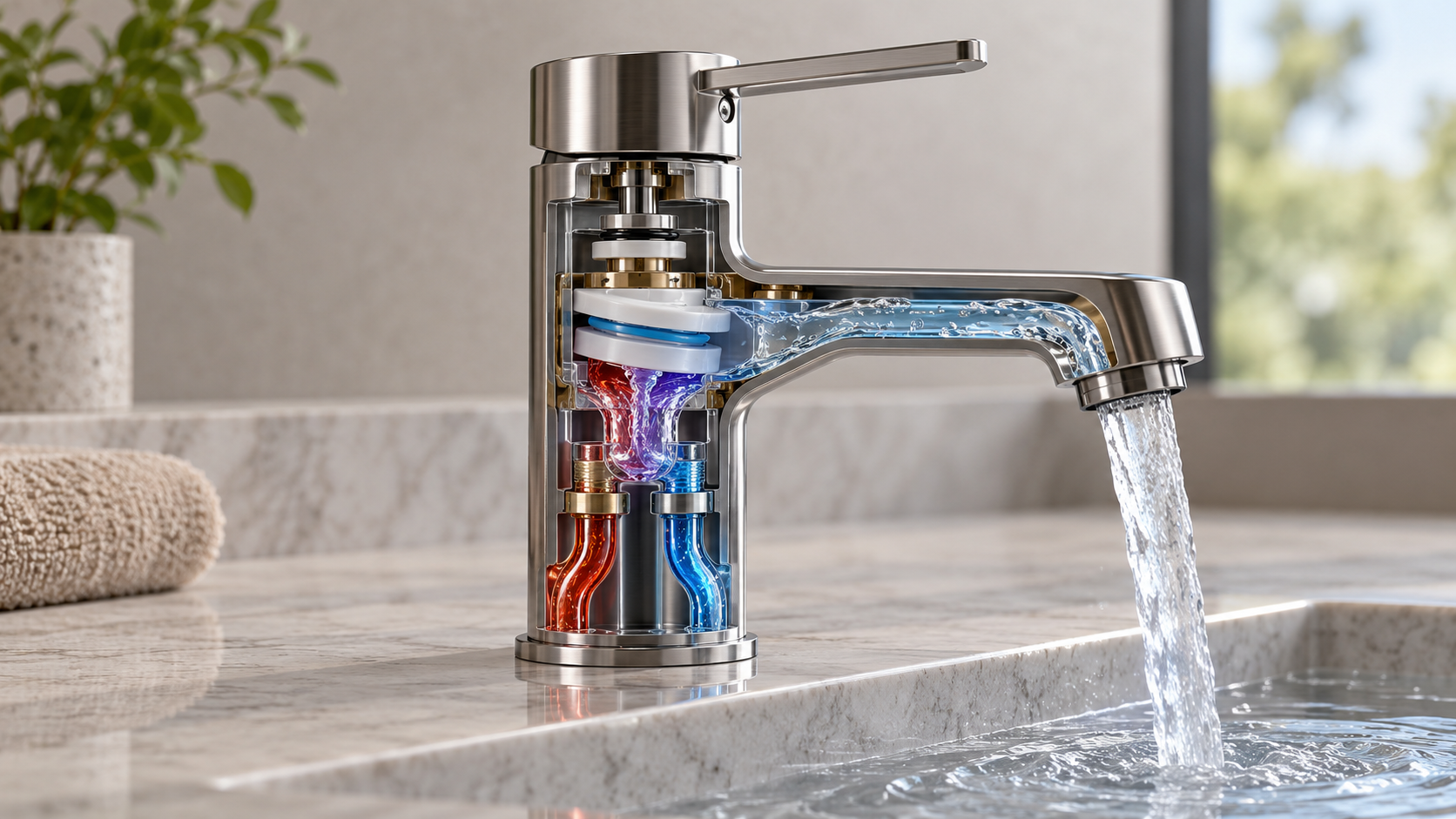
A cartridge whose moving plate changes the overlap between hot, cold, and outlet ports is the core of this everyday mechanism. In normal use, lifting or rotating the handle shifts the plate across fixed openings, changing total flow and the proportion admitted from each supply before the streams combine and leave through the spout. The visible result comes from ordinary geometry, material behavior, pressure, friction, or stored energy working as a sequence rather than from one mysterious part. Identifying the input, the moving or controlling element, and the output makes the whole device easier to understand.
The sequence begins when the user or surrounding system supplies motion, force, heat, or fluid pressure. Lifting or rotating the handle shifts the plate across fixed openings, changing total flow and the proportion admitted from each supply before the streams combine and leave through the spout Each component therefore has a specific job: one admits or stores energy, another guides or resists motion, and another produces the useful effect. If a seal, contact face, linkage, or passage cannot do its part, the object may look intact while performance changes sharply.
Real-world behavior depends on cartridge geometry, supply pressures and temperatures, seal condition, ceramic surfaces, debris, handle travel, and stop adjustment. These variables explain why two versions of the same device can feel different, or why a familiar product changes after installation, cleaning, wear, temperature shifts, or a new load. The mechanism performs predictably only inside the range assumed by its dimensions, materials, and intended operating conditions.
Supply valves are closed before service, and trapped pressure is relieved. Screens, seats, and cartridge surfaces are protected from grit; persistent dripping often requires the correct replacement cartridge or seals. Good troubleshooting starts with the actual path of force, motion, air, water, or electrical control instead of appearance alone. A symptom narrows the possibilities but rarely proves a single failed part, so inspection proceeds in a safe order and compares the device with its manufacturer instructions.
The handle position cannot guarantee a safe outlet temperature when supply conditions change. Scald protection depends on the fixture design, water-heater setting, code requirements, and any pressure- or thermostatic-balancing device. Ratings and warnings matter because the same mechanical advantage, pressure, sharp edge, stored spring energy, hot surface, or chemical compatibility that makes a tool useful can also magnify misuse. Applying extra force to a jam usually transfers the problem to a weaker component rather than correcting alignment, blockage, contamination, or wear.
In short, a single-handle faucet mix hot and cold water works through a coordinated chain of input, control, and output. Lifting or rotating the handle shifts the plate across fixed openings, changing total flow and the proportion admitted from each supply before the streams combine and leave through the spout The practical lesson is to preserve the surfaces and moving parts that create that sequence, use the device within its specified range, and treat unexpected leakage, heat, sound, resistance, looseness, or misalignment as evidence worth investigating before continued use.
Lifting or rotating the handle shifts the plate across fixed openings, changing total flow and the proportion admitted from each supply before the streams combine and leave through the spout Key factors include cartridge geometry, supply pressures and temperatures, seal condition, ceramic surfaces, debris, handle travel, and stop adjustment.
The cartridge maps handle movement to port overlap, using one direction mainly for area and another for the hot-cold ratio.
Scratches, scale, or damaged seals leave a small path between pressurized inlet ports and the outlet.
Explore more "Explainers"
Discover additional explainers across politics, science, business, technology, and other fields. Each explainer breaks down a complex idea into clear, everyday language—helping you better understand how major concepts, systems, and debates shape the world around us.