

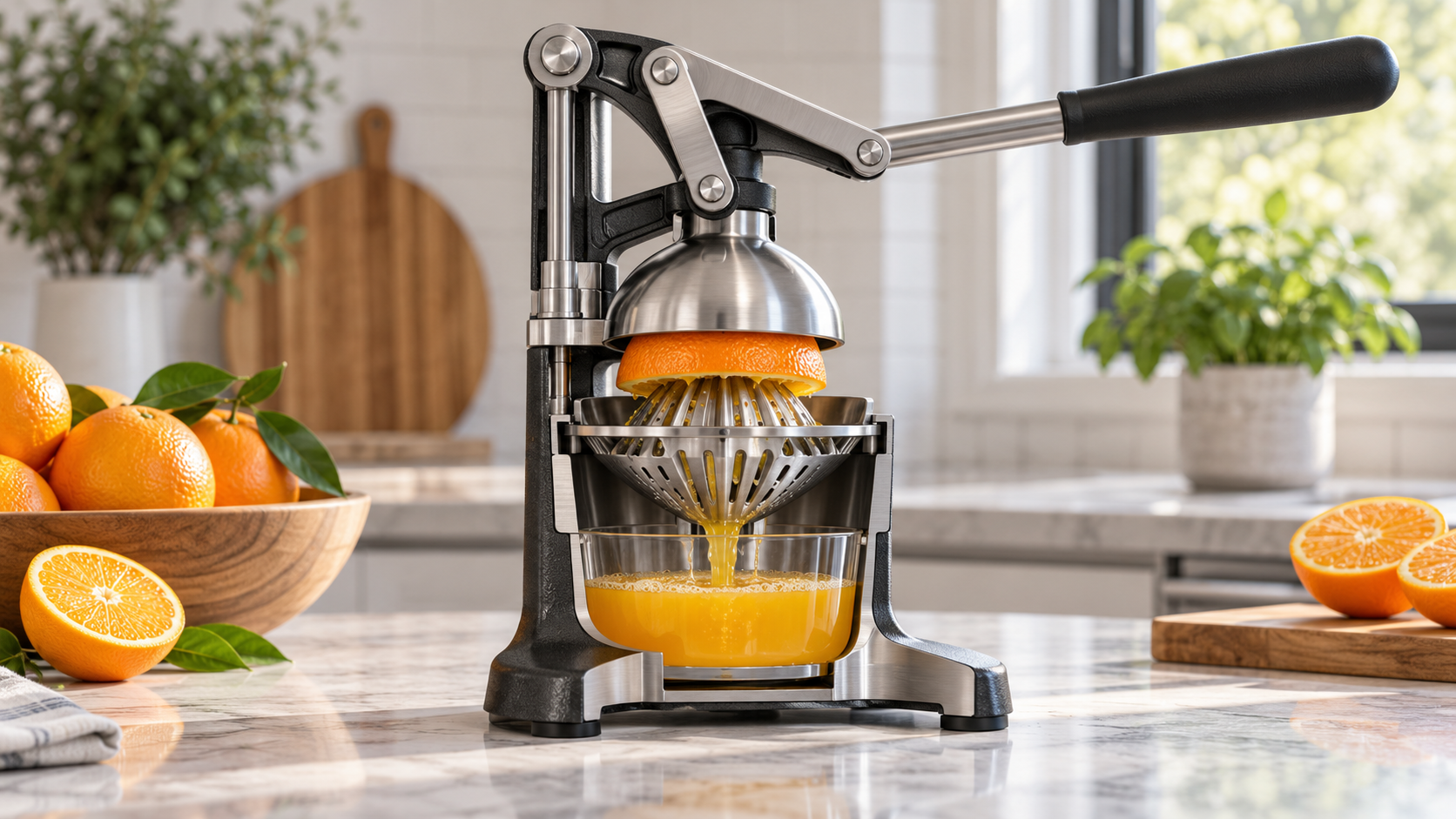
Lever Citrus Press Mechanical Advantage
A long hand lever and linkage that drive a pressing dome toward a supported fruit half is the core of this everyday mechanism. In normal use, the hand applies force far from the main pivot, creating torque; the shorter output arm and linkage convert that torque into a larger downward force that compresses the fruit against a cone or perforated cup. The visible result comes from ordinary geometry, material behavior, pressure, friction, or stored energy working as a sequence rather than from one mysterious part. Identifying the input, the moving or controlling element, and the output makes the whole device easier to understand.
The sequence begins when the user or surrounding system supplies motion, force, heat, or fluid pressure. The hand applies force far from the main pivot, creating torque; the shorter output arm and linkage convert that torque into a larger downward force that compresses the fruit against a cone or perforated cup Each component therefore has a specific job: one admits or stores energy, another guides or resists motion, and another produces the useful effect. If a seal, contact face, linkage, or passage cannot do its part, the object may look intact while performance changes sharply.
Real-world behavior depends on handle length, pivot spacing, linkage angle, fruit size and ripeness, cup alignment, bearing friction, frame stiffness, and pressing stroke. These variables explain why two versions of the same device can feel different, or why a familiar product changes after installation, cleaning, wear, temperature shifts, or a new load. The mechanism performs predictably only inside the range assumed by its dimensions, materials, and intended operating conditions.
Fruit is centered, the press stands on a stable surface, and fingers stay clear of the linkage and cup. Removable food-contact parts are washed and dried, while loose pivots or a cracked frame are repaired. Good troubleshooting starts with the actual path of force, motion, air, water, or electrical control instead of appearance alone. A symptom narrows the possibilities but rarely proves a single failed part, so inspection proceeds in a safe order and compares the device with its manufacturer instructions.
Mechanical advantage increases force but not energy; the handle travels farther than the press head. Excessive force can damage the rind, mechanism, counter, or user, so the product limits apply. Ratings and warnings matter because the same mechanical advantage, pressure, sharp edge, stored spring energy, hot surface, or chemical compatibility that makes a tool useful can also magnify misuse. Applying extra force to a jam usually transfers the problem to a weaker component rather than correcting alignment, blockage, contamination, or wear.
In short, a lever citrus press multiply hand force works through a coordinated chain of input, control, and output. The hand applies force far from the main pivot, creating torque; the shorter output arm and linkage convert that torque into a larger downward force that compresses the fruit against a cone or perforated cup The practical lesson is to preserve the surfaces and moving parts that create that sequence, use the device within its specified range, and treat unexpected leakage, heat, sound, resistance, looseness, or misalignment as evidence worth investigating before continued use.
The hand applies force far from the main pivot, creating torque; the shorter output arm and linkage convert that torque into a larger downward force that compresses the fruit against a cone or perforated cup Key factors include handle length, pivot spacing, linkage angle, fruit size and ripeness, cup alignment, bearing friction, frame stiffness, and pressing stroke.
Changing linkage angles can increase output force as the handle approaches its closed position, while head travel per degree becomes smaller.
No. It trades a longer hand movement for a shorter, stronger pressing movement, aside from frictional losses.
Explore more "Explainers"
Discover additional explainers across politics, science, business, technology, and other fields. Each explainer breaks down a complex idea into clear, everyday language—helping you better understand how major concepts, systems, and debates shape the world around us.