

On This Day in Business: July 9, 1877
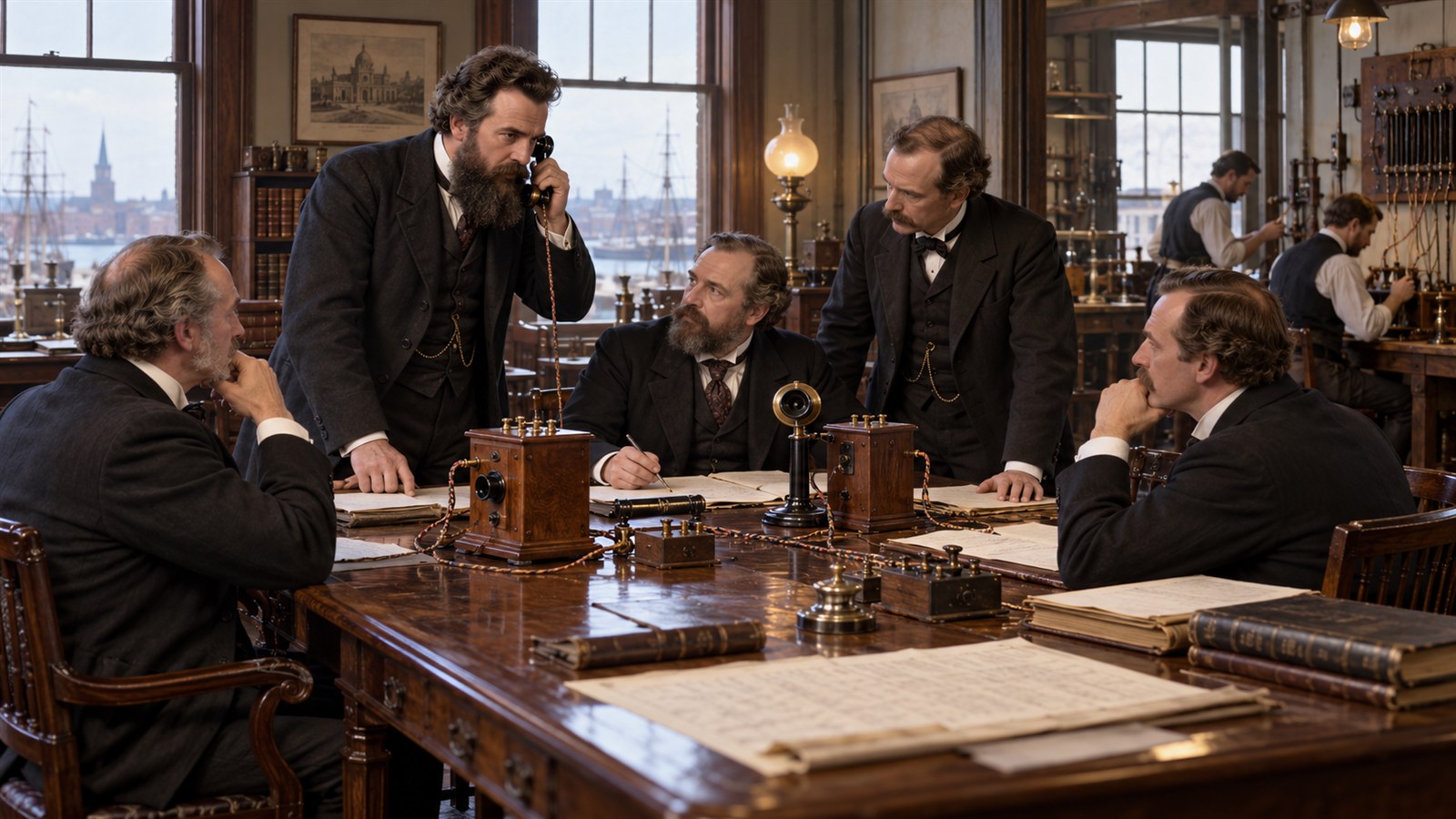
On July 9, 1877, associates of Alexander Graham Bell organized the Bell Telephone Company in Massachusetts. Bell had received his principal telephone patent the previous year and demonstrated that recognizable speech could travel over an electrical wire. A device alone, however, did not create a communications business. Gardiner Greene Hubbard, Thomas Sanders, and other partners needed to control patents, finance manufacturing, license equipment, and persuade customers to adopt an unfamiliar system. The new company gave those tasks a legal and commercial home while Bell continued research and public demonstrations.
Early telephones were commonly leased rather than sold. That arrangement protected the company's technology and produced recurring revenue, but it also made Bell responsible for equipment, connections, and service. At first, instruments linked two fixed points, such as an office and a workshop. Exchanges soon allowed many subscribers to reach one another through operators and switchboards. Each new connection could make every existing subscription more useful, creating a network effect. Building that value required capital for wires, poles, switching equipment, installers, repairs, billing, and local operating companies.
Competition and litigation followed rapidly. Western Union backed a rival system and possessed deep telegraph experience, while inventors contested patent claims and local companies experimented with different equipment. An 1879 settlement strengthened Bell's control of telephone patents and helped define the industry's structure. The enterprise evolved through reorganizations that eventually produced the American Bell Telephone Company and, later, American Telephone and Telegraph. Long-distance lines, standardized practices, research laboratories, and regulated local monopolies turned a fragile voice experiment into national infrastructure.
The July organization matters because networks must be managed as systems. Bell's patent was valuable, yet customers cared about whom they could call, whether the connection worked, and how quickly faults were repaired. Leasing aligned the company with ongoing performance and supplied funds for expansion. Exchanges transformed isolated devices into membership in a growing service. The same challenge appears in later communications markets: technical novelty attracts attention, but coverage, compatibility, reliability, and support create durable value. The Bell Telephone Company was an early attempt to build all of those complements around an invention. Local telephone companies also had to decide where to build first. Dense business districts generated more calls per mile of wire than scattered households, so commercial users often justified initial investment. As costs declined and coverage grew, residential service became more attractive. The pattern shows how networks may begin with concentrated high-value customers before expanding toward broader access.
Bell's telephone patent demonstrated electrical speech, but commercialization required a company to coordinate rights and capital.
Partners organized the Bell Telephone Company on July 9, 1877, to license equipment and develop the market.
Leasing produced recurring revenue while keeping installation, maintenance, and technical control within the network.
Telephone exchanges increased the usefulness of every instrument by allowing many subscribers to reach one another.
Patent disputes, local operators, long-distance lines, standards, and regulation shaped the system that followed.
The company showed that a communications invention becomes valuable through coverage, reliability, compatibility, and service.
Explore more of "On This Day ..."
Discover more events from the same date across news, politics, technology, sports, and other fields. Each link highlights significant moments that shaped history on different fronts.