

On This Day in Business: July 10, 1962
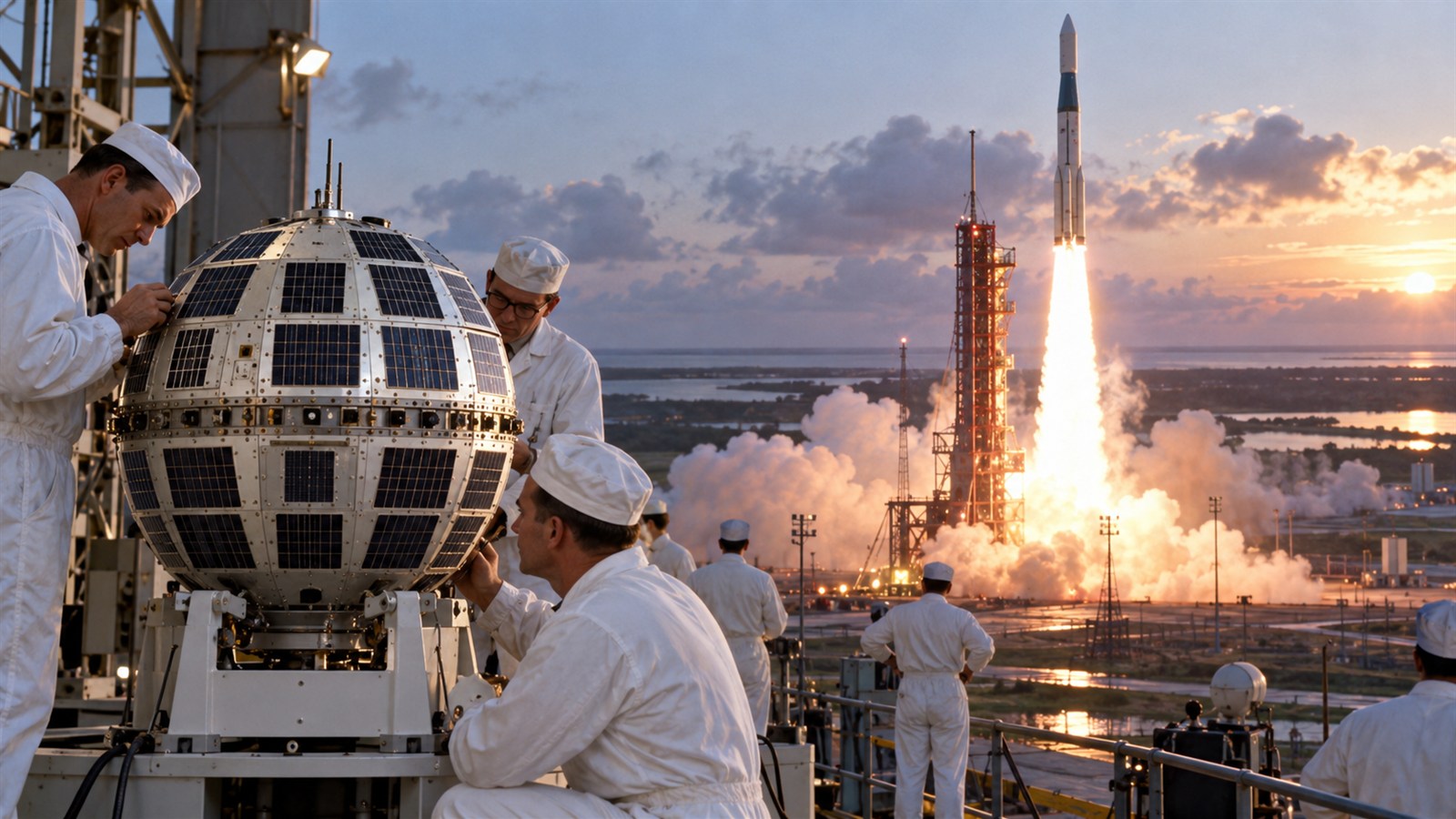
On July 10, 1962, a Delta rocket launched Telstar 1 from Cape Canaveral. Built by Bell Telephone Laboratories for AT&T with help from international partners, the small faceted satellite received microwave signals, amplified them, and transmitted them back to Earth. It was the first active satellite associated with commercial communications and a major test of whether space could carry telephone, television, and data traffic between continents. Unlike a passive reflector, Telstar contained electronics powered by solar cells, turning an orbiting object into a working relay station.
The service required far more than the satellite. Large steerable ground antennas at Andover, Maine, Pleumeur-Bodou in France, and Goonhilly Downs in Britain had to track a fast-moving spacecraft. Engineers coordinated frequencies, timing, signal strength, and international operating windows. Because Telstar used a low orbit, each pass offered only a short period of contact before the satellite fell below the horizon. The system was therefore an experiment in global scheduling as much as a hardware demonstration. Its costs were shared across companies, governments, launch providers, and national communications organizations.
The day after launch, Telstar relayed television images, telephone calls, facsimiles, and data across the Atlantic. Later broadcasts gave audiences an immediate sense of events happening on another continent. Radiation eventually damaged the satellite's electronics, limiting its useful life, but the demonstrations validated demand and informed later designs. Communications satellites moved toward higher orbits and continuous coverage, supporting global broadcasting, international telephone capacity, navigation, weather observation, finance, and the internet's physical backbone.
The launch matters because infrastructure experiments can create markets before they deliver permanent service. Telstar's short contact windows and brief life were serious limitations, yet customers, broadcasters, engineers, and regulators could finally observe transatlantic electronic communication through space. That proof reduced uncertainty for the next round of investment. The business value also came from coordinated standards: a satellite without compatible ground stations was useless. Telstar demonstrated a recurring rule of network technology. The most visible component may orbit overhead, but reliable service depends on an entire chain of institutions and machines agreeing where, when, and how to connect. Telstar also altered expectations inside the media business. Broadcasters could imagine live international programming rather than film flown across an ocean, creating demand for satellite time and ground-station coordination. The demonstrations turned immediacy into a premium feature. Once audiences experienced distant events as they occurred, delayed coverage increasingly felt like a limitation instead of a normal condition.
Bell Laboratories built Telstar 1 as an active relay that received, amplified, and retransmitted microwave signals.
A Delta rocket launched the satellite from Cape Canaveral on July 10, 1962.
Ground stations in the United States, France, and Britain tracked short passes through Telstar's low orbit.
The system carried television, telephone, facsimile, and data, proving several commercial uses with one platform.
Radiation damage shortened the experiment, but its results guided later satellites with broader and more reliable coverage.
Telstar showed that global communications depend on coordinated spacecraft, ground equipment, standards, schedules, and partners.
Explore more of "On This Day ..."
Discover more events from the same date across news, politics, technology, sports, and other fields. Each link highlights significant moments that shaped history on different fronts.