

“Quality control starts and ends with education.”
Kaoru Ishikawa repeatedly taught that quality control begins and ends with education, a principle preserved by the Union of Japanese Scientists and Engineers. His work on company-wide quality control and quality circles treated learning as a continuing responsibility rather than a one-time technical course. Standards, diagrams, and statistical tools matter only when people understand why they are used and can adapt them intelligently. Education develops the judgment to recognize abnormal conditions, investigate causes, collaborate across functions, and improve a standard instead of merely following it. The business value of the line appears when it changes a real decision. It directs attention toward assumptions that routine can hide and invites a team to examine the system behind an outcome instead of treating the visible result as a complete explanation.
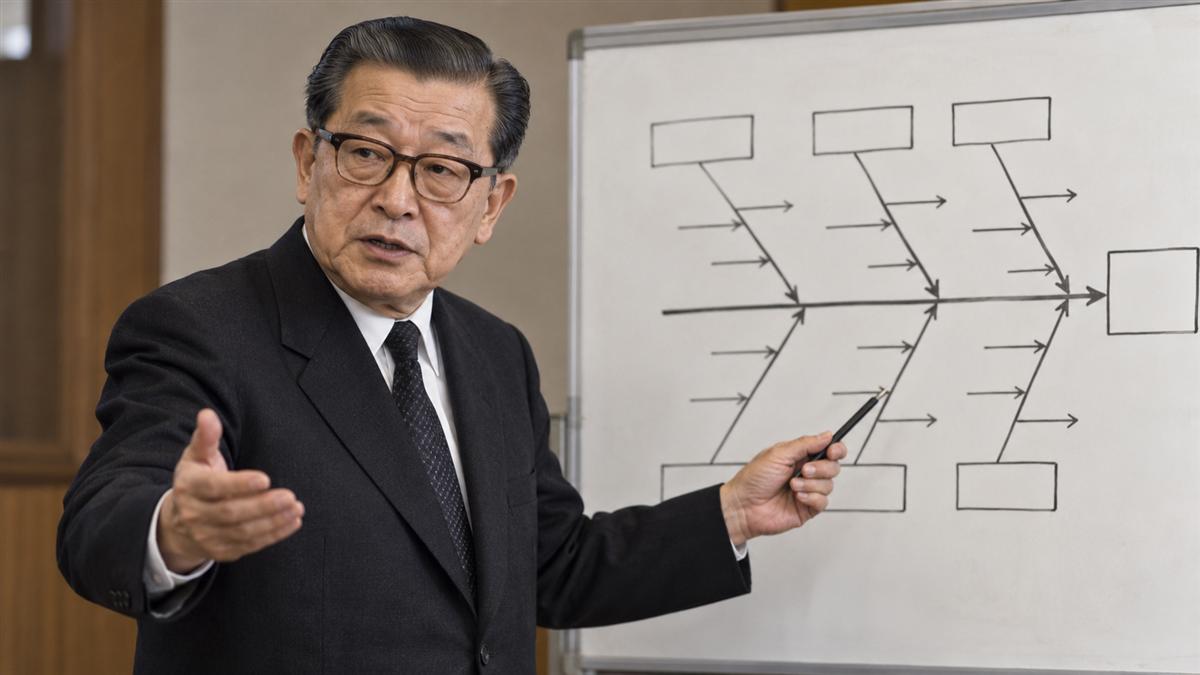
Organizations can combine short lessons with real workplace problems, letting employees gather evidence, map causes, test a countermeasure, and teach what they learned. Leaders should participate so education changes management behavior as well as frontline technique. Application therefore requires an explicit mechanism: what should people do differently, what signal should move, and when will the team examine the result? Writing those elements down turns general agreement into a testable management practice.
Training hours are not proof of learning, and quality education should not become a compliance performance. People need time, coaching, useful data, and authority to apply knowledge. A course that leaves the process and incentives untouched will rarely change results. Context matters because an idea that improves one situation can create harm in another. Leaders need boundaries, dissent, representative evidence, and a way to correct course. Accountability cannot be delegated to the quotation or the tool used to implement it.
As tools and models evolve quickly, yesterday’s instructions can become tomorrow’s risk. Continuous education helps teams understand AI limitations, data provenance, cybersecurity, accessibility, and customer expectations while retaining the habit of investigating the work directly. A quality-learning cycle can connect each lesson to an observed problem, a tested change, and a short teach-back that demonstrates whether the team can use the idea without the instructor. The review should preserve what was known when the choice was made, document what changed, and share the learning beyond one team. Repeated with discipline, that cycle converts a memorable sentence into better judgment rather than another short-lived management theme. It also makes the cost of assumptions visible, allowing future teams to reuse proven knowledge while recognizing the point at which a different customer, risk, or operating environment requires fresh testing.
Kaoru Ishikawa repeatedly taught that quality control begins and ends with education, a principle preserved by the Union of Japanese Scientists and Engineers. His work on company-wide quality control and quality circles treated learning as a continuing responsibility rather than a one-time technical course.
Standards, diagrams, and statistical tools matter only when people understand why they are used and can adapt them intelligently. Education develops the judgment to recognize abnormal conditions, investigate causes, collaborate across functions, and improve a standard instead of merely following it.
Organizations can combine short lessons with real workplace problems, letting employees gather evidence, map causes, test a countermeasure, and teach what they learned. Leaders should participate so education changes management behavior as well as frontline technique.
Training hours are not proof of learning, and quality education should not become a compliance performance. People need time, coaching, useful data, and authority to apply knowledge. A course that leaves the process and incentives untouched will rarely change results.
As tools and models evolve quickly, yesterday’s instructions can become tomorrow’s risk. Continuous education helps teams understand AI limitations, data provenance, cybersecurity, accessibility, and customer expectations while retaining the habit of investigating the work directly.
A quality-learning cycle can connect each lesson to an observed problem, a tested change, and a short teach-back that demonstrates whether the team can use the idea without the instructor.
Explore more "Quotes of The Day"
Discover more notable quotes from influential voices across politics, science, business, technology, sports, and culture. Each quote offers insight into how ideas, beliefs, and decisions shape the world around us.