

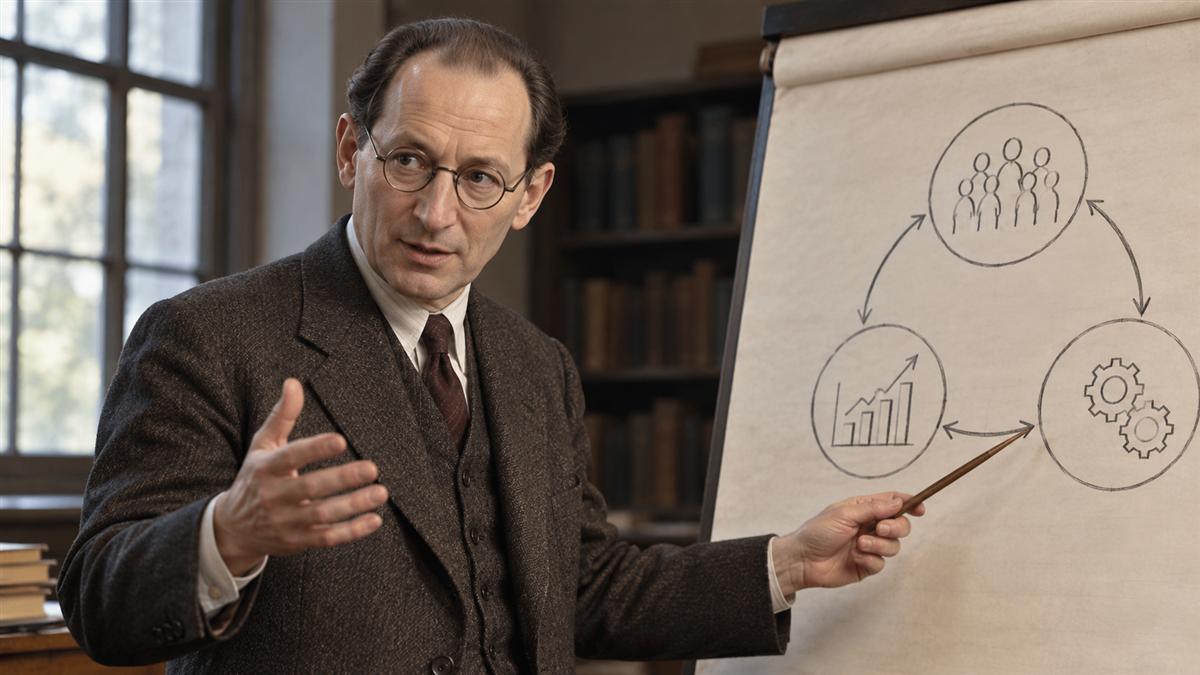
“There is nothing so practical as a good theory.”
Kurt Lewin used this formulation while arguing for a productive relationship between research and action. A good theory organizes observation, identifies mechanisms, and generates expectations that can be tested, making it more useful than an isolated technique copied without understanding. In management, theory is the explanation linking an intervention to an outcome. When that link is explicit, a team can examine assumptions, detect why a practice failed in a new context, and improve the model instead of merely repeating or abandoning the tactic. Behind the concise wording is a claim about how organizations create results. It encourages leaders to look beyond individual effort and examine design, incentives, information, relationships, and the customer context that determine whether a good intention becomes reliable performance.
Leaders can write a short theory of change for a major initiative: if the organization does these things, under these conditions, these mechanisms should produce these measurable effects. Evidence and dissent then have a clear structure to challenge. Managers can translate the claim into a small experiment with a baseline, an owner, a defined customer or employee outcome, and a review date. Specificity protects the work from drifting into broad language that nobody can challenge or verify.
A theory earns practical value through testability and revision, not elegance alone. Abstract language can protect a favored belief from reality, while a single successful case can be mistaken for proof. Teams should state disconfirming evidence and competing explanations. Responsible use also requires naming the tradeoff. Speed, cost, autonomy, safety, equity, and learning may not all improve at once. People closest to the consequences should have a meaningful voice, and uncertainty should be reported instead of hidden behind confidence.
AI products often move from prototype to deployment with an implicit theory that faster output equals value. A stronger theory includes adoption, accuracy, workflow change, trust, skill effects, and the circumstances in which human judgment must override the system. A project review can replace a vague promise with a one-page causal model, named assumptions, leading evidence, and a date when the team will decide whether the theory still holds. Evidence from the experiment can guide scaling, revision, or stopping. The durable lesson is to join purpose with measurement and human judgment, so the organization becomes better at seeing reality and responding before a local success or failure hardens into mythology. Recording the decision and its limits gives colleagues a foundation they can inspect, challenge, and improve instead of asking them to rely on memory, authority, or an unexplained result.
Kurt Lewin used this formulation while arguing for a productive relationship between research and action. A good theory organizes observation, identifies mechanisms, and generates expectations that can be tested, making it more useful than an isolated technique copied without understanding.
In management, theory is the explanation linking an intervention to an outcome. When that link is explicit, a team can examine assumptions, detect why a practice failed in a new context, and improve the model instead of merely repeating or abandoning the tactic.
Leaders can write a short theory of change for a major initiative: if the organization does these things, under these conditions, these mechanisms should produce these measurable effects. Evidence and dissent then have a clear structure to challenge.
A theory earns practical value through testability and revision, not elegance alone. Abstract language can protect a favored belief from reality, while a single successful case can be mistaken for proof. Teams should state disconfirming evidence and competing explanations.
AI products often move from prototype to deployment with an implicit theory that faster output equals value. A stronger theory includes adoption, accuracy, workflow change, trust, skill effects, and the circumstances in which human judgment must override the system.
A project review can replace a vague promise with a one-page causal model, named assumptions, leading evidence, and a date when the team will decide whether the theory still holds.
Explore more "Quotes of The Day"
Discover more notable quotes from influential voices across politics, science, business, technology, sports, and culture. Each quote offers insight into how ideas, beliefs, and decisions shape the world around us.