

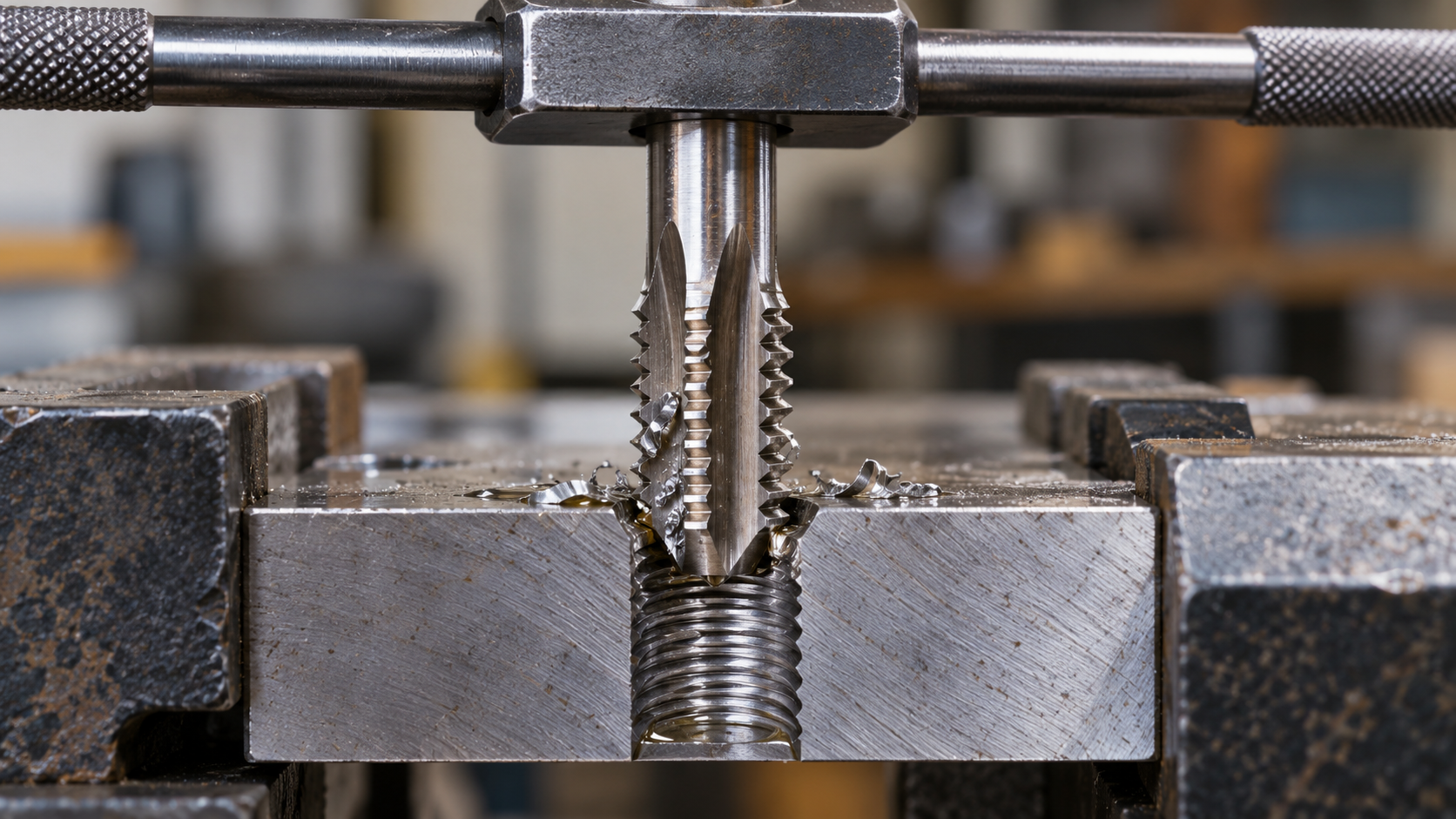
Tap Chamfer, Cutting Teeth, and Chip Flutes
A cutting tap is a hardened, externally threaded tool whose flutes interrupt the thread form to create sharp cutting edges and spaces for chips. The tapered chamfer at the tip lets successive teeth remove the thread groove in small increments; as the tap advances one pitch per revolution, full-form teeth behind the chamfer size and guide the new internal helix. The round hole or helical form is therefore not produced by the tool’s outline alone; it comes from accurately constrained rotation, sharp edge geometry, and steady feed through the work.
The tapered chamfer at the tip lets successive teeth remove the thread groove in small increments; as the tap advances one pitch per revolution, full-form teeth behind the chamfer size and guide the new internal helix. The parts that are not visibly cutting still matter. Relief behind an edge prevents rubbing, the holder keeps the axis aligned, and empty spaces around the cutting faces give displaced material somewhere to go. If any one of those jobs is interrupted, friction and required torque rise quickly.
Real-world performance depends on tap style, thread pitch and class, pilot-hole diameter, chamfer length, flute direction, work material, cutting speed, lubrication, alignment, chip control, hole depth, and reversal method. Those variables influence cutting force, heat, surface finish, dimensional accuracy, and tool life. Tools that look similar may therefore need different speeds, preparation, or technique because their geometry and intended materials are not identical.
The specified tap-drill size is used, the tap starts square in a suitable wrench or machine holder, and cutting proceeds with the lubrication and chip-clearing method recommended for the material and hole type. Progress should feel controlled rather than forced. A sudden rise in resistance, a change in chip shape, squealing, wobble, or a rough finish is a reason to stop, clear the cut, and inspect alignment and edge condition before continuing.
A pilot hole that is too small greatly increases torque, while packed chips, poor alignment, bottoming in a blind hole, or reversing carelessly can break the tap and damage an otherwise finished part. Eye protection and secure workholding are basic safeguards because chips can be sharp and a rotating tool can grab a loose workpiece. Product instructions and established machining data should control tool selection, speed, lubrication, and permitted use.
In short, the mechanism succeeds by turning rotation into a carefully shaped cut. The tapered chamfer at the tip lets successive teeth remove the thread groove in small increments; as the tap advances one pitch per revolution, full-form teeth behind the chamfer size and guide the new internal helix. Accuracy comes from matching the tool to the intended geometry, starting on axis, giving chips a reliable exit path, and stopping before excess force turns a minor setup error into a damaged part or broken tool.
A cutting tap is a hardened, externally threaded tool whose flutes interrupt the thread form to create sharp cutting edges and spaces for chips. The tapered chamfer at the tip lets successive teeth remove the thread groove in small increments; as the tap advances one pitch per revolution, full-form teeth behind the chamfer size and guide the new internal helix.
The chamfer distributes the full thread depth across several teeth so each leading edge removes only part of the material.
They form the cutting faces, create clearance behind the edges, and provide passages for chips, air, and cutting fluid.
Explore more "Explainers"
Discover additional explainers across politics, science, business, technology, and other fields. Each explainer breaks down a complex idea into clear, everyday language—helping you better understand how major concepts, systems, and debates shape the world around us.