

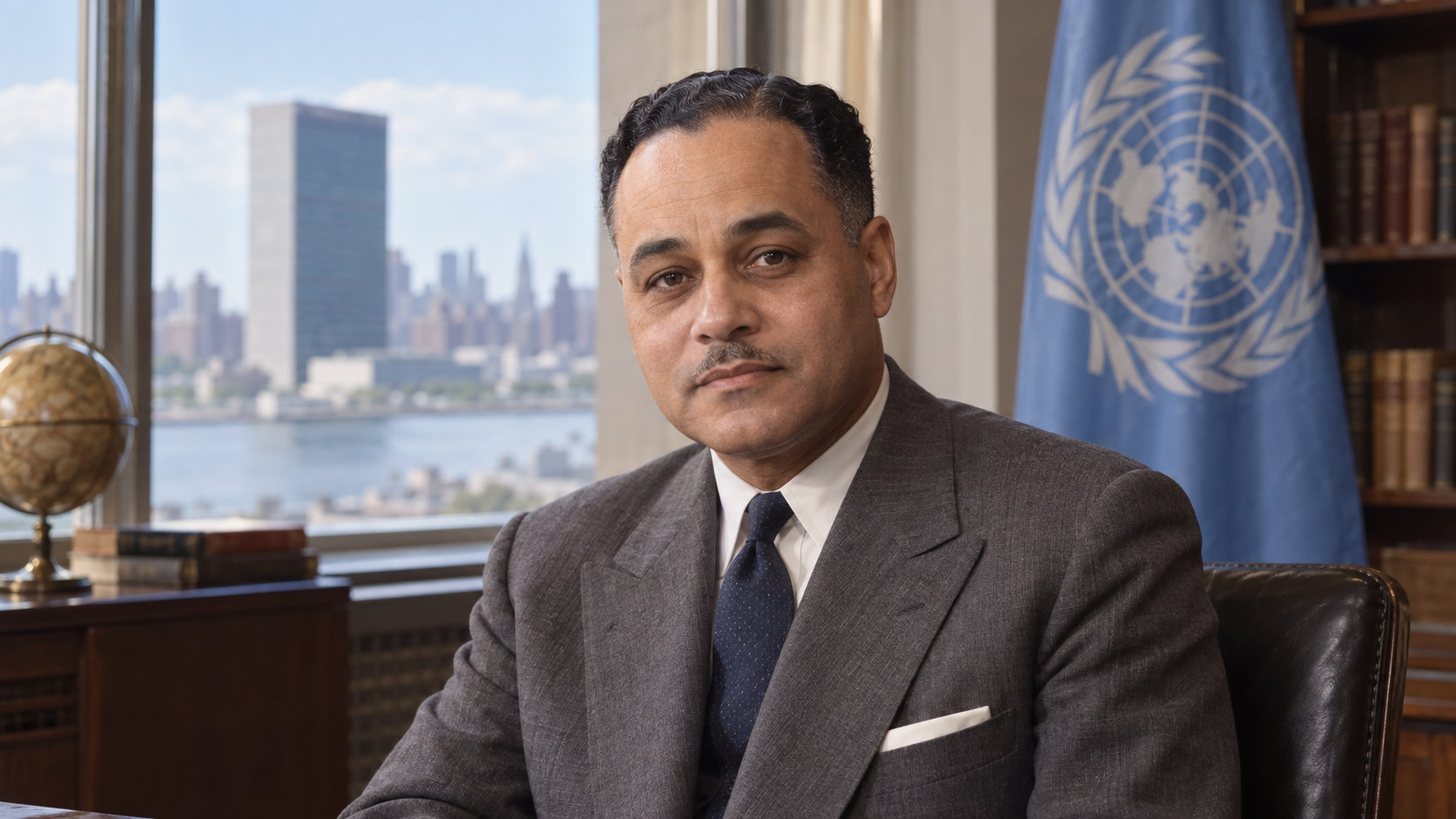
“Peace must be paced by human progress.”
Ralph Bunche’s sentence appears in the published full version of his Nobel lecture, Some Reflections on Peace in Our Time, dated December 11, 1950. The United Nations diplomat had received the Peace Prize for his mediation work on the armistice agreements following the Arab-Israeli war. In the lecture, he considered both immediate international tensions and the longer work required for a secure peace. The featured line introduced a passage connecting peace with food, shelter, health, education, freedom, and human dignity. The Nobel archive notes that his delivered lecture was shorter than the published text. The quotation is therefore attributed here to that full published version rather than presented as a verified word-for-word recording.
The verb paced makes progress part of the work of sustaining peace. Ending a battle can be urgent and valuable without resolving every condition that makes daily life precarious. People may still lack dependable access to necessities or fair ways to influence public decisions. Bunche’s formulation asks readers to consider those conditions alongside military and diplomatic developments. It does not reduce peace to one economic indicator. The surrounding argument includes rights and dignity, so human progress involves how people are treated as well as what they possess. A practical interpretation examines whether an agreement opens room for a better life and whether institutions can help maintain that opportunity.
Bunche was addressing the world of 1950, with the United Nations still a young institution and the Korean War underway. His lecture combined support for negotiation with discussion of the organization’s response to aggression. It should not be read as a claim that development alone can prevent every war or that international institutions can act without authority and support. Likewise, an armistice ends fighting under specified terms; it does not necessarily settle the political questions that produced a conflict. These distinctions matter because an attractive definition of peace can otherwise blur different achievements together. Bunche’s sentence adds a standard for durability without diminishing the immediate value of stopping violence.
For readers following public policy, the quotation encourages attention to what happens after an announcement of peace or recovery. Can people return to education, obtain basic services, and exercise their rights? Are improvements broad enough to reach those whose suffering is easily overlooked? Asking such questions creates a clearer account of progress than ceremonial language can provide. It also leaves room to assess competing proposals through evidence about their results. Good intentions cannot establish that a policy improves living conditions, and a favorable average can conceal serious exclusion. Bunche’s statement directs political attention toward the continuing work that makes a quieter world more livable, joining security with an accountable effort to improve the human conditions beneath it.
The line comes from the published full version of Bunche’s Nobel lecture, dated December 11, 1950.
The Nobel archive explains that the address was shortened in delivery, so the published text should be identified accurately.
Bunche connected peace with basic needs, freedom, and dignity rather than only the absence of fighting.
His argument does not mean that development alone resolves aggression or every political conflict.
An armistice and a durable political settlement are different achievements.
Readers can assess progress through access to services and rights, while checking whether gains reach people otherwise overlooked.
Explore more "Quotes of The Day"
Discover more notable quotes from influential voices across politics, science, business, technology, sports, and culture. Each quote offers insight into how ideas, beliefs, and decisions shape the world around us.