

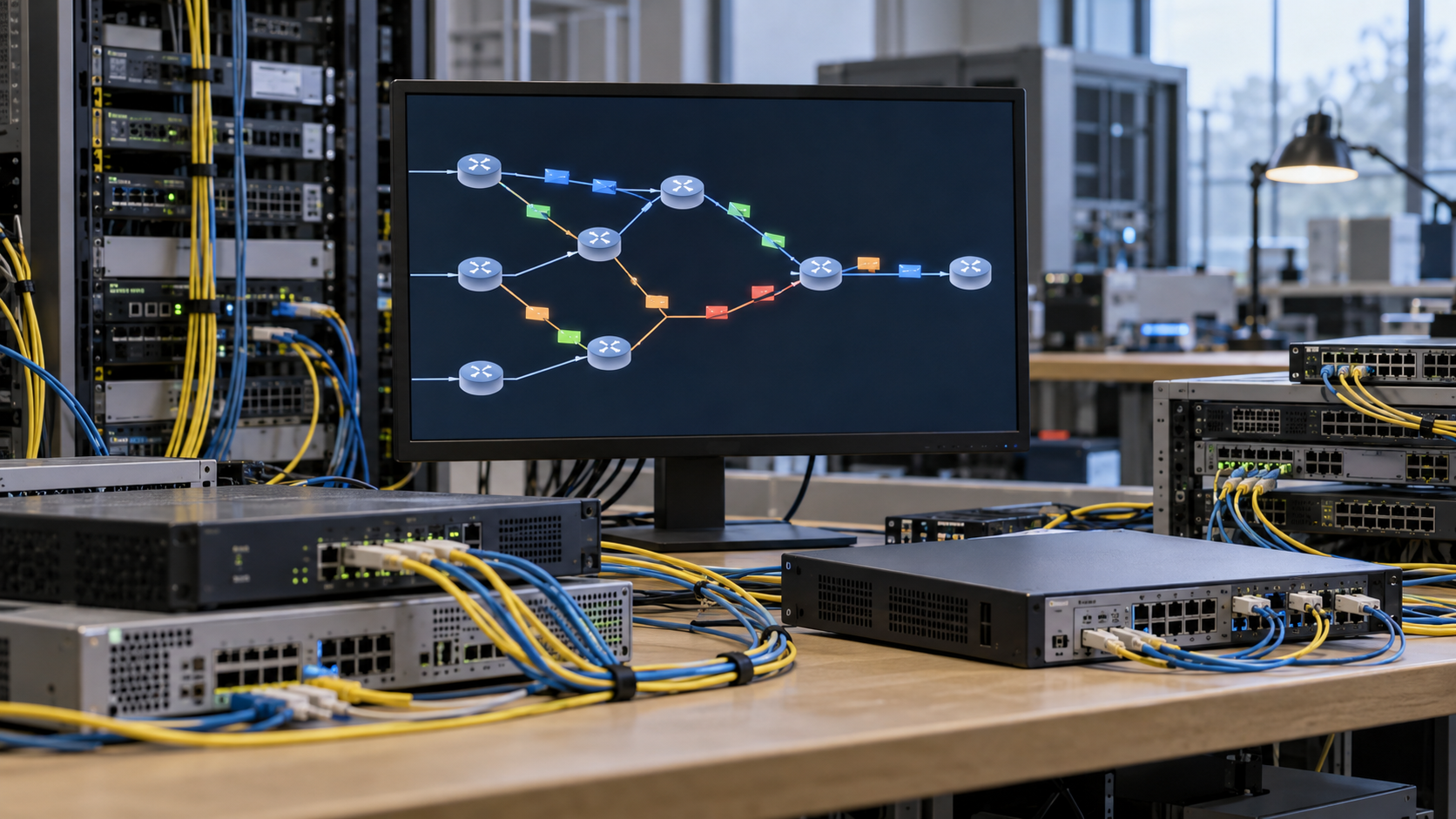
Packet switching is a way to move digital information by dividing it into smaller units that can share network links with traffic from many other users. Each packet carries a header with control information, including addresses that help the network deliver it, plus a portion of the original data. A sender hands packets to a local router, which forwards them toward the destination one link at a time. Unlike a traditional circuit that reserves a continuous path for one conversation, a packet-switched network can fill each available transmission opportunity with whichever packet is ready.
Routers make forwarding decisions by examining a packet’s destination address and consulting a forwarding table. That table reflects routes learned from directly connected networks, configured policy, and routing protocols. The router chooses a next hop, places the packet in an output queue, and transmits it when the selected link is available. The next router repeats the process. This store-and-forward pattern means the complete end-to-end route does not need to be reserved before communication begins. Routing changes can cause later packets in the same flow to take a different path from earlier ones.
Sharing links statistically is efficient for bursty computer traffic. A laptop may download intensely for a moment and then remain quiet; another device can use the link during the idle period. Packets from video calls, web pages, backups, and messages are interleaved rather than given permanently separate circuits. That efficiency comes with variable timing. If packets arrive at a router faster than an outgoing link can transmit them, they wait in a queue. Longer queues increase latency and jitter, and a full queue forces the router to drop packets. Network operators add capacity and manage queues to control these effects.
The Internet Protocol provides best-effort delivery. IP routers try to forward packets but do not guarantee that each one arrives, arrives once, or arrives in order. A packet can be lost because of congestion, a failed link, a corrupted frame, or a routing change. Higher-layer protocols decide what to do. TCP numbers data, acknowledges received bytes, retransmits missing information, and adjusts its sending rate when it detects congestion. Other applications use UDP and add only the recovery or timing behavior they need. Real-time audio may prefer an occasional loss to a late retransmission.
Packet size also matters. Every link has a maximum transmission unit, or MTU. If an IP packet is too large for a path, it may need fragmentation in some circumstances or the sender may be told to use a smaller size. Headers consume part of each packet, so extremely small packets create overhead, while large packets take longer to transmit and can amplify the cost of loss. At the destination, IP and transport-layer information lets software associate arriving pieces with the correct communication. The application receives a reassembled stream or a sequence of messages rather than manually sorting raw network frames.
Packet switching does not automatically provide privacy or authenticity. Routers need enough visible addressing information to forward traffic, and unencrypted payloads may be readable on systems that carry or capture them. Protocols such as TLS add encryption and authentication above the basic delivery mechanism. Nor does one diagram of several routes mean every packet is intentionally sprayed across all paths; routing policy often keeps a flow on one path until conditions change. The enduring achievement of packet switching is flexible sharing: independent networks and applications can exchange data over common infrastructure while routing, transport, and security layers each solve a defined part of the job. Troubleshooting tools expose parts of this journey. A packet capture shows headers and timing at one observation point, while traceroute probes reveal a sequence of responding routers without mapping every hidden link. Results can change by direction or time, so a single trace is evidence about one moment rather than a permanent route diagram.
A packet includes a portion of application data plus headers that identify destinations and provide control information for networking and transport.
Not necessarily. Routing changes or load-sharing can send packets along different paths, and the receiving protocols handle ordering where required.
No. IP is best effort. Protocols such as TCP or application-specific logic add acknowledgments, retransmission, ordering, and congestion response when needed.
Explore more "Explainers"
Discover additional explainers across politics, science, business, technology, and other fields. Each explainer breaks down a complex idea into clear, everyday language—helping you better understand how major concepts, systems, and debates shape the world around us.