

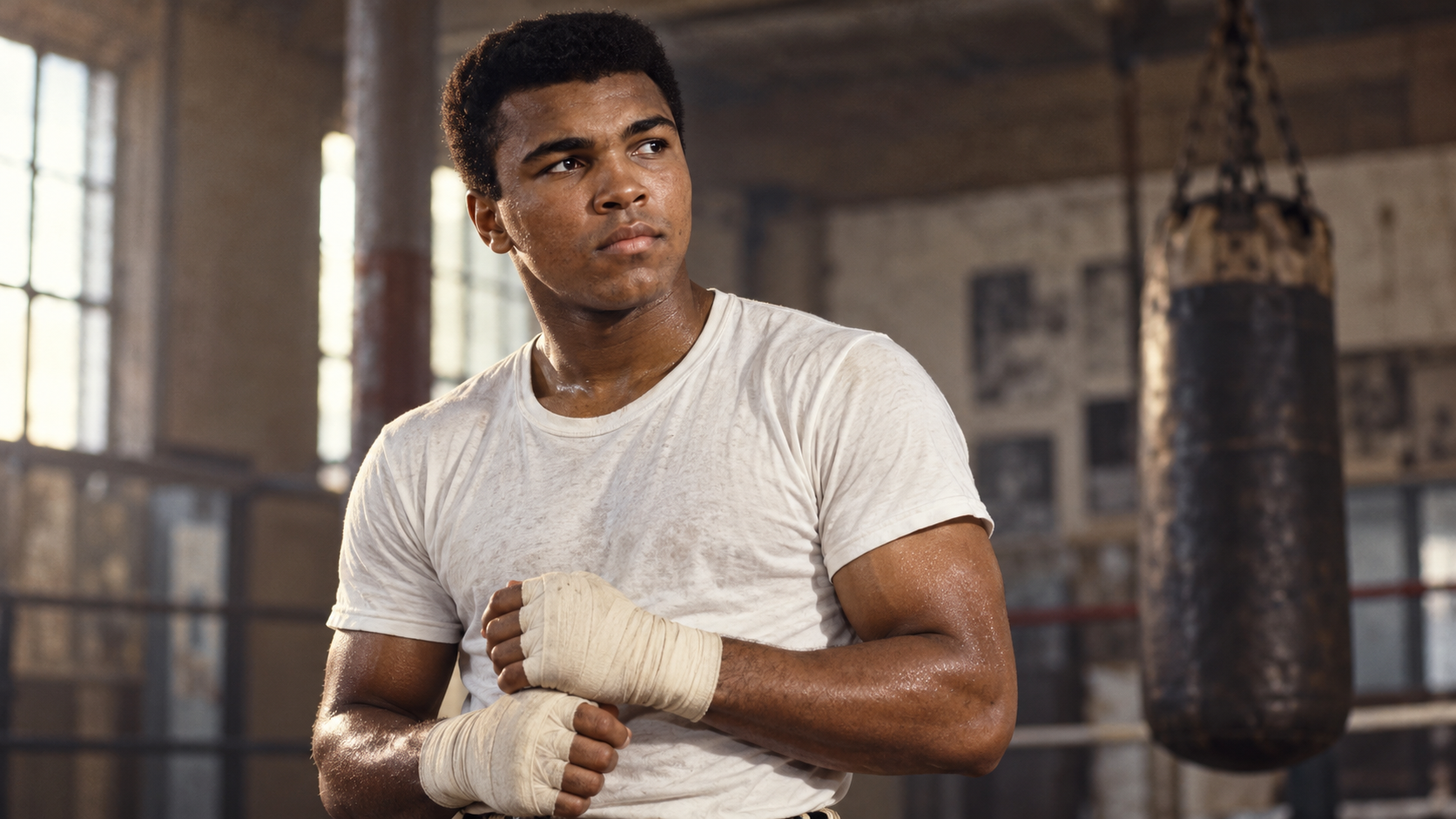
“I am the greatest, I said that even before I knew I was.”
Muhammad Ali said, “I am the greatest, I said that even before I knew I was.” Ali’s declaration grew from the persona he developed as a young contender, including the 1963 spoken-word album titled “I Am the Greatest!” He predicted victories, played with rhyme, and insisted on his own importance before the boxing establishment agreed. The line captures that sequence: public confidence arrived first, then championships made the claim part of sports history. The quotation has lasted because it turns a complicated sporting experience into language that is easy to remember.
Ali became heavyweight champion in 1964, won the title three times, and produced some of boxing’s most studied contests. His importance also rests on his refusal of military induction, the years of competition he lost, and the cultural and political consequences of his voice. Bravado was one part of a complex public figure who understood performance in the ring and in language. Those details give the sentence weight without turning one career into a formula that everyone else must copy. It also explains why the line belongs in a sports series: competition made the principle visible, while the speaker’s wider life showed where the principle could help and where it could be misunderstood.
The quotation celebrates self-belief, but Ali’s confidence was not empty. It was paired with training, tactical intelligence, courage, and a willingness to accept consequences for convictions. Copying the boast without the work turns it into noise. The phrase also belongs to a Black athlete asserting dignity in an era that often demanded deference; its historical force cannot be reduced to generic positive thinking. It invites ambition while leaving room for evidence, support, safety, and a change of plan when circumstances require one. Motivation becomes more credible when it respects context instead of treating every obstacle as identical or every result as a moral judgment.
Athletes sometimes need to speak possibility before evidence feels complete. A confident statement can change posture, attract attention, and interrupt a story imposed by others. It can also become pressure or disrespect if detached from humility and accountability. Ali’s line invites a disciplined form of self-authorship: name the future you intend, then do the work and accept the tests that give the words meaning. That is why the words can remain inspiring without becoming a demand for perfection. For readers, the practical question is not how to imitate a famous career. It is how to translate the underlying idea into one honest, proportionate action in the situation directly ahead.
Ali’s declaration grew from the persona he developed as a young contender, including the 1963 spoken-word album titled “I Am the Greatest!” He predicted victories, played with rhyme, and insisted on his own importance before the boxing establishment agreed. The line captures that sequence: public confidence arrived first, then championships made the claim part of sports history.
The wording and surrounding record are documented in the primary source and supported by this additional source.
The quotation celebrates self-belief, but Ali’s confidence was not empty. It was paired with training, tactical intelligence, courage, and a willingness to accept consequences for convictions. Copying the boast without the work turns it into noise. The phrase also belongs to a Black athlete asserting dignity in an era that often demanded deference; its historical force cannot be reduced to generic positive thinking.
The line is most responsible when it encourages deliberate action without pretending that effort controls every condition, injury, institution, or outcome.
Athletes sometimes need to speak possibility before evidence feels complete. A confident statement can change posture, attract attention, and interrupt a story imposed by others. It can also become pressure or disrespect if detached from humility and accountability. Ali’s line invites a disciplined form of self-authorship: name the future you intend, then do the work and accept the tests that give the words meaning.
Its continuing value lies in turning admiration into a practical question about preparation, support, judgment, and the next decision.
Explore more "Quotes of The Day"
Discover more notable quotes from influential voices across politics, science, business, technology, sports, and culture. Each quote offers insight into how ideas, beliefs, and decisions shape the world around us.