

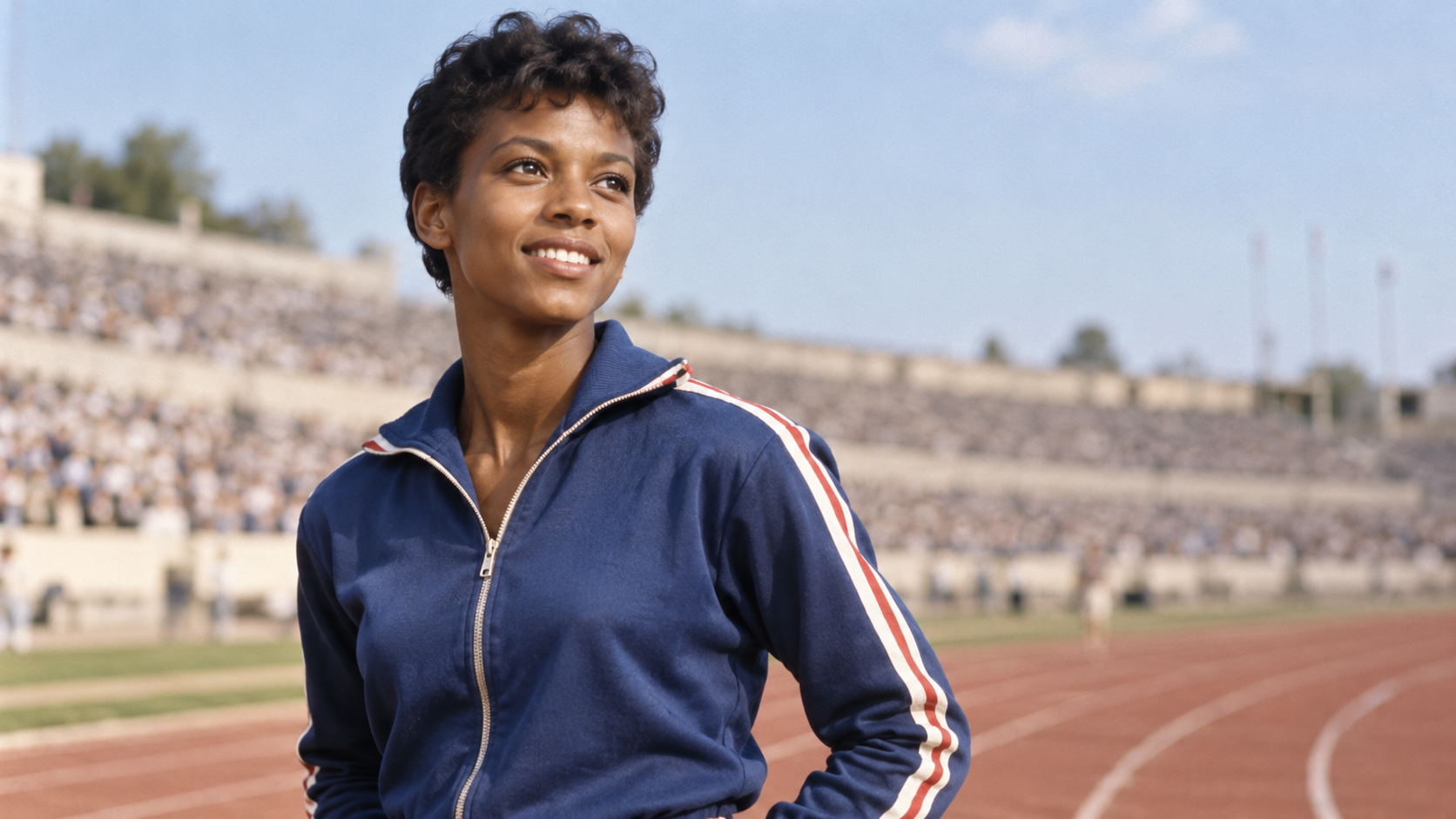
“The triumph can’t be had without the struggle.”
Wilma Rudolph said, “The triumph can’t be had without the struggle.” Rudolph’s statement is closely associated with the life story she shared after becoming the first American woman to win three track-and-field gold medals at a single Olympic Games. Childhood polio and years of treatment preceded her rise as a sprinter. The quote refuses to separate the celebrated finish line from the difficult, uneven work that made reaching it possible. Its force comes from the distance between a simple sentence and the years of work that stand behind it.
At the 1960 Rome Olympics, Rudolph won the 100 meters, 200 meters, and 4×100-meter relay. Her speed and international fame challenged racial and gender expectations, yet she returned to a segregated Tennessee. She insisted that a homecoming celebration be integrated. Athletic triumph and civic struggle therefore belonged to the same story rather than separate chapters. The achievement is therefore evidence of a process, not proof that a memorable phrase can replace the process. It also explains why the line belongs in a sports series: competition made the principle visible, while the speaker’s wider life showed where the principle could help and where it could be misunderstood.
The line does not claim that suffering automatically produces success or that preventable hardship should be preserved for character. Struggle can injure, exclude, and end opportunities. Rudolph’s insight is that meaningful achievement usually contains friction—practice, uncertainty, resistance, and repeated adjustment. Recognizing that reality helps people prepare for difficulty without worshipping it or judging those whose outcomes differ. Its best interpretation strengthens agency without blaming people for barriers or outcomes they cannot fully control. Motivation becomes more credible when it respects context instead of treating every obstacle as identical or every result as a moral judgment.
Sports storytelling often compresses years of work into a medal image. Rudolph’s sentence restores the missing middle. Coaches can honor struggle by providing recovery, resources, and fair conditions, not by manufacturing needless pain. Athletes can understand a setback as part of a process while still asking whether the environment should change. Triumph is richer when it remembers both effort and the people who made effort possible. The enduring value is not certainty; it is a clearer way to meet the next meaningful choice. For readers, the practical question is not how to imitate a famous career. It is how to translate the underlying idea into one honest, proportionate action in the situation directly ahead.
Rudolph’s statement is closely associated with the life story she shared after becoming the first American woman to win three track-and-field gold medals at a single Olympic Games. Childhood polio and years of treatment preceded her rise as a sprinter. The quote refuses to separate the celebrated finish line from the difficult, uneven work that made reaching it possible.
The wording and surrounding record are documented in the primary source and supported by this additional source.
The line does not claim that suffering automatically produces success or that preventable hardship should be preserved for character. Struggle can injure, exclude, and end opportunities. Rudolph’s insight is that meaningful achievement usually contains friction—practice, uncertainty, resistance, and repeated adjustment. Recognizing that reality helps people prepare for difficulty without worshipping it or judging those whose outcomes differ.
The line is most responsible when it encourages deliberate action without pretending that effort controls every condition, injury, institution, or outcome.
Sports storytelling often compresses years of work into a medal image. Rudolph’s sentence restores the missing middle. Coaches can honor struggle by providing recovery, resources, and fair conditions, not by manufacturing needless pain. Athletes can understand a setback as part of a process while still asking whether the environment should change. Triumph is richer when it remembers both effort and the people who made effort possible.
Its continuing value lies in turning admiration into a practical question about preparation, support, judgment, and the next decision.
Explore more "Quotes of The Day"
Discover more notable quotes from influential voices across politics, science, business, technology, sports, and culture. Each quote offers insight into how ideas, beliefs, and decisions shape the world around us.