

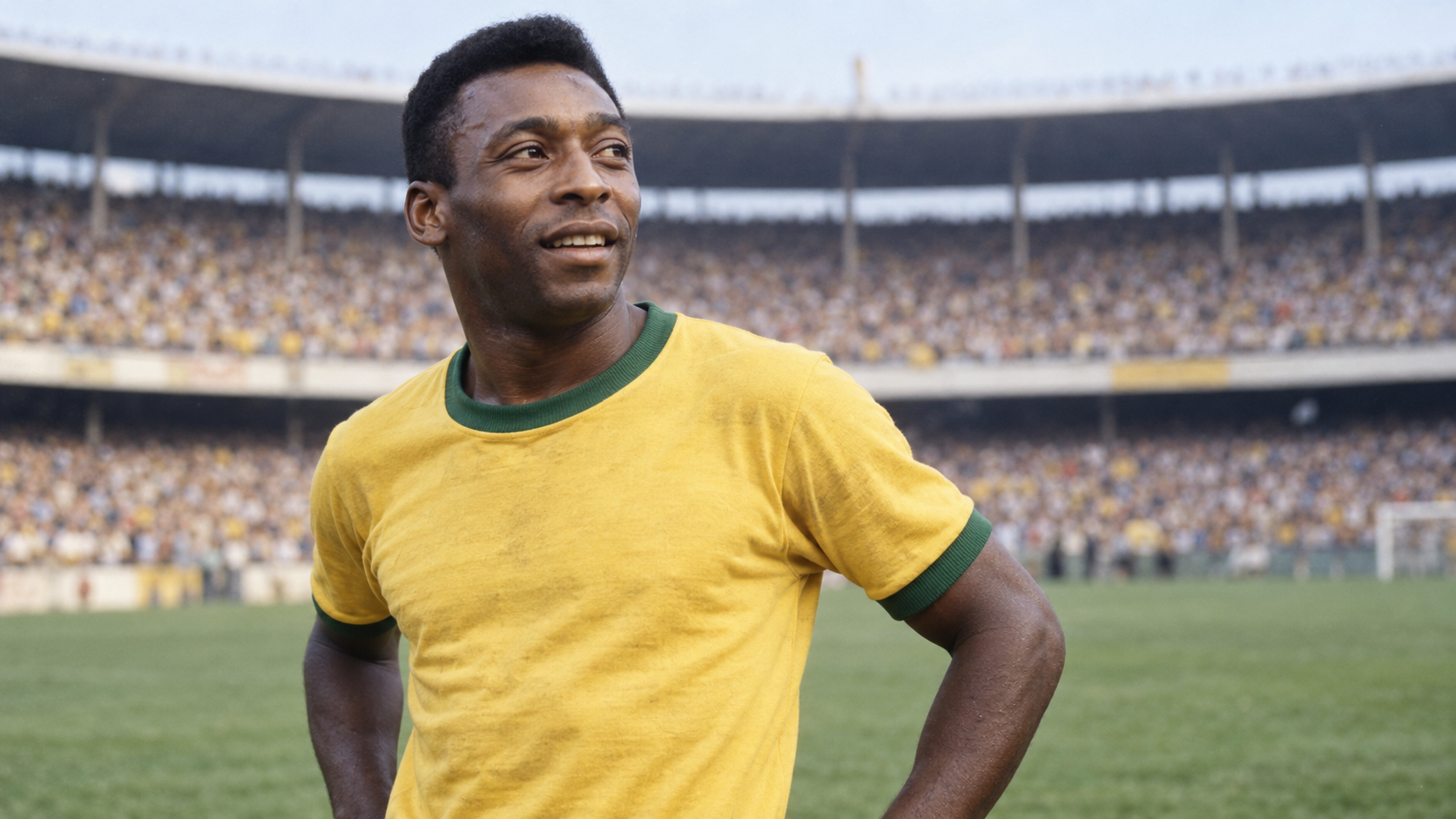
“I’ll win the World Cup for you.”
Pelé said, “I’ll win the World Cup for you.” Pelé recalled making this promise to his father after Brazil lost the 1950 World Cup final at home. He was nine years old and saw his father cry. The vow gained legendary weight because eight years later Pelé, still only seventeen, helped Brazil win the tournament in Sweden. FIFA’s later interviews preserved the memory as a family scene before it became football mythology. Read alone, the sentence sounds universal; read in context, it becomes more precise and more useful.
Pelé remains the only player to win three men’s World Cups, in 1958, 1962, and 1970. His skill, scoring, and global fame helped shape football’s modern image, while the simplified legend can sometimes obscure teammates, tactics, clubs, and the Brazilian traditions around him. The childhood promise is compelling because history supplied an outcome almost too perfect for the original moment. The record matters because it shows how the idea was tested through preparation, change, and public pressure. It also explains why the line belongs in a sports series: competition made the principle visible, while the speaker’s wider life showed where the principle could help and where it could be misunderstood.
A child’s promise cannot be treated as a plan or guarantee. Pelé could not know the opportunities, health, selection, or extraordinary ability the future would require. Its value lies in the emotional direction it created: grief was answered with an image of contribution. The later victory does not prove that every promise comes true, only that a bold hope can become one thread in years of development. That distinction is important whenever inspirational language is used around injury, inequality, or uncertain outcomes. Motivation becomes more credible when it respects context instead of treating every obstacle as identical or every result as a moral judgment.
Sport is full of vows made after losses. Most should be translated into smaller commitments rather than carried as crushing destiny. Pelé’s story invites young athletes to dream while reminding adults to supply coaching, joy, and perspective. The promise became beautiful because it connected generations and because the game remained larger than one child’s words. Ambition grows best when love, opportunity, and sustained practice grow with it. The result is a lesson that can guide preparation without flattening the complexity of a human life. For readers, the practical question is not how to imitate a famous career. It is how to translate the underlying idea into one honest, proportionate action in the situation directly ahead.
Pelé recalled making this promise to his father after Brazil lost the 1950 World Cup final at home. He was nine years old and saw his father cry. The vow gained legendary weight because eight years later Pelé, still only seventeen, helped Brazil win the tournament in Sweden. FIFA’s later interviews preserved the memory as a family scene before it became football mythology.
The wording and surrounding record are documented in the primary source and supported by this additional source.
A child’s promise cannot be treated as a plan or guarantee. Pelé could not know the opportunities, health, selection, or extraordinary ability the future would require. Its value lies in the emotional direction it created: grief was answered with an image of contribution. The later victory does not prove that every promise comes true, only that a bold hope can become one thread in years of development.
The line is most responsible when it encourages deliberate action without pretending that effort controls every condition, injury, institution, or outcome.
Sport is full of vows made after losses. Most should be translated into smaller commitments rather than carried as crushing destiny. Pelé’s story invites young athletes to dream while reminding adults to supply coaching, joy, and perspective. The promise became beautiful because it connected generations and because the game remained larger than one child’s words. Ambition grows best when love, opportunity, and sustained practice grow with it.
Its continuing value lies in turning admiration into a practical question about preparation, support, judgment, and the next decision.
Explore more "Quotes of The Day"
Discover more notable quotes from influential voices across politics, science, business, technology, sports, and culture. Each quote offers insight into how ideas, beliefs, and decisions shape the world around us.