

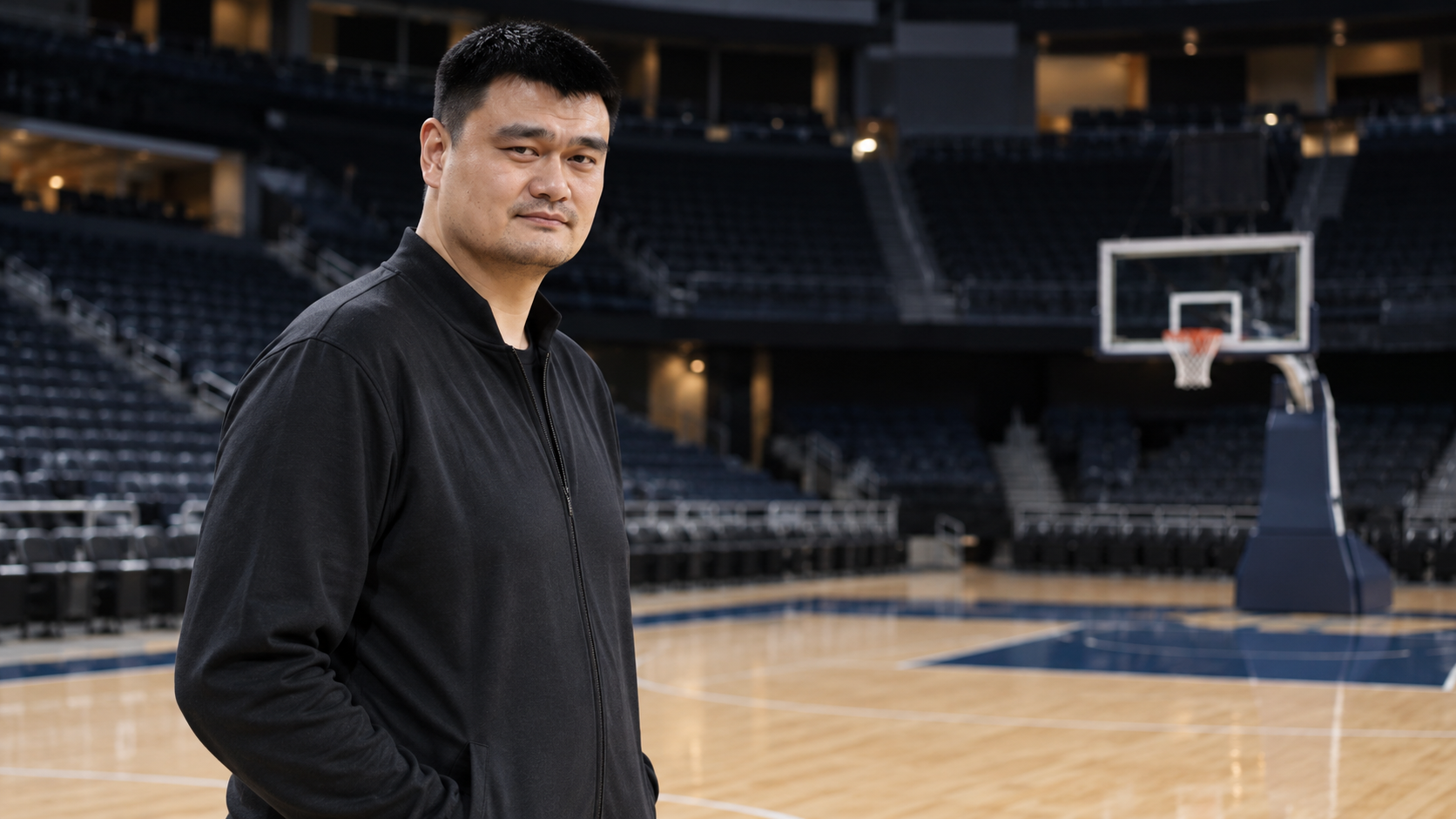
“Great opponents push us forward.”
Yao Ming said, “Great opponents push us forward.” in his Naismith Memorial Basketball Hall of Fame induction speech. Yao used the line while thanking Shaquille O’Neal, one of the centers who tested him most severely in the NBA. He treated rivalry as a form of instruction: a difficult opponent exposes limits, demands adaptation, and gives an athlete a clearer picture of what improvement requires. The circumstances are essential because they prevent a polished sentence from floating free of the difficult event that produced it.
A result may be recorded in seconds, yet the habits behind it accumulate through coaching, repetition, recovery, travel, and decisions made far from an audience. That wider frame is where the quotation earns its authority. In this case, the quotation belongs to basketball, but the record around it also shows how sporting achievement is shaped by relationships, institutions, and the meaning an athlete gives to experience. A source-first reading checks three connected layers: the exact wording, the occasion described as his Naismith Memorial Basketball Hall of Fame induction speech, and the later significance attached to the remark. Keeping those layers together helps protect Yao Ming from a cleaner or larger interpretation than the documented moment can support.
An opponent does not automatically make anyone better. Progress still depends on preparation, health, coaching, and the willingness to study what the contest revealed rather than merely resenting the result. It should not be used to blame athletes who face different bodies, institutions, or opportunities. The useful lesson concerns agency inside a situation, not an imaginary promise that every person can command the same outcome. This is the difference between honoring a speaker’s insight and turning a vivid sentence into advice it was never designed to carry.
Yao’s sentence turns competition into a shared engine of development, even when the people involved are trying to defeat one another. What remains is not a formula for winning. It is a disciplined way to meet pressure: hold the context, choose the next honest action, and let progress be measured across more than one moment. The enduring question is not whether another person can reproduce the same career. It is whether the underlying idea can improve preparation, judgment, or care in the circumstances that actually exist now. That approach lets the quotation remain attached to Yao Ming and basketball while still inviting a reader to carry its most defensible lesson into a different arena. Context narrows the claim, but that precision is what makes the lesson portable.
Yao Ming delivered these words in his Naismith Memorial Basketball Hall of Fame induction speech. Yao used the line while thanking Shaquille O’Neal, one of the centers who tested him most severely in the NBA. He treated rivalry as a form of instruction: a difficult opponent exposes limits, demands adaptation, and gives an athlete a clearer picture of what improvement requires.
An opponent does not automatically make anyone better. Progress still depends on preparation, health, coaching, and the willingness to study what the contest revealed rather than merely resenting the result.
The quotation is most responsible when it strengthens deliberate action without pretending that effort controls every body, institution, resource, injury, or competitive result.
Yao’s sentence turns competition into a shared engine of development, even when the people involved are trying to defeat one another.
Its present value lies in turning admiration into a practical question about preparation, support, judgment, and the next decision.
Explore more "Quotes of The Day"
Discover more notable quotes from influential voices across politics, science, business, technology, sports, and culture. Each quote offers insight into how ideas, beliefs, and decisions shape the world around us.