

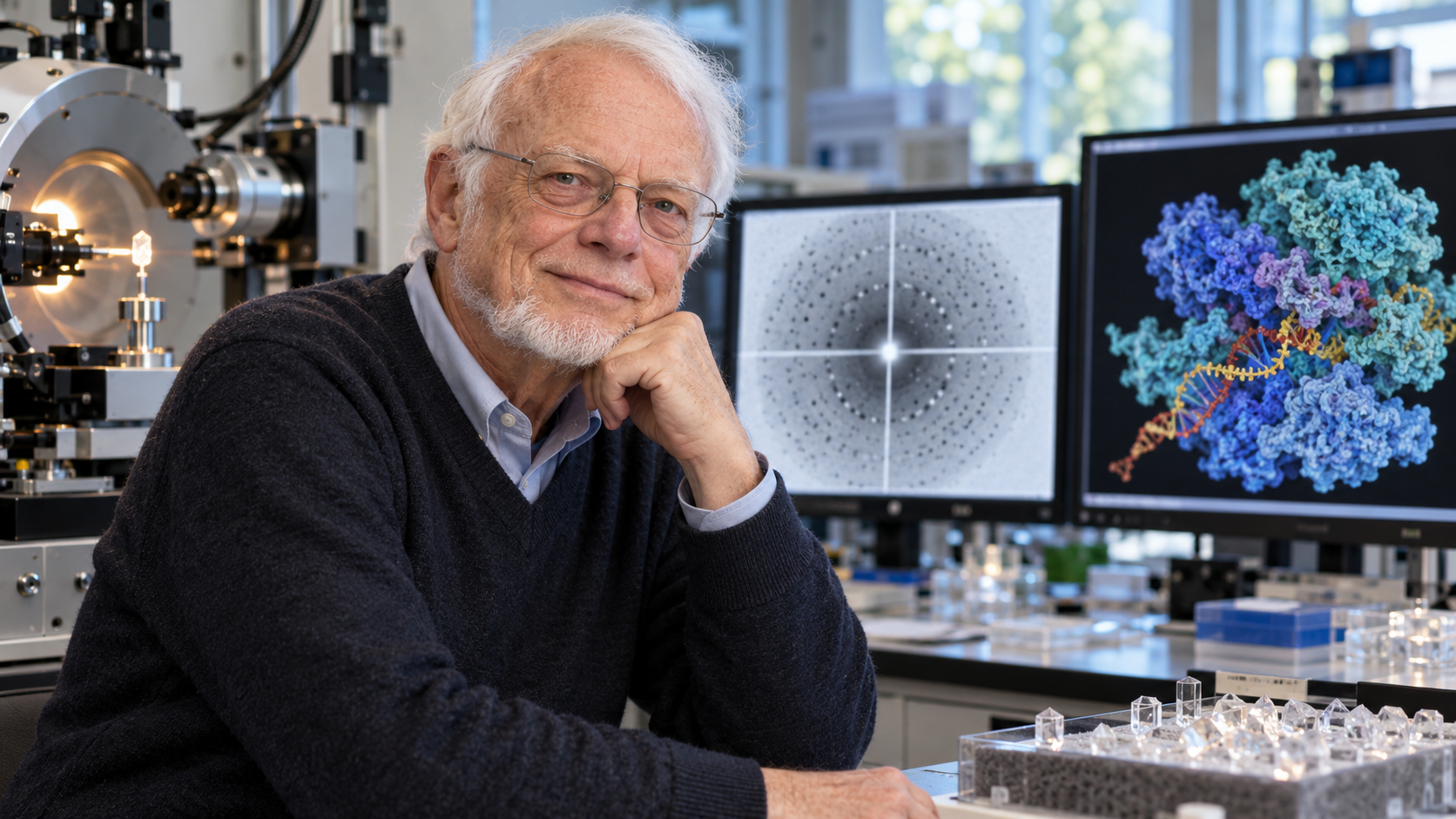
“We learned to ask as well as answer questions.”
Thomas A. Steitz wrote, “We learned to ask as well as answer questions.” in his Nobel biographical essay, describing an education that treated scientific questions as skills to be practiced rather than merely received. Steitz carried that emphasis into structural biology, where a question must be translated into purified samples, crystals, diffraction data, and an interpretable molecular model. His group helped determine detailed ribosome structures. The line is memorable partly because it compresses a larger argument about evidence, method, and scientific judgment.
Scientific history favors decisive breakthroughs, though knowledge is built from ordinary observations and repeated corrections. The quotation bridges those scales: one remembered sentence and the patient labor that made it defensible. In this case, the quotation belongs to X-ray crystallography, but the record around it also shows how knowledge is shaped by instruments, collaborators, institutions, and the questions a researcher chooses to pursue. A source-first reading checks three connected layers: the exact wording, the occasion described as his Nobel biographical essay, describing an education that treated scientific questions as skills to be practiced rather than merely received, and the later significance attached to the remark. Keeping those layers together protects Thomas A. Steitz from a cleaner or larger interpretation than the documented moment can support.
Asking questions is not automatically valuable; the question must be clear enough to constrain a test. Answers remain provisional when the method cannot distinguish competing explanations. That distinction matters because scientific language can become misleading when authority replaces evidence. A responsible reading keeps the insight while leaving every claim open to measurement, criticism, and revision. This is the difference between honoring a speaker’s insight and turning a vivid sentence into advice it was never designed to carry.
Steitz shared the 2009 Nobel Prize in Chemistry for studies of the ribosome, including structures that clarified how peptide bonds form and antibiotics act. Its continuing usefulness lies in better attention. Instead of imitating a famous career, a reader can identify the scientific principle underneath it and apply that principle proportionately to the problem directly ahead. The enduring question is not whether another person can reproduce the same career. It is whether the underlying idea can improve observation, judgment, or explanation in the circumstances that actually exist now. That approach lets the quotation remain attached to Thomas A. Steitz and X-ray crystallography while still inviting a reader to carry its most defensible lesson into another problem. Context narrows the claim, but that precision is what makes the lesson portable.
Thomas A. Steitz wrote these words in his Nobel biographical essay, describing an education that treated scientific questions as skills to be practiced rather than merely received. Steitz carried that emphasis into structural biology, where a question must be translated into purified samples, crystals, diffraction data, and an interpretable molecular model. His group helped determine detailed ribosome structures.
Asking questions is not automatically valuable; the question must be clear enough to constrain a test. Answers remain provisional when the method cannot distinguish competing explanations.
The quotation is most responsible when it prompts a testable question without allowing reputation, enthusiasm, or hindsight to replace evidence.
Steitz shared the 2009 Nobel Prize in Chemistry for studies of the ribosome, including structures that clarified how peptide bonds form and antibiotics act.
Its present value lies in connecting the remembered sentence to the methods, limits, collaborators, and later results that made the work scientifically useful.
Explore more "Quotes of The Day"
Discover more notable quotes from influential voices across politics, science, business, technology, sports, and culture. Each quote offers insight into how ideas, beliefs, and decisions shape the world around us.