

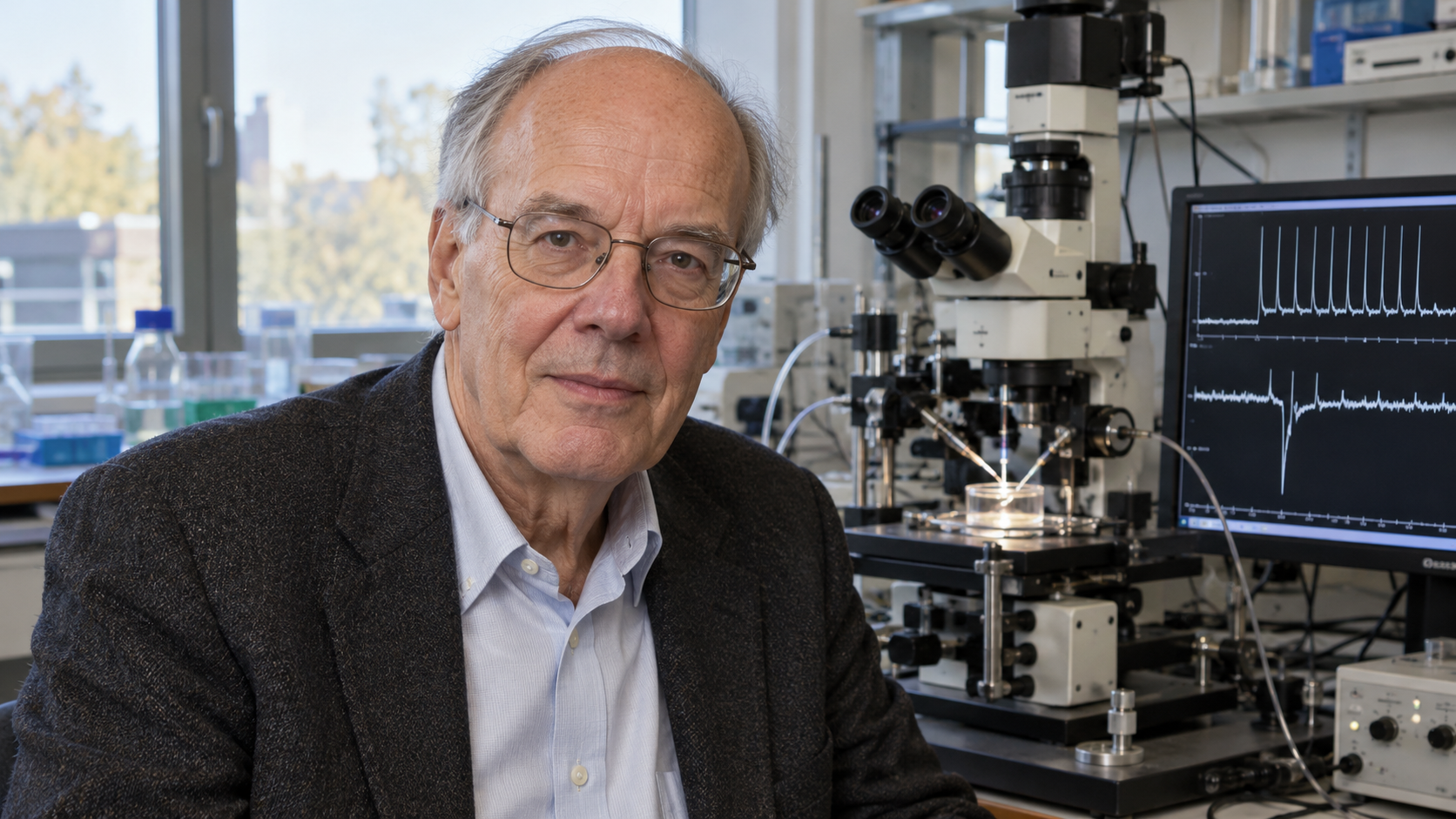
“With Erwin Neher I shared an exciting and wonderful sixteen years of scientific adventures and ‘basteln’ on new methods in the Max-Planck-Institute in Göttingen.”
Bert Sakmann wrote, “With Erwin Neher I shared an exciting and wonderful sixteen years of scientific adventures and ‘basteln’ on new methods in the Max-Planck-Institute in Göttingen.” in his Nobel biographical essay, describing long collaboration on ion-channel recording. Sakmann used the German word “basteln” to evoke hands-on tinkering with methods. He and Neher refined glass pipettes, seals, amplifiers, and preparations until current through single membrane channels could be resolved. The line is memorable partly because it compresses a larger argument about evidence, method, and scientific judgment.
Scientific history favors decisive breakthroughs, though knowledge is built from ordinary observations and repeated corrections. The quotation bridges those scales: one remembered sentence and the patient labor that made it defensible. In this case, the quotation belongs to neurophysiology and cellular biophysics, but the record around it also shows how knowledge is shaped by instruments, collaborators, institutions, and the questions a researcher chooses to pursue. A source-first reading checks three connected layers: the exact wording, the occasion described as his Nobel biographical essay, describing long collaboration on ion-channel recording, and the later significance attached to the remark. Keeping those layers together protects Bert Sakmann from a cleaner or larger interpretation than the documented moment can support.
Tinkering is productive when each modification is documented and judged against stable performance criteria. The romance of improvisation should not obscure the precision, patience, failed setups, and shared technical knowledge required to make a method reliable. That distinction matters because scientific language can become misleading when authority replaces evidence. A responsible reading keeps the insight while leaving every claim open to measurement, criticism, and revision. This is the difference between honoring a speaker’s insight and turning a vivid sentence into advice it was never designed to carry.
Patch clamping allowed direct investigation of electrical signaling in individual channels and cells. The quote celebrates collaboration as a prolonged craft of building an instrument precise enough to reveal previously hidden behavior. Its continuing usefulness lies in better attention. Instead of imitating a famous career, a reader can identify the scientific principle underneath it and apply that principle proportionately to the problem directly ahead. The enduring question is not whether another person can reproduce the same career. It is whether the underlying idea can improve observation, judgment, or explanation in the circumstances that actually exist now. That approach lets the quotation remain attached to Bert Sakmann and neurophysiology and cellular biophysics while still inviting a reader to carry its most defensible lesson into another problem. Context narrows the claim, but that precision is what makes the lesson portable.
Bert Sakmann wrote these words in his Nobel biographical essay, describing long collaboration on ion-channel recording. Sakmann used the German word “basteln” to evoke hands-on tinkering with methods. He and Neher refined glass pipettes, seals, amplifiers, and preparations until current through single membrane channels could be resolved.
Tinkering is productive when each modification is documented and judged against stable performance criteria. The romance of improvisation should not obscure the precision, patience, failed setups, and shared technical knowledge required to make a method reliable.
The quotation is most responsible when it prompts a testable question without allowing reputation, enthusiasm, or hindsight to replace evidence.
Patch clamping allowed direct investigation of electrical signaling in individual channels and cells. The quote celebrates collaboration as a prolonged craft of building an instrument precise enough to reveal previously hidden behavior.
Its present value lies in connecting the remembered sentence to the methods, limits, collaborators, and later results that made the work scientifically useful.
Explore more "Quotes of The Day"
Discover more notable quotes from influential voices across politics, science, business, technology, sports, and culture. Each quote offers insight into how ideas, beliefs, and decisions shape the world around us.