

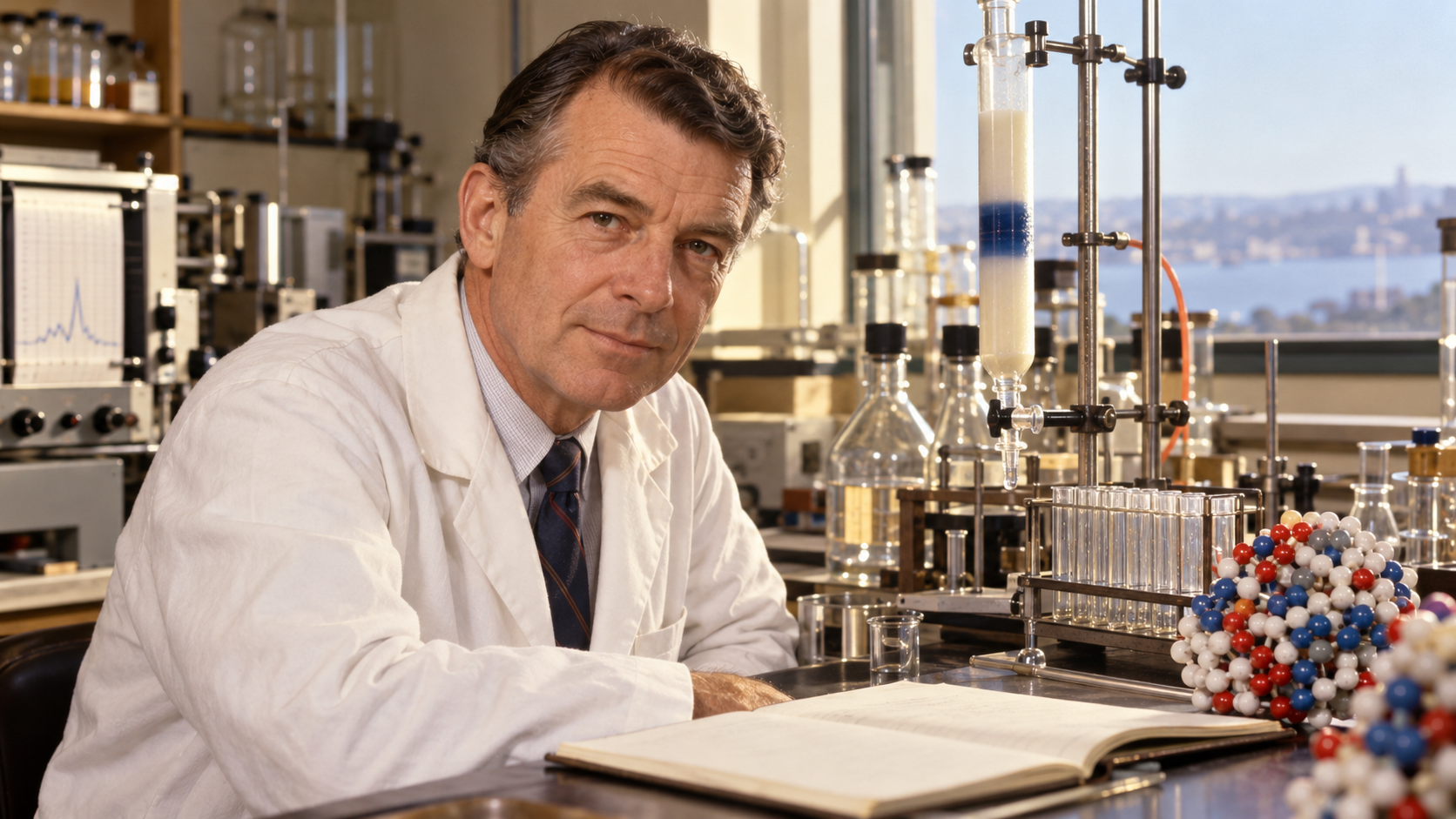
“Studies on the Principles that Govern the Folding of Protein Chains”
Christian B. Anfinsen wrote, “Studies on the Principles that Govern the Folding of Protein Chains” in the title of his official Nobel lecture on the relation between amino-acid sequence and protein structure. Anfinsen’s ribonuclease experiments showed that a denatured protein could recover its active three-dimensional structure after disruptive chemicals were removed. The result demonstrated that the information needed for folding is encoded in the amino-acid sequence under the tested conditions. Its brevity works because the surrounding experiment, paper, or public explanation supplies the rest of the reasoning.
Science often compresses years of observation, failed trials, calculation, and criticism into one published conclusion. This account restores the longer process behind the line and shows why a short sentence can carry several layers of meaning. In this case, the quotation belongs to biochemistry and protein folding, but the record around it also shows how knowledge is shaped by instruments, collaborators, institutions, and the questions a researcher chooses to pursue. A source-first reading checks three connected layers: the exact wording, the occasion described as the title of his official Nobel lecture on the relation between amino-acid sequence and protein structure, and the later significance attached to the remark. Keeping those layers together protects Christian B. Anfinsen from a cleaner or larger interpretation than the documented moment can support.
The principle does not say that every protein folds rapidly or unaided inside a cell. Molecular chaperones, membranes, chemical modifications, crowding, degradation systems, and kinetic traps influence folding, while some sequences can misfold or aggregate. The point is not that confidence overrides evidence or that persistence always produces a discovery. Good judgment includes uncertainty, failed hypotheses, changing conditions, and the courage to revise a model when observations no longer fit. This is the difference between honoring a speaker’s insight and turning a vivid sentence into advice it was never designed to carry.
Protein folding remains central to structural biology, biotechnology, and the study of disease. Anfinsen’s title emphasizes principles rather than a single structure, inviting scientists to connect sequence, energy, environment, and function through testable mechanisms. The quote lasts because it offers direction rather than certainty. It asks for a clearer response to an unknown while respecting the people, instruments, institutions, and time required for reliable knowledge. The enduring question is not whether another person can reproduce the same career. It is whether the underlying idea can improve observation, judgment, or explanation in the circumstances that actually exist now. That approach lets the quotation remain attached to Christian B. Anfinsen and biochemistry and protein folding while still inviting a reader to carry its most defensible lesson into another problem. Context narrows the claim, but that precision is what makes the lesson portable.
Christian B. Anfinsen wrote these words in the title of his official Nobel lecture on the relation between amino-acid sequence and protein structure. Anfinsen's ribonuclease experiments showed that a denatured protein could recover its active three-dimensional structure after disruptive chemicals were removed. The result demonstrated that the information needed for folding is encoded in the amino-acid sequence under the tested conditions.
The principle does not say that every protein folds rapidly or unaided inside a cell. Molecular chaperones, membranes, chemical modifications, crowding, degradation systems, and kinetic traps influence folding, while some sequences can misfold or aggregate.
The quotation is most responsible when it prompts a testable question without allowing reputation, enthusiasm, or hindsight to replace evidence.
Protein folding remains central to structural biology, biotechnology, and the study of disease. Anfinsen's title emphasizes principles rather than a single structure, inviting scientists to connect sequence, energy, environment, and function through testable mechanisms.
Its present value lies in connecting the remembered sentence to the methods, limits, collaborators, and later results that made the work scientifically useful.
Explore more "Quotes of The Day"
Discover more notable quotes from influential voices across politics, science, business, technology, sports, and culture. Each quote offers insight into how ideas, beliefs, and decisions shape the world around us.