

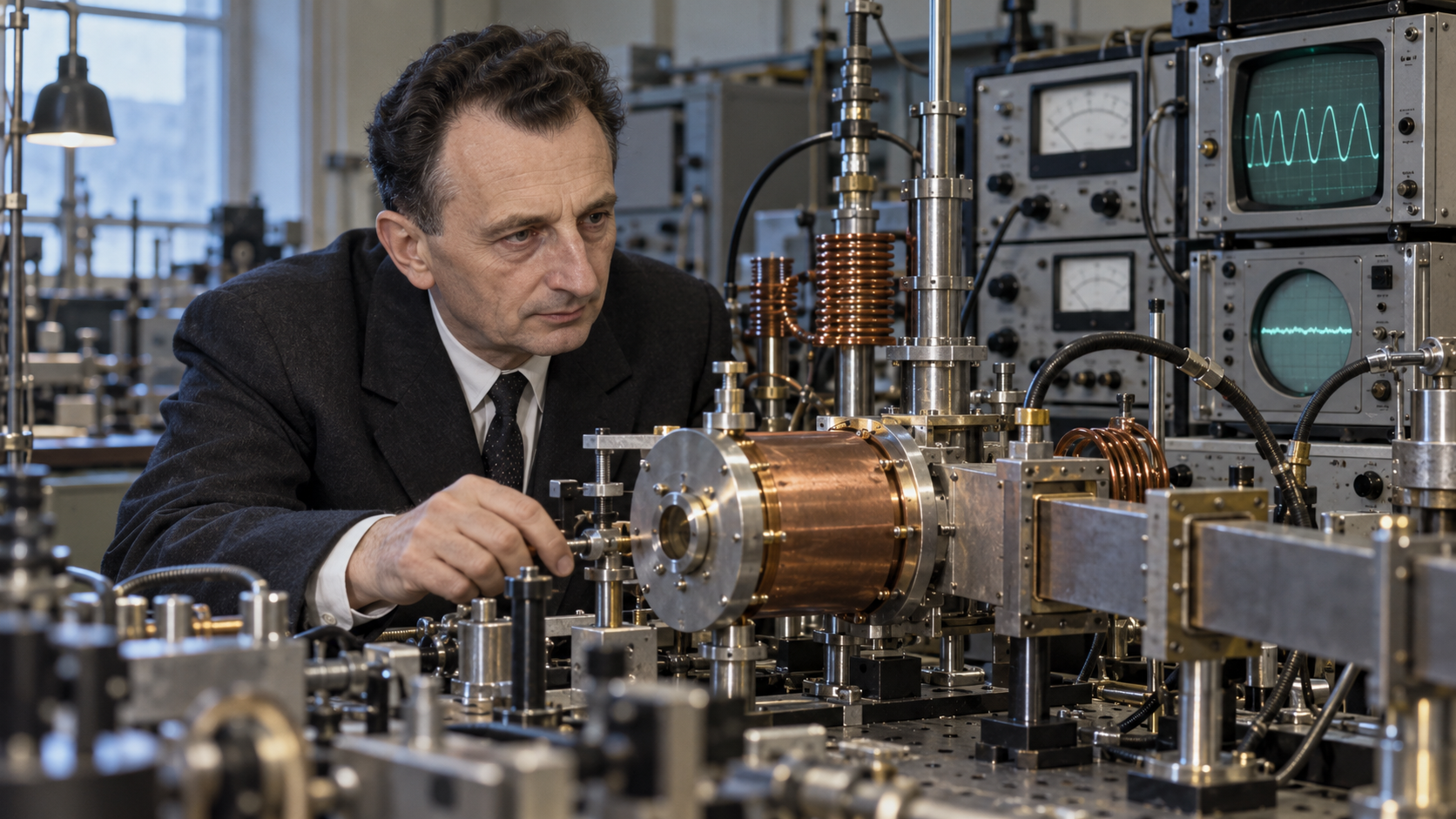
“Quantum Electronics”
Aleksandr M. Prokhorov wrote, “Quantum Electronics” in the title of his official Nobel lecture on stimulated emission devices. Prokhorov developed theoretical and experimental foundations for masers and lasers, including resonator concepts and methods for achieving the nonequilibrium populations required for amplification. His work helped establish quantum electronics as a distinct field. The circumstances matter because they keep a polished sentence attached to the investigation that produced it.
A result may appear as a single equation or claim, yet the habits behind it accumulate through measurement, replication, correspondence, and revision. That wider frame is where the quotation earns its authority. In this case, the quotation belongs to quantum electronics, masers, and lasers, but the record around it also shows how knowledge is shaped by instruments, collaborators, institutions, and the questions a researcher chooses to pursue. A source-first reading checks three connected layers: the exact wording, the occasion described as the title of his official Nobel lecture on stimulated emission devices, and the later significance attached to the remark. Keeping those layers together protects Aleksandr M. Prokhorov from a cleaner or larger interpretation than the documented moment can support.
Stimulated emission alone does not guarantee a useful oscillator or amplifier. Energy-level structure, pumping, resonator stability, linewidth, losses, and material properties determine whether a proposed quantum device can operate. It should not be used to turn one scientist into a solitary hero or one sentence into proof. The useful lesson concerns disciplined inquiry inside a community that tests, extends, and sometimes corrects the original work. This is the difference between honoring a speaker’s insight and turning a vivid sentence into advice it was never designed to carry.
Quantum electronics grew into laser science, precision spectroscopy, photonics, and quantum technologies. Prokhorov’s broad title was appropriate because the work joined fundamental quantum transitions with an entire family of practical devices. What remains is not a formula for discovery. It is a disciplined way to meet uncertainty: preserve the context, choose the next honest test, and let understanding change when the evidence changes. The enduring question is not whether another person can reproduce the same career. It is whether the underlying idea can improve observation, judgment, or explanation in the circumstances that actually exist now. That approach lets the quotation remain attached to Aleksandr M. Prokhorov and quantum electronics, masers, and lasers while still inviting a reader to carry its most defensible lesson into another problem. Context narrows the claim, but that precision is what makes the lesson portable.
Aleksandr M. Prokhorov wrote these words in the title of his official Nobel lecture on stimulated emission devices. Prokhorov developed theoretical and experimental foundations for masers and lasers, including resonator concepts and methods for achieving the nonequilibrium populations required for amplification. His work helped establish quantum electronics as a distinct field.
Stimulated emission alone does not guarantee a useful oscillator or amplifier. Energy-level structure, pumping, resonator stability, linewidth, losses, and material properties determine whether a proposed quantum device can operate.
The quotation is most responsible when it prompts a testable question without allowing reputation, enthusiasm, or hindsight to replace evidence.
Quantum electronics grew into laser science, precision spectroscopy, photonics, and quantum technologies. Prokhorov's broad title was appropriate because the work joined fundamental quantum transitions with an entire family of practical devices.
Its present value lies in connecting the remembered sentence to the methods, limits, collaborators, and later results that made the work scientifically useful.
Explore more "Quotes of The Day"
Discover more notable quotes from influential voices across politics, science, business, technology, sports, and culture. Each quote offers insight into how ideas, beliefs, and decisions shape the world around us.