

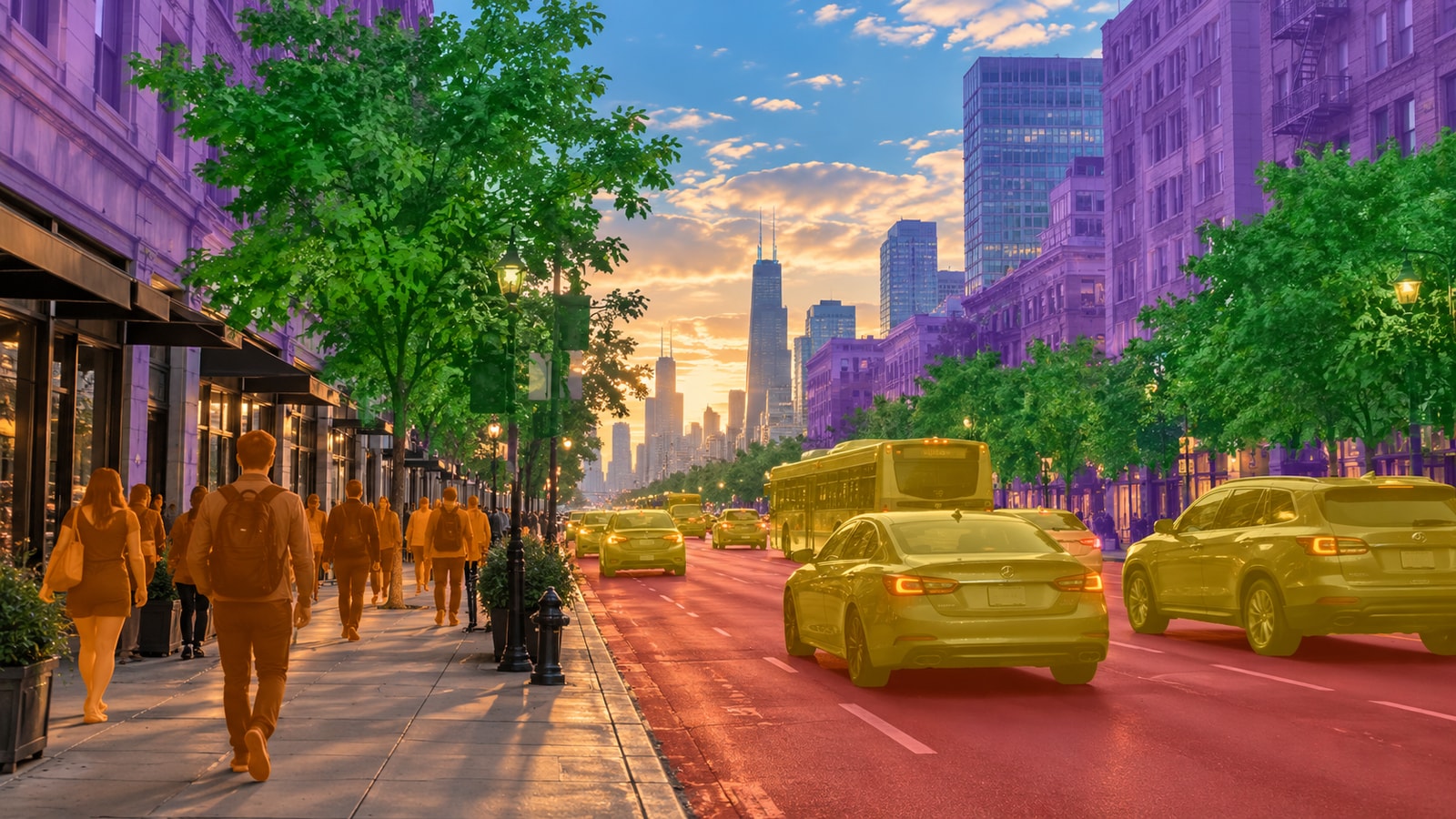
Image Segmentation Explainer
Image segmentation divides an image into meaningful pixel-level regions. Semantic segmentation labels every pixel by class, while instance segmentation also separates individual objects that share the same class. Panoptic segmentation combines both ideas.
Modern systems use learned feature encoders and decoders to produce a mask aligned with the input image. Training requires images paired with pixel masks or weaker forms of supervision, and losses compare predicted regions with annotated ones.
Segmentation is used in medical imaging, satellite analysis, autonomous systems, manufacturing, photo editing, and augmented reality. It provides more detailed spatial information than a single image label or a rectangular detection box.
Pixel annotation is costly and subjective, especially at fuzzy boundaries. Small objects, occlusion, unfamiliar environments, and class imbalance can reduce quality. Good evaluation considers overlap, boundary accuracy, rare categories, uncertainty, and consequences of missed regions.
Image segmentation assigns a category or object identity to pixels so a computer can separate meaningful regions in a picture.
Key terms include pixel mask, semantic segmentation, instance segmentation, panoptic segmentation, encoder, decoder, boundary and intersection over union.
Semantic masks describe classes, while instance masks distinguish separate objects.
A decoder converts learned visual features into regions aligned with the original image.
Human annotations can disagree where objects overlap or edges are indistinct.
Rare classes and tiny regions need targeted evaluation rather than a single average score.
Explore more "Explainers"
Discover additional explainers across politics, science, business, technology, and other fields. Each explainer breaks down a complex idea into clear, everyday language—helping you better understand how major concepts, systems, and debates shape the world around us.