

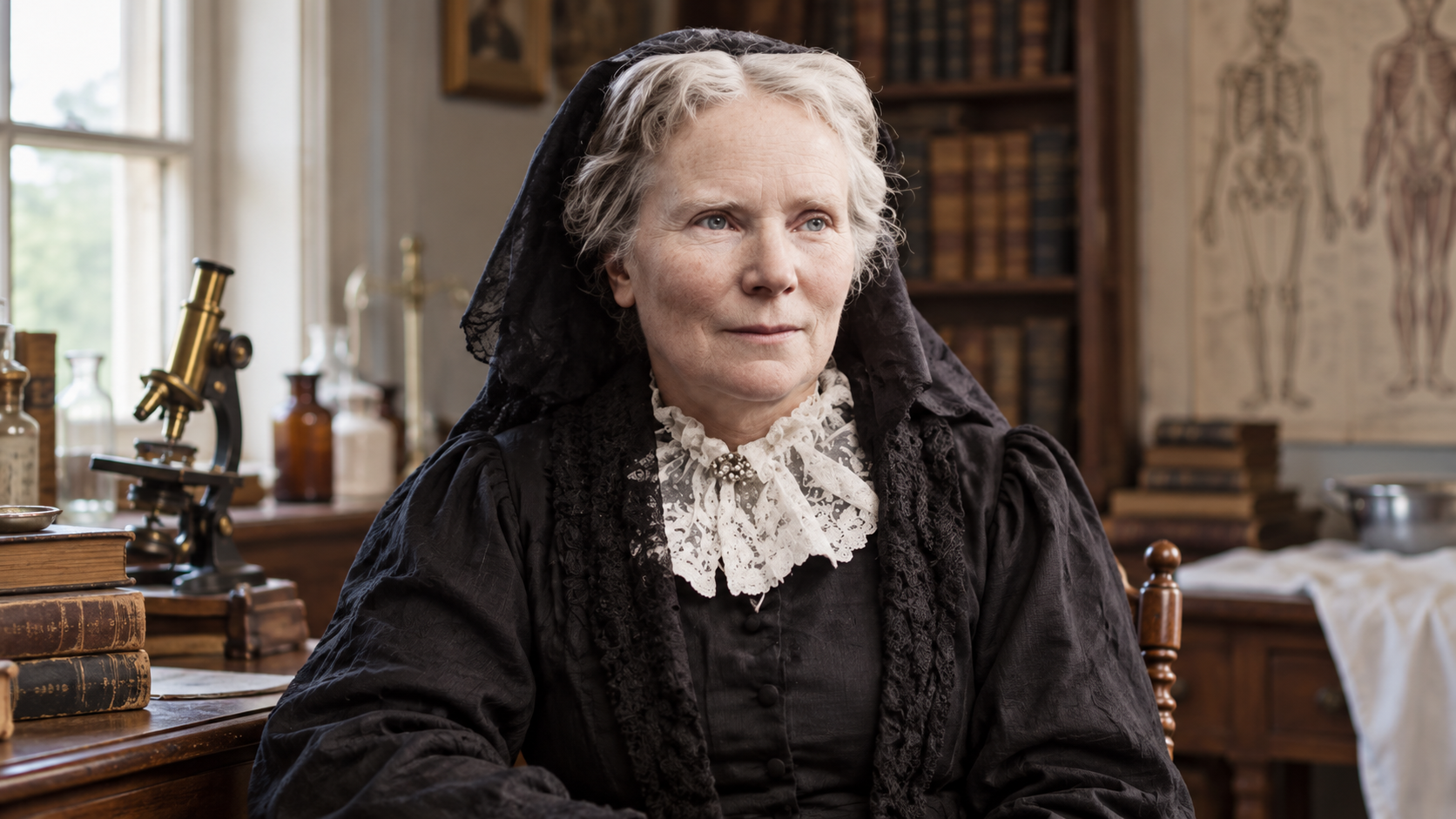
“The idea of winning a doctor’s degree gradually assumed the aspect of a great moral struggle”
Elizabeth Blackwell described the pursuit of a medical degree as a moral struggle in her 1895 memoir, Pioneer Work in Opening the Medical Profession to Women. The featured words are the first clause of a longer sentence in which she explains why that struggle attracted her. They refer back to the obstacles she encountered while considering medical training, rather than to a speech made on the date assigned to this post. Blackwell received her degree from Geneva Medical College in New York in 1849, becoming the first woman to earn an M.D. from an American medical school. Her memoir gives the achievement a more complicated background than a simple story of personal determination: advisers could approve of the idea while insisting that no practical route existed for a woman to accomplish it.
That distinction between encouragement and access is the heart of the quotation. Being told that a goal is admirable does little if institutions will not provide the education, supervised practice, and recognition needed to pursue it. Blackwell’s account shows her reframing the apparent impossibility as a challenge to be investigated. It would be misleading, however, to conclude that exclusion is beneficial because it can motivate someone, or that everyone facing a barrier can overcome it through persistence. A memoir tells the story of one person who succeeded; it cannot reveal all the opportunities that were lost when others were kept out. The moral dimension lies in the rules governing participation as well as in Blackwell’s response. Medical standards can be rigorous without making a person’s sex a reason to deny access to the training through which those standards are met.
For health readers, the passage connects the composition of the medical profession with the institutions that decide who may enter it. A profession draws its abilities from people who are able to obtain education, experience, and a fair assessment of their work. When entry depends on irrelevant restrictions, the loss extends beyond the rejected applicant to the people who might have benefited from that person’s service. This is an interpretation of Blackwell’s experience, not a claim that any single reform automatically guarantees better care. Her subsequent involvement in institutions for women’s medical education demonstrates why creating a pathway mattered alongside winning an individual place. The quotation encourages a concrete question about opportunity: does a system make its stated requirements achievable for qualified people, or does it praise ambition while withholding the means to develop it? Blackwell’s account makes that contradiction visible.
This excerpt comes from Blackwell’s 1895 autobiography, in the discussion of deciding to seek medical education. The full sentence continues by describing the attraction of the moral fight.
The source year is the memoir’s publication year. It is not the year she earned her medical degree, which was 1849.
The passage describes Blackwell’s response to advice that medical study was worthwhile but impossible for a woman. The obstacle was access to a recognized educational route.
Persistence should not be used to excuse the barriers themselves. A successful individual story does not measure the number of people excluded.
Blackwell’s work raises questions about who can obtain medical training and how institutions assess ability. Her later involvement in women’s medical education extended the issue beyond her own admission.
The continuing lesson concerns practical opportunity: fair access requires a pathway through which people can meet professional standards.
Explore more "Quotes of The Day"
Discover more notable quotes from influential voices across politics, science, business, technology, sports, and culture. Each quote offers insight into how ideas, beliefs, and decisions shape the world around us.