

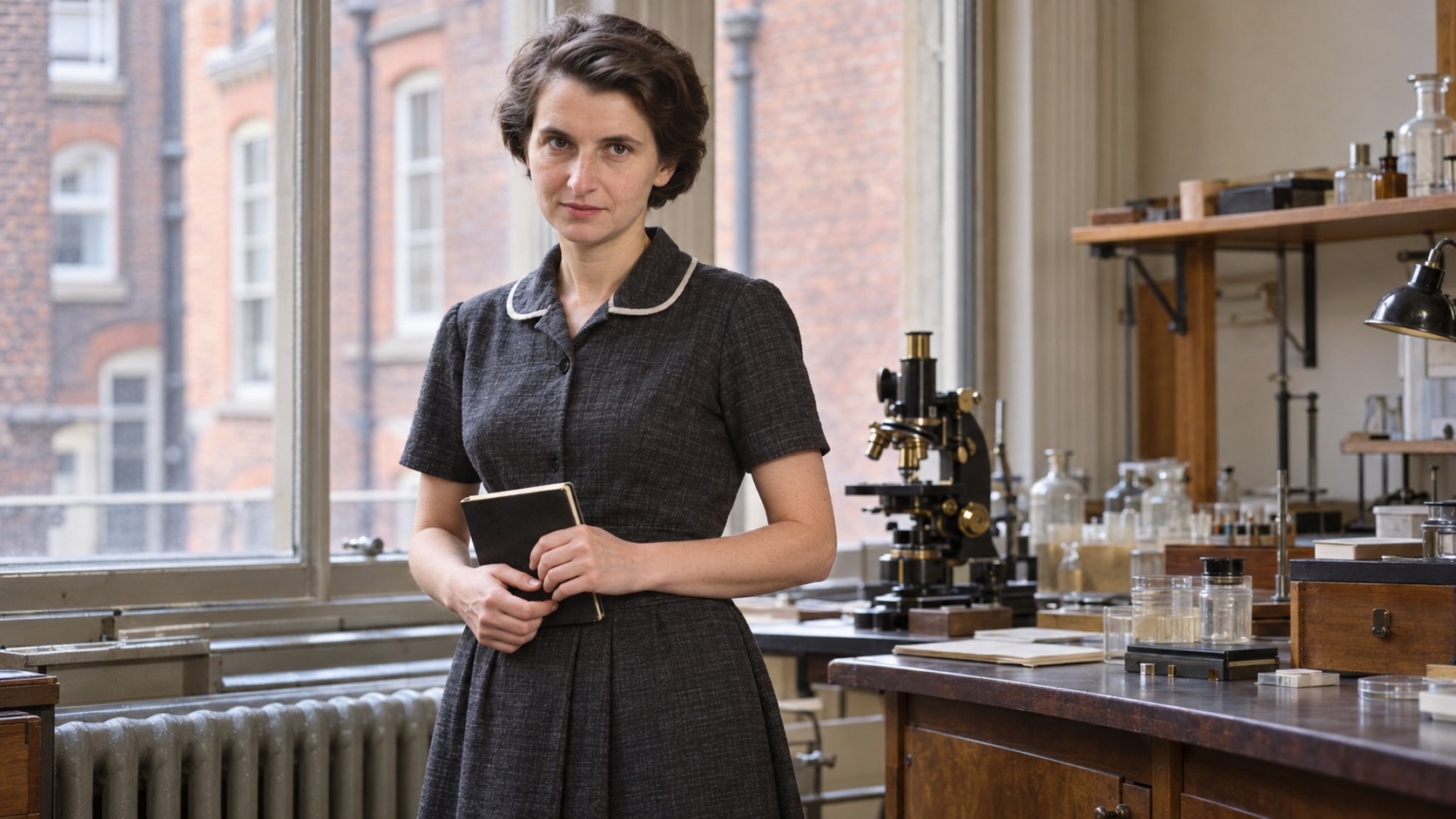
“But science and everyday life cannot and should not be separated.”
Rosalind Franklin wrote these words to her father in 1940, before the DNA research for which she is now widely remembered. The opening word matters: she was answering a suggestion that science should be kept apart from ordinary existence. In the letter, she explained that scientific training influenced her reasoning and that science offered an account grounded in experience and experiment. She also recognized that this account was partial. The sentence therefore brings inquiry into daily life without pretending that it supplies every kind of meaning. Its relevance to health lies in that combination of connection and modesty. Questions about the body affect real choices and real people, while reliable answers require more than an attractive explanation. Scientific thinking can enter those questions as a way of asking what is known, what supports it and where the limits of a claim begin.
A health claim may sound convincing because it fits a familiar story or offers a welcome promise. Franklin’s reasoning suggests that the next step is to ask how that claim was established. Is it based on a measured observation, a comparison or an interpretation that has been tested? What remains uncertain? These questions do not require every reader to become a laboratory scientist. They make room for an explanation of why someone believes a statement deserves confidence. Imagine a person encountering a striking headline about a new finding and discussing it with a clinician. Understanding whether the finding is preliminary, whom it concerns and what it can actually tell us may change the conversation. The example is hypothetical, but the habit is concrete: move from the appeal of a conclusion toward the basis for accepting it.
Franklin’s later career demonstrates the value of careful observation, including the X-ray diffraction work that supplied crucial evidence about DNA’s structure. Yet the everyday lesson need not be reduced to the story of one celebrated image. It can also be about keeping curiosity active when information feels complicated or unfamiliar. A person should be able to ask for clearer language and to hear uncertainty stated honestly. A professional can respect those questions without turning every exchange into a technical lecture. Science becomes connected with daily life when its reasoning can be discussed in relation to the problem someone actually faces. Other concerns, including a person’s values and circumstances, remain part of that discussion. For March 16, Franklin’s words invite a thoughtful relationship with knowledge: neither setting it aside as remote from living nor asking it to answer beyond its reach. Evidence earns trust through explanation, and curiosity helps us understand what that evidence permits us to conclude.
The sentence comes from a 1940 letter to her father, Ellis Franklin. She challenged the idea that science belonged in a separate compartment from everyday existence, explaining the influence of scientific training on her reasoning.
The initial “But” is retained here because it belongs to that response. The letter predates her work on DNA, so the quotation is not presented as a comment made during the discovery of its structure.
In the same passage, Franklin described science’s explanation as partial. Her argument linked it with experience and experiment while recognizing the scope of what it could offer.
That qualification matters when applying the quote to health. Evidence can inform a decision, while the meaning of that decision for a particular person also involves circumstances, preferences and values.
Ask what supports a claim and what it leaves uncertain. The hypothetical headline discussion illustrates how a convincing statement can become a more useful conversation when its basis and limitations are made clear.
Clear explanations help people participate in decisions without requiring specialist training. The aim is a reasoned understanding of evidence, accompanied by enough openness to ask further questions when something is unclear.
Explore more "Quotes of The Day"
Discover more notable quotes from influential voices across politics, science, business, technology, sports, and culture. Each quote offers insight into how ideas, beliefs, and decisions shape the world around us.